Shopify vs Squarespace (2026): Which Platform Actually Fits Your Store
Shopify vs Squarespace compared on pricing, transaction fees, SEO, and multi-channel selling — plus where Wix, BigCommerce, and WooCommerce fit in.

Long Nguyen
Lập trình viên Fullstack · Kỹ sư AI · Nhà nghiên cứu
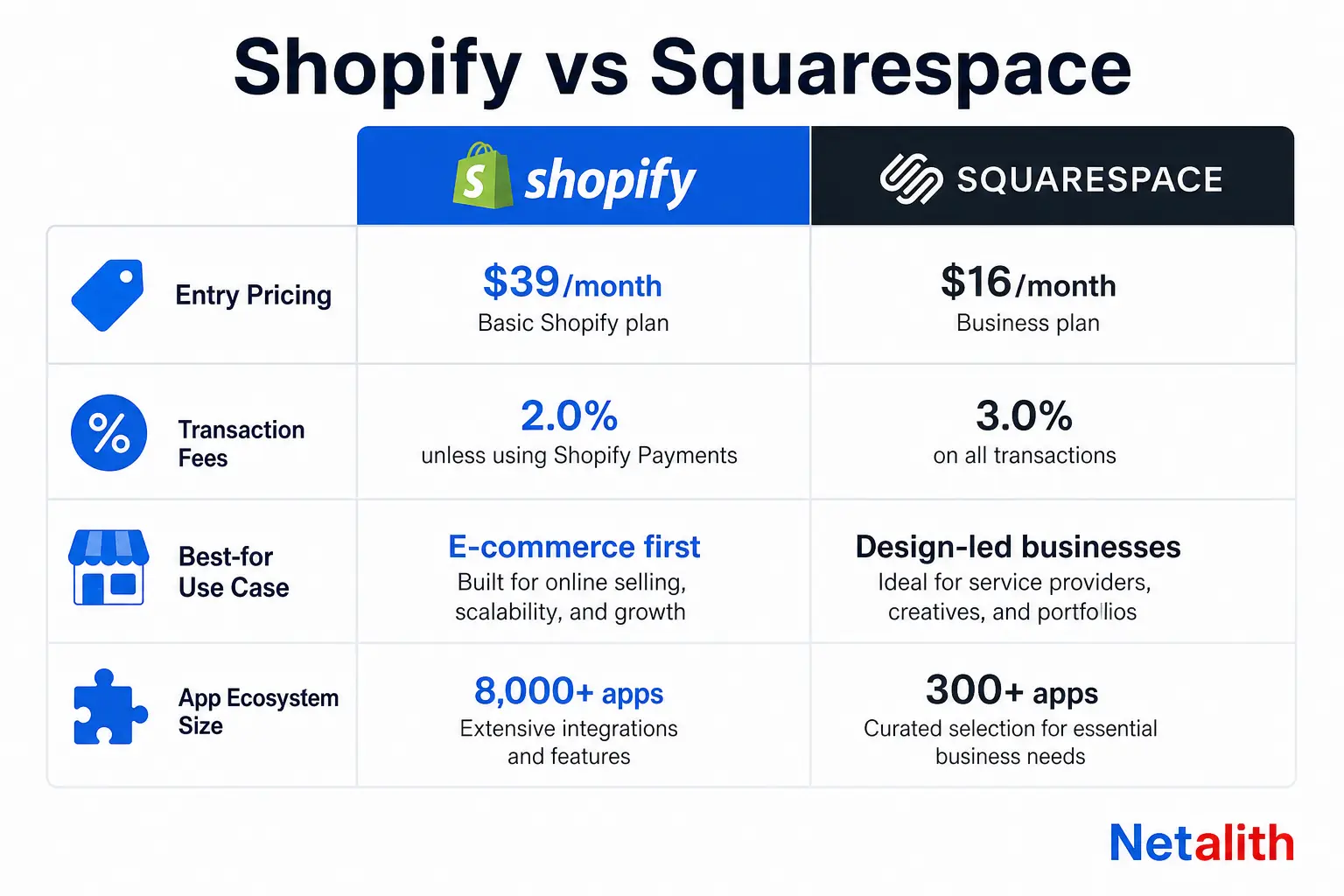
Shopify vs Squarespace at a Glance
Both platforms will get a store online. The difference shows up once you start selling for real: Shopify is an ecommerce engine with a website attached, and Squarespace is a website builder with ecommerce attached. That one sentence explains almost every trade-off below.
| Category | Shopify | Squarespace |
|---|---|---|
| Core identity | Dedicated ecommerce platform, website is secondary | Design-led website builder, ecommerce is a layer on top |
| Entry price (annual billing) | $29/mo (Basic) | $16/mo (Basic, limited commerce) |
| Cheapest full commerce plan | $29/mo, unlimited products | $23/mo (Core), 0% transaction fee |
| App ecosystem | 13,000+ apps in the Shopify App Store | Small curated extension marketplace |
| Multi-channel selling (Amazon, TikTok Shop, POS) | Native and via first-party channel apps | Limited; mostly social and marketplace sync via third parties |
| Design flexibility | Good, but themes feel more templated unless you build custom | Best-in-class visual design and typography control |
| Best for | Product-first stores planning to scale, sell on multiple channels, or run high order volume | Design-first brands, service businesses, and content-led stores with modest catalogs |
Pricing and Transaction Fees Compared
The sticker price is the least useful number here. Transaction fees and card-processing rates move more money over a year than the plan price does for any store doing real volume, so compare the whole cost stack, not just the monthly bill.
Plan pricing (billed annually)
| Tier | Shopify | Squarespace |
|---|---|---|
| Entry | Basic — $29/mo | Basic — $16/mo |
| Mid | Grow — $79/mo | Core — $23/mo |
| Growth | Advanced — $299/mo | Plus — $39/mo |
| Top tier | Advanced-highest — $399/mo equiv.* | Advanced — $99/mo |
| Enterprise | Shopify Plus — from $2,300/mo | No enterprise tier |
*Shopify's published range for its three core self-serve plans is $29 to $299 per month on annual billing, rising to $39–$399 on monthly billing.
Transaction and card-processing fees
| Plan level | Shopify third-party fee | Shopify online card rate | Squarespace transaction fee | Squarespace online card rate |
|---|---|---|---|---|
| Entry | 2.0% | 2.9% + $0.30 | 2.0% | 2.9% + $0.30 |
| Mid | 1.0% | 2.7% + $0.30 | 0% | 2.9% + $0.30 |
| Growth | 0.6% | 2.5% + $0.30 | 0% | 2.7% + $0.30 |
| Top tier | 0.6% | 2.5% + $0.30 | 0% | 2.5% + $0.30 |
The pattern that matters: Shopify's "third-party fee" only applies if you route payments through a non-Shopify-Payments processor — pick Shopify Payments and it disappears, leaving just the card rate. Squarespace's transaction fee is a flat cut of every sale on its cheapest plan; upgrading to Core removes it entirely, which is why most stores that sell more than the occasional item skip the Basic plan. Net effect: a Shopify Basic store on Shopify Payments and a Squarespace Core store land in roughly the same processing-cost neighborhood — Squarespace's entry commerce tier is cheaper on paper but only becomes fee-competitive once you're one plan up from the bottom.
Multi-Channel Selling and API Integrations: the Difference That Shows Up at Scale
This is where the two platforms stop being comparable, and it's the part most "Shopify vs Squarespace" roundups skip because it only bites once a store is past its first few hundred orders. Having spent years building and maintaining marketplace API integrations — Amazon SP-API, eBay, TikTok Shop, Etsy, and 20+ others — the difference in how these two platforms expose their data is structural, not cosmetic.
- Shopify: a documented GraphQL Admin API, webhooks for orders/inventory/fulfillment, and an app ecosystem where nearly every major marketplace, ERP, and 3PL already has a listed connector. Building a custom sync (for TikTok Shop, a POS, or an internal warehouse system) is a known, bounded engineering task because the data model — products, variants, inventory locations, fulfillment orders — is stable and well documented.
- Squarespace: the Commerce APIs (available from Core and up) cover orders, inventory, and products, but the platform was not built channel-first. There is no equivalent of Shopify's Markets, multi-location inventory across warehouses, or a POS hardware ecosystem. Syncing a Squarespace catalog to Amazon or a marketplace usually means a third-party connector app doing double duty, with less flexibility if that connector doesn't map a field you need.
If a store's roadmap includes anything beyond "sell on our own website" — a physical retail location, a wholesale channel, syndication to Amazon or TikTok Shop, or an ERP that needs real-time inventory — that roadmap is a Shopify decision, not a Squarespace one, independent of which platform looks nicer in a demo. Squarespace is entirely sufficient, and often the better choice, for a single-channel store that will stay single-channel: a designer's studio, a small coffee roaster, a service business with a handful of products.
Stores outgrowing a single-channel setup usually hit the wall around inventory sync and order routing first — that's the part worth scoping properly before committing engineering time, and it's exactly the kind of marketplace API and store-platform integration work that determines whether a migration goes smoothly or turns into months of reconciling mismatched SKUs.
SEO and Content Flexibility
Both platforms handle SEO fundamentals — clean URLs, meta tags, sitemaps, canonical tags, and alt text — out of the box, so "which one ranks better" is the wrong question. The real difference is control and content depth.
| Capability | Shopify | Squarespace |
|---|---|---|
| Blog and long-form content | Functional but basic; most stores lean on apps or a headless front end for serious content | Strong native blogging, closer to a CMS than Shopify's default blog |
| URL structure control | Locked collection/product URL patterns (e.g. /products/, /collections/) that can't be fully customized on standard plans | Fully custom URL structure, no forced prefixes |
| Structured data | Solid default product schema; more via apps or theme edits | Decent defaults, less flexible to extend without custom code injection |
| Page speed (out of the box) | Generally fast on default themes; heavy apps and bloated themes are the usual culprit when it slows down | Generally fast; large image-heavy templates can be the bottleneck |
For a content-driven brand — one that plans to publish buying guides, comparisons, or answer-engine-style content to earn organic and AI-assistant traffic alongside product pages — Squarespace's native blogging and URL control give more room to work with. For a catalog-driven store where the product feed itself is the SEO asset (thousands of SKUs, faceted collections, frequent inventory changes), Shopify's structured, app-extensible product data model scales better.
Design, Checkout, and App Ecosystem
Squarespace wins on out-of-the-box design quality. Its templates are opinionated, typography-forward, and produce a polished site with minimal effort — which is exactly why design studios, photographers, and service businesses default to it. Shopify themes are more utilitarian by default; getting a Squarespace-level look on Shopify usually means a paid theme or custom development.
Checkout runs the other way. Shopify's checkout is purpose-built for conversion — one-page, optimized over more than a decade of A/B testing across millions of stores, with native support for Shop Pay, buy-now-pay-later options, and abandoned-cart recovery on every plan. Squarespace's checkout is capable but less battle-tested at scale, and customization options (custom checkout fields, multi-step flows) are more limited.
The app ecosystems aren't close. Shopify's app store covers everything from subscriptions to loyalty programs to advanced shipping rules, mostly built by third parties competing on features. Squarespace keeps its extension surface smaller and more curated — fewer options, but also less risk of assembling a fragile stack of five overlapping apps, which is a real failure mode on Shopify stores that grow by bolting on tools instead of picking a smaller, well-integrated set.
Shopify vs Wix vs Squarespace: the Three-Way Comparison
Wix enters this conversation as the "easiest to start" option, sitting between the other two on ecommerce depth.
| Factor | Shopify | Squarespace | Wix |
|---|---|---|---|
| Ecommerce depth | Highest — purpose-built | Medium — capable for modest catalogs | Medium — closing the gap with Shopify fast |
| Design quality | Good, more work to reach "designer" level | Best default design | Very flexible (true drag-and-drop), inconsistent results without design skill |
| Entry ecommerce price (annual) | $29/mo | $16–23/mo | $17/mo (Light) |
| App/extension ecosystem | Largest by far | Smallest | Large, growing quickly |
| Best fit | Product-first stores planning to scale or go multi-channel | Design-first brands with a modest, stable catalog | Small stores that want maximum layout control without touching code |
In practice, the three-way decision collapses fast once you know your catalog size and channel plans: under ~50 SKUs with no multi-channel ambitions, any of the three works and the tiebreaker is design taste (Squarespace) versus layout control (Wix). Above that, or with any plan to sell beyond your own website, Shopify is the only one of the three built for it natively.
Where BigCommerce and WooCommerce Fit In
Two more names show up constantly in this search — BigCommerce and WooCommerce — and they solve a different problem than Shopify or Squarespace.
- BigCommerce targets the same audience as Shopify's Advanced/Plus tiers but bakes more B2B and multi-storefront features into lower plans, and — unlike Shopify — doesn't charge its own transaction fee on any plan. The trade-off is a smaller app ecosystem and a steeper learning curve for non-technical teams.
- WooCommerce is a free WordPress plugin, not a hosted platform: no monthly software fee, but you own hosting, security, updates, and every integration yourself (or pay a developer to). It's the most flexible and the most work. Real total cost usually lands near or above Shopify once hosting, premium plugins, and maintenance are counted.
For a small business weighing "Shopify vs WooCommerce vs BigCommerce vs Squarespace" specifically: Squarespace and Shopify Basic are the lowest-effort starting points, BigCommerce is worth a look if avoiding transaction fees entirely matters more than app selection, and WooCommerce only makes sense if you already have WordPress skills in-house or on retainer — it is rarely the cheaper option once you account for the time to maintain it.
Which Platform Should You Choose?
| If you are... | Choose |
|---|---|
| A design-first brand or service business with a small, stable catalog | Squarespace |
| A content publisher who also sells a handful of products | Squarespace |
| Planning to sell on Amazon, TikTok Shop, or in person via POS | Shopify |
| Running (or planning) more than a few hundred SKUs | Shopify |
| Prioritizing zero transaction fees on a tight budget | BigCommerce, or Squarespace Core and above |
| Have in-house WordPress expertise and want full ownership | WooCommerce |
The honest failure mode on both platforms is the same: picking based on which demo looked nicer instead of where the store will be in 18 months. A Squarespace store that outgrows its channel plans mid-year and a Shopify store carrying five overlapping apps it never needed are both symptoms of skipping that step. If you're mapping out a platform choice or a migration and want a second opinion before committing, Netalith offers a free AI-visibility and platform-fit consultation — no cost, no account required.
CÂU HỎI THƯỜNG GẶP
Câu hỏi thường gặp
Is Shopify or Squarespace better for SEO?
Both handle core SEO basics well. Squarespace gives more native blogging depth and full URL control, which helps content-led sites; Shopify's structured, app-extensible product data scales better for large, frequently changing catalogs. Neither platform has an inherent ranking advantage over the other — content quality and site structure decide the outcome.
Which is cheaper, Shopify or Squarespace?
Squarespace's entry plans are cheaper on paper ($16-23/mo vs Shopify's $29/mo), but Squarespace's cheapest commerce tier still charges a 2% transaction fee that only disappears on the $23/mo Core plan and up. Once you factor in transaction fees and card processing, the two land close together at comparable tiers — the bigger cost driver is usually apps and customization, not the base plan.
Can you migrate a Squarespace store to Shopify without losing products and orders?
Yes. Shopify supports CSV import for products, and several migration apps handle products, customers, and historical orders from Squarespace. Order history migration is less automated than product migration, so it's worth scoping which historical data actually needs to move versus what can be archived and referenced separately.
Does Squarespace charge transaction fees like Shopify?
Only on its Basic plan, where it charges 2% per sale. Squarespace's Core, Plus, and Advanced plans all have 0% platform transaction fees. Shopify charges a third-party transaction fee (2%, 1%, or 0.6% depending on plan) only if you use a payment processor other than Shopify Payments; using Shopify Payments removes that fee on any plan.
Is Wix a better fit than Shopify or Squarespace for a small store?
Wix is a reasonable middle ground for a small store that wants true drag-and-drop layout control without touching code. Its ecommerce features have improved significantly, but its app ecosystem and multi-channel selling tools still trail Shopify, and its design output is less consistently polished than Squarespace's without deliberate design effort.
Which platform is best for selling on multiple channels like Amazon or TikTok Shop?
Shopify. Its API and app ecosystem are built around syncing inventory, orders, and fulfillment across channels, with native or first-party connectors for most major marketplaces and POS hardware. Squarespace can connect to some channels through third-party apps, but it wasn't designed as a multi-channel hub the way Shopify was.