TikTok Shop vs Amazon: Fees, Fulfillment, and Which to Sell On in 2026
TikTok Shop vs Amazon compared on real 2026 fees, fulfillment costs, and audience type — a practical guide to picking the right channel.

Long Nguyen
Lập trình viên Fullstack · Kỹ sư AI · Nhà nghiên cứu
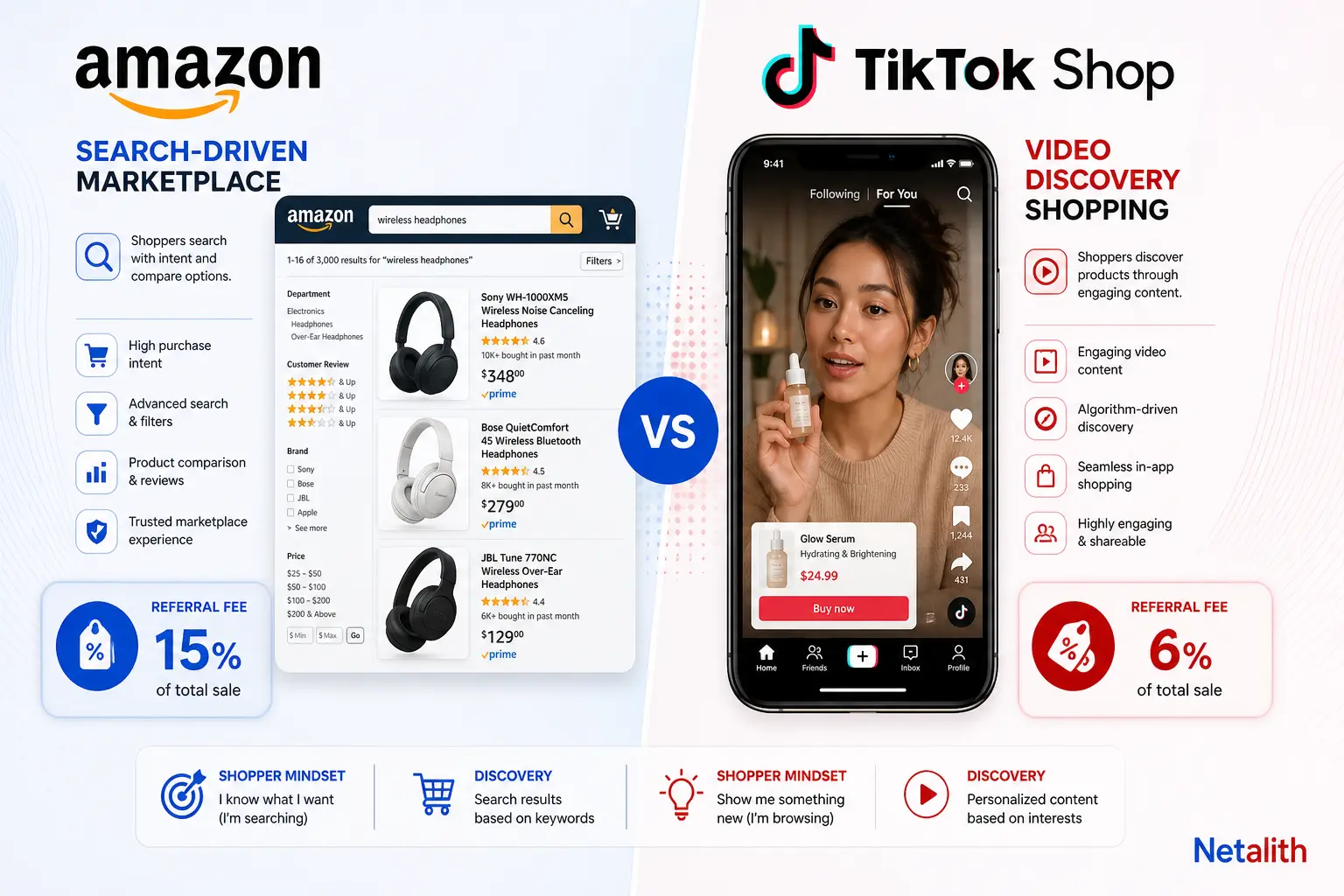
TikTok Shop vs Amazon at a Glance
Netalith's engineering team has built and maintained marketplace API integrations across both platforms for merchant catalogs, so this comparison is built from what actually shows up in seller dashboards and settlement reports — not the headline numbers vendor blogs lead with. The short version: Amazon is a search-first marketplace where shoppers arrive already knowing what they want; TikTok Shop is a discovery-first feed where a video creates the want. That single difference explains almost every other gap between the two — fees, fulfillment, content requirements, and who wins on which.
| Dimension | Amazon | TikTok Shop |
|---|---|---|
| Core model | Search-driven marketplace | Video and livestream discovery feed |
| Standard referral fee | 8–45% by category, most common categories 15% | 6% (5% on jewelry and select pre-owned goods) |
| Fulfillment | FBA (optional), from about $3.22/unit | Fulfilled by TikTok (near-mandatory for most US sellers), $2.86–$4.28/unit |
| Monthly account fee | $39.99 Professional plan, or $0.99 per item on the Individual plan | None — referral fee is the only mandatory platform cost |
| Best fit | Evergreen demand, established catalogs, buyers who already search for the product | Visually demonstrable products, trend-driven categories, impulse price points |
Fees: What Each Platform Actually Takes
Both platforms publish a headline rate that undersells the real cost. Here is what each fee stack looks like once every line item is accounted for.
Amazon fee stack (US, 2026)
| Fee | Rate | Notes |
|---|---|---|
| Referral fee | 8–45% of sale price by category | Most categories sit at 15%; electronics often run lower, Amazon Device accessories run highest |
| FBA fulfillment | From ~$3.22/unit, scaling with size and weight tier | Amazon's 2026 update raised FBA fees by an average of $0.08 per unit effective mid-January, and added a temporary 3.5% fuel and logistics surcharge on the fulfillment fee starting mid-April |
| Monthly storage | Roughly $0.87–$2.40 per cubic foot | Spikes 2–3x during Q4 peak season |
| Inbound placement | $0.21–$1.58 per unit | Charged when inventory is received into fulfillment centers |
| Account plan | $39.99/month (Professional) or $0.99/item (Individual) | Professional is worth it past roughly 40 units sold per month |
Amazon's own 2026 seller update frames the fulfillment increase as modest in isolation, but the referral fee, storage, and the new fuel surcharge compound — a seller who only budgets for the referral fee is usually 8–12 points short of the real take rate. Amazon's official 2026 fee update is worth reading directly if referral or FBA rates materially affect your margin.
TikTok Shop fee stack (US, 2026)
| Fee | Rate | Notes |
|---|---|---|
| Referral fee | 6% (5% on jewelry, luggage, watches, and select pre-owned goods) | Bundles payment processing — there is no separate transaction fee on top |
| New seller discount | Reduced rate for the first 30–90 days | Exact window and rate vary by category; confirm yours in Seller Center rather than trusting a generic figure |
| Creator/affiliate commission | 5–25%, set by the seller | Open-collaboration listings that skip affiliate get little organic reach; most brands run 10–15% to attract creators |
| Fulfilled by TikTok (FBT) | $2.86–$4.28 per unit | Includes 60 days of free storage; TikTok requires FBT for most US sellers rather than treating it as optional |
| Refund administration fee | 20% of the referral fee, capped at $5 per SKU | Charged on refunded orders — a real cost with no matching revenue |
TikTok Shop's Seller Center documentation still lists 6% as of this writing, though multiple independent seller resources report an increase toward 8% on non-food categories since August 2026 that hasn't yet been reflected in the public rate table. Treat 8% as the number to plan around until your own settlement statements confirm otherwise.
Net-net: on a $50 order with no affiliate spend, TikTok Shop's referral fee alone costs about $3 versus roughly $7.50 on Amazon at a 15% category rate. Add a 15% creator commission on TikTok or FBA fulfillment and storage on Amazon, and the gap narrows sharply — the "cheaper" platform depends entirely on how the product is actually sold, not the headline rate.
Getting Started: Requirements and Time to Launch
Amazon's seller registration asks for a government-issued ID, a bank account, a chargeable credit card, and tax information, then runs an identity verification step that can take anywhere from same-day to a couple of weeks depending on category and document quality. Certain categories (supplements, medical devices, some electronics) require additional approval (gating) before you can list at all.
TikTok Shop registration is lighter for individual sellers — business sellers still need a registered business entity, tax ID, and bank details, but there's no separate gating step for most categories, and shop activation is often same-day once documents are approved. The trade-off is upstream: TikTok expects a content plan (product videos, livestream cadence, or creator partnerships) before a listing produces meaningful traffic, where an optimized Amazon listing can convert from search traffic with zero content investment.
How Buyers Find You: Search Intent vs. Discovery Feed
This is the real fork in the decision, more than fees. Amazon shoppers open the app already looking for something — they search, compare listings, read reviews, and buy. Your job is winning the search result and the buy box, not creating demand. TikTok Shop buyers aren't searching for your product; a video, livestream, or a creator's recommendation introduces something they weren't looking for, and the purchase happens inside that same scroll without leaving the app.
Practically, this means a product with strong existing search demand (people already type its category into a search bar) tends to perform on Amazon with far less ongoing effort. A product that's hard to explain in text but easy to show — a gadget demo, a before/after, a styling trick — tends to outperform on TikTok Shop, but only with a steady stream of new content. A listing you set up once and leave alone will coast on Amazon; the same listing will go quiet on TikTok Shop within days.
Fulfillment: FBA vs. Fulfilled by TikTok (FBT)
FBA (Fulfilled by Amazon) is technically optional — you can self-fulfill (FBM) — but skipping it means losing the Prime badge, which materially hurts conversion for most categories. FBT (Fulfilled by TikTok) has moved further than that: as of 2026, TikTok requires most US sellers to fulfill through FBT or another approved logistics partner rather than shipping with their own carrier labels, which removes the self-fulfillment option that used to differentiate the two platforms.
Per-unit cost is close between them at the low end ($2.86–$4.28 for FBT vs. roughly $3.22+ for FBA), but Amazon's fee structure adds monthly storage and inbound placement charges that accumulate even when nothing sells, while FBT's 60 days of free storage absorbs more of that risk for fast-moving inventory. For slow-moving or seasonal SKUs, Amazon's storage and aged-inventory surcharges can erode margin faster than TikTok's model does.
Returns, Refunds, and Seller Performance Scores
Amazon gates account health on metrics like order defect rate, valid tracking rate, and policy violations — fall below thresholds and Amazon can suspend selling privileges outright. TikTok Shop runs two separate scores: a performance score tied to how fast you get paid out, and a shop/content health score that affects how much organic reach your listings and videos get in the feed. A seller can stay technically compliant on TikTok and still lose most of their visibility if the health score drops, which is a different failure mode than an Amazon suspension but just as damaging to revenue.
On refunds specifically: TikTok Shop's refund administration fee (20% of the referral fee, capped at $5/SKU) means a high return-rate category quietly compounds against you in a way that doesn't show up in a simple margin calculation. Model expected return rate by category before committing inventory to either platform.
Can You Sell on Both? Running a Multi-Channel Strategy
Yes, and for most catalogs it's the right answer rather than an either/or choice — TikTok Shop drives discovery and impulse purchases, Amazon captures the search-driven demand that TikTok's own marketing generates elsewhere. The friction isn't strategic, it's operational: inventory has to stay in sync across two very different seller APIs, pricing has to account for two different fee structures without eroding margin on either side, and order management has to reconcile two platforms that report fulfillment status differently. That's the part that quietly breaks spreadsheet-based multi-channel setups once order volume climbs past a few dozen orders a day.
This is exactly the kind of integration work Netalith's eCommerce support service handles — connecting Amazon's SP-API and TikTok Shop's seller API to a single inventory and order source so stock levels, pricing, and fulfillment status stay accurate across both without manual reconciliation.
Which One Should You Choose?
| If your product is… | Lean toward |
|---|---|
| Something people already search for by name or category | Amazon |
| Visually demonstrable, trend-sensitive, or benefits from a creator explaining it | TikTok Shop |
| Low-touch and you want a "set it up once" listing | Amazon |
| You can commit to ongoing video content or creator partnerships | TikTok Shop |
| High-ticket or considered purchase with research-heavy buyers | Amazon |
| Impulse price point ($15–$60 sweet spot) with strong visual appeal | TikTok Shop |
Most brands that outgrow "pick one" end up running both, with Amazon as the steady base and TikTok Shop as the growth channel that needs active management. If you're weighing whether to launch on one platform first, integrate both from day one, or migrate an existing catalog into a multi-channel setup, Netalith can scope the right approach for your specific catalog and volume.
Get a quote covering marketplace integration, migration, or ongoing multi-channel support — tell us what you're selling and where, and we'll recommend the right scope.
CÂU HỎI THƯỜNG GẶP
Câu hỏi thường gặp
Which is cheaper, TikTok Shop or Amazon?
TikTok Shop's headline referral fee (6%) is lower than Amazon's (commonly 15%), but TikTok's creator commissions and near-mandatory Fulfilled by TikTok fees close most of that gap. Amazon has no affiliate requirement but adds monthly storage and account fees Amazon charges regardless of sales. Model your actual product's fee stack on both platforms rather than comparing headline rates.
Can I sell the same product on TikTok Shop and Amazon at the same time?
Yes. There's no exclusivity requirement on either platform. The challenge is operational — keeping inventory, pricing, and order status in sync across two different seller APIs — not a platform rule against it.
Do I need a registered business to sell on TikTok Shop or Amazon?
Amazon requires a bank account, tax information, and identity verification for any seller account. TikTok Shop allows individual seller accounts with lighter requirements, but business accounts — needed for most brands and for access to FBT — require a registered business entity and tax ID.
Is TikTok Shop worth it for a small brand in 2026?
It depends on whether the product is visually demonstrable and whether the brand can sustain regular video content or creator partnerships. TikTok Shop's US GMV has grown fast through 2026, but that growth is concentrated in sellers actively producing content and running affiliate programs, not passive listings.
What happens to TikTok Shop fees when an order is refunded?
TikTok Shop charges a refund administration fee equal to 20% of the referral fee, capped at $5 per SKU, on top of losing the sale itself. High-return categories should factor this into margin planning before committing inventory.