TikTok Shop vs Etsy: Fees, Reach, and Which One Fits Your Products
TikTok Shop vs Etsy compared: real 2026 fees, how buyers find each platform, seller requirements, and what breaks when you list on both.

Long Nguyen
Fullstack Developer · AI Engineer · Researcher
TikTok Shop vs Etsy, in one line
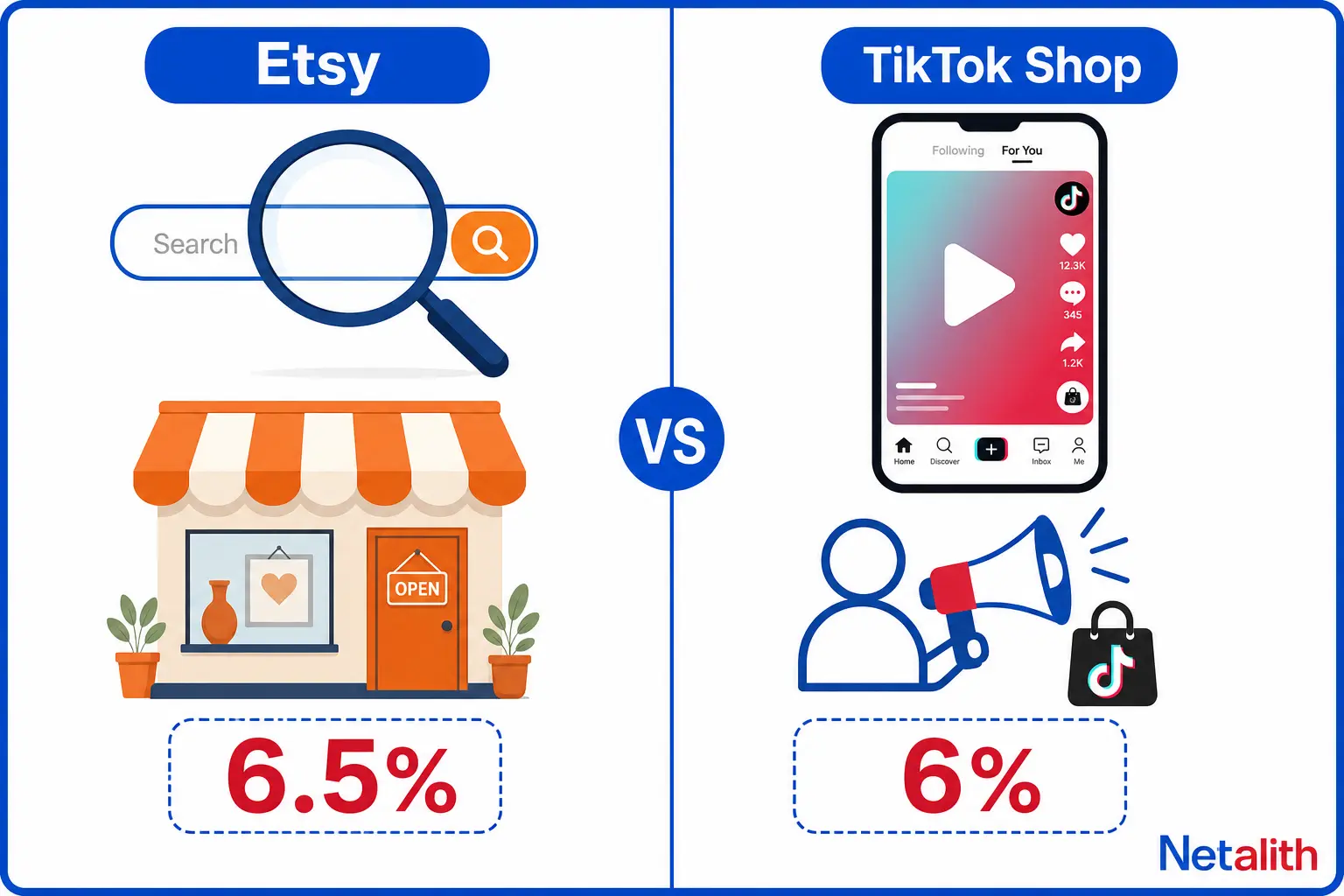
Etsy is a search-driven marketplace: buyers type what they want and Etsy's own rules limit what you can list to handmade goods, items at least 20 years old, or craft supplies. TikTok Shop is a discovery-driven marketplace bolted onto a short-video feed: almost any legal product category is allowed, but you're competing for attention inside videos and livestreams, not search results, and creator commissions are baked into how the algorithm rewards you.
That single difference — search intent versus content discovery — explains almost every other gap between the two platforms: the fee structure, who gets approved to sell, how fast a listing can spike, and what breaks when you try to run one catalog across both. The rest of this piece works through each of those in order.
| Etsy | TikTok Shop | |
|---|---|---|
| What it is | Search marketplace for handmade, vintage (20+ years), and craft supplies | Social commerce layer on top of TikTok's short-video and livestream feed |
| How buyers arrive | Typed search, saved shops, Etsy Ads | Algorithmic For You feed, livestreams, creator videos |
| Who can sell | Anyone; the restriction is on the product type | Anyone who passes seller verification; the restriction is lighter on product type, heavier on account setup |
| Headline fee | 6.5% transaction fee + payment processing | 6% referral fee (bundles payment processing) |
| Biggest hidden cost | Offsite Ads (12–15%) if a sale is attributed to one | Creator/affiliate commission, which you set yourself but which effectively gates visibility |
What each platform actually takes in fees
Headline rates are the least useful number on either platform — on both, the fee that isn't on the pricing page is usually the bigger one. Here's what each layer costs as of late 2026.
Etsy's fee stack
Etsy documents these directly for sellers in its own Fee Basics guide, and the core numbers have held steady since Etsy's last transaction-fee change in 2022.
| Fee | Rate | Applies to |
|---|---|---|
| Listing fee | $0.20 per listing | Charged when a listing publishes or auto-renews every four months, whether or not it sells |
| Transaction fee | 6.5% | Item price, plus shipping and gift wrap you charge the buyer |
| Payment processing (US) | 3% + $0.25 | The full order total, per order, through Etsy Payments |
| Offsite Ads | 15% under $10k trailing-year sales, 12% at or above | Only when a sale is attributed to an offsite ad click; capped at $100 per order, and shops above the $10k threshold are auto-enrolled |
| Regulatory operating fee | Small % where it applies | Sellers based in a handful of countries only |
On a $50 sale with no Offsite Ads involved, that's roughly $3.25 transaction fee plus $1.75 payment processing plus the $0.20 already spent listing it — about $5.20, or just over 10% of the sale. If that same sale is credited to an Offsite Ads click, add another $7.50 and the take climbs to around 25%.
TikTok Shop's fee stack
| Fee | Rate | Applies to |
|---|---|---|
| Referral fee | 6% on most US categories, 5% on select jewelry and pre-owned goods | Bundles payment processing — there's no separate processing line the way Etsy has one |
| New-seller promo rate | Discounted for a limited window | Program terms vary and change; confirm the live figure in Seller Center rather than trusting any article, including this one |
| Creator/affiliate commission | You set it — commonly 10–20%, higher in competitive niches | Optional in principle, but products with zero affiliate commission rarely get picked up by creators, so it functions as a real cost of visibility |
| Refund administration fee | 20% of the original referral fee, capped at $5 per SKU | Returns and refunds |
| Fulfilled by TikTok (FBT) | Roughly $2.86–$4.28 per unit by weight, if used | Optional in most cases, though TikTok has been expanding where managed fulfillment is required |
Independent seller reports describe TikTok raising the standard US referral fee from 6% to 8% on most non-food categories starting August 2026, while TikTok's own published category table hadn't been updated to match at the time those reports ran. That gap between what's reported and what's documented is normal for TikTok Shop, which has changed its fee schedule several times since its 2023 US launch — treat any specific percentage, including the ones in this table, as something to reconfirm in your own Seller Center before you price a product.
On the same $50 order with no affiliate commission, TikTok Shop's fee is $3.00, or 6%. Add a realistic 15% creator commission and the total jumps to $10.50, or 21% — more than Etsy's equivalent once you're paying for reach on either side.
How buyers actually find you
This is the difference that matters more than any fee line, because it determines what kind of product does well at all.
Etsy buyers search. They type "walnut cutting board" or "personalized dog tag" because they already decided roughly what they want, and Etsy's ranking rewards listings with accurate titles, tags, and attributes that match that query — the same intent-matching logic as any search engine. A well-optimized listing can sell steadily for years with no active promotion, which is why Etsy shops built around evergreen, gift-able, personalizable items tend to compound.
TikTok Shop buyers don't search for your product; they scroll past it. The feed decides what they see based on watch time, engagement, and purchase signal from people like them, not a typed query. A product succeeds when it's genuinely watchable — a visible transformation, a satisfying process, a problem solved in fifteen seconds — and when creators are incentivized to make that content, which loops back to the affiliate commission you're willing to pay. A product with a great use case but nothing visually interesting about it can do very well on Etsy and close to nothing on TikTok Shop, and the reverse is just as common.
Who can sell, and what you're allowed to sell
Etsy's restriction sits entirely on the product, not the seller. Anyone can open a shop in minutes, but everything listed has to fall into one of three categories: handmade (designed or made by you, with any production partner disclosed), vintage (genuinely at least 20 years old), or craft supplies (materials or tools whose primary purpose is helping someone else make something). Reselling mass-produced goods you didn't design is explicitly against Etsy's policy and is one of the more common reasons shops get suspended.
TikTok Shop flips that. Product category restrictions are lighter — standard retail and even some resold goods are fine in most categories — but the seller side is heavier: you go through account and, in most cases, business verification, and specific categories (supplements, certain electronics, regulated goods) require extra licensing or gated approval before you can list. There's no "must be handmade" filter, but there is a "must pass onboarding review" filter that Etsy doesn't have at all.
Running one catalog on both platforms
Having built marketplace integrations across both platforms — among a dozen-plus others — for a multi-channel ecommerce company, the part that trips up sellers isn't deciding which platform to use. It's assuming the same product data will work on both once they've already committed to selling on both.
It usually doesn't, for a few concrete reasons:
| Where they diverge | Etsy | TikTok Shop |
|---|---|---|
| Product identifiers | No GTIN/UPC required for handmade or vintage listings | Most categories require a GTIN, EAN, or equivalent barcode — a hard rejection point for handmade sellers with no barcode to give |
| Category taxonomy | Etsy's own taxonomy, built around craft/vintage/supply attributes (materials, occasion, style) | A retail-style taxonomy closer to Amazon's, expecting brand, model, and spec-style attributes many handmade listings don't have |
| Media requirements | Static photos; video is optional | Video is functionally required for discovery, even though a listing can technically go live with photos only |
| Variation structure | Flexible, seller-defined variation options | Structured variation sets tied to the category's attribute schema |
The practical fallout: a feed built for Etsy usually fails validation on TikTok Shop until someone maps it to TikTok's category attributes and either sources or generates compliant identifiers, and going the other direction wastes Etsy's more flexible, story-driven listing fields by cramming them into a spec sheet nobody searches for on Etsy. If you're at the point of syncing inventory and orders across marketplaces without double-selling out-of-stock items, that's the same problem Netalith's marketplace API integration work exists to solve — it's built around exactly this kind of multi-channel mapping, TikTok Shop and Etsy included.
Which one fits your product
Neither platform is categorically better; they reward different products and different amounts of your time.
- Handmade, personalizable, or gift-oriented items — Etsy first. Search intent does a lot of the selling work for you, and the platform's restrictions match what you're already making.
- Visually demonstrable products — the transformation, the unboxing, the "how does that work" hook — TikTok Shop, provided you can either make the content yourself or fund creator commissions well enough that others will.
- Mass-produced retail goods with no maker story — TikTok Shop is the more natural fit; Etsy's handmade/vintage/supply policy will reject most of this category outright.
- You want both — plan for two separate catalogs from day one, mapped to each platform's category and identifier requirements, rather than trying to force one feed to satisfy both. It's less rework up front than retrofitting a TikTok-shaped feed onto Etsy, or vice versa, after the first batch of listing rejections.
If you're weighing this decision for a catalog that's already live somewhere else, a scoped quote is the faster way to find out what a TikTok Shop or Etsy expansion would actually take for your specific products than guessing from a comparison article.
FAQ
Frequently asked questions
Is TikTok Shop or Etsy cheaper to sell on?
On a plain sale with no ads or creator commission, TikTok Shop's 6% referral fee is lower than Etsy's roughly 10%+ combined transaction and processing fees. That gap narrows or reverses once you add TikTok Shop's creator commissions or Etsy's Offsite Ads, since both are effectively pay-to-play for visibility rather than optional extras.
Can I sell the same products on TikTok Shop and Etsy?
Yes, but rarely with one unmodified feed. TikTok Shop typically requires a GTIN or barcode and a retail-style category schema that most handmade Etsy listings don't have, so the two catalogs usually need separate mapping rather than a single export pushed to both.
Does TikTok Shop accept handmade products like Etsy does?
Yes, handmade products can sell on TikTok Shop and there's no 20-years-old or handmade-only restriction the way Etsy enforces. The trade-off is that TikTok Shop still expects standard product identifiers and category attributes that Etsy's handmade listings don't require.
Is TikTok Shop or Etsy better for beginners?
Etsy has a lower time-to-first-sale for handmade or vintage sellers because search intent does much of the discovery work once a listing is optimized. TikTok Shop can outperform it fast if a product goes viral, but that outcome depends on content and creator relationships rather than listing quality alone, which is a steeper and less predictable learning curve.
Do I need a business license to sell on TikTok Shop?
TikTok Shop runs sellers through account and, in most cases, business verification during onboarding, which is a heavier gate than Etsy's near-instant shop setup. Exact document requirements vary by seller type and market, so check the current requirement in TikTok Shop's own onboarding flow before assuming either way.