Feedonomics Alternative in 2026: 4 Routes, Sorted by Who Does the Work
Looking for a Feedonomics alternative? Compare self-serve feed tools, free native apps and a custom feed pipeline by real pricing and 2026 API changes.

Long Nguyen
Fullstack Developer · AI Engineer · Researcher
Why sellers look for a Feedonomics alternative
Feedonomics is a managed product feed platform. You hand over your catalog, and its team builds and maintains the feeds that go to Google Shopping, Meta, marketplaces and other channels. It has belonged to BigCommerce, which now operates under the Commerce name, since 2021, and it works with stores on any platform.
The managed model is why people buy it, and it is also why they leave. Three situations send sellers looking elsewhere:
- The price is quote-only. You cannot budget for it, or compare it, without a sales call.
- You want your own hands on the rules. The service is designed around their team doing the work. If you would rather rewrite a title rule yourself the moment a campaign needs it, a self-serve tool fits better.
- The catalog is too small for a managed service. A few hundred products on two channels rarely needs a feed team.
Most comparison pages rank alternatives by feature count. That is the wrong axis. The useful question is who does the feed work after you switch, because that decides both the invoice and the hours you spend. This guide sorts the alternatives that way.
How much does Feedonomics cost?
Feedonomics does not publish prices. Its pricing page says pricing “varies by SKU count, channel type, number of channels, and service level,” adds that it never takes a percentage of revenue, and asks you to request a custom quote.
So no article can honestly tell you whether an alternative is cheaper. Only your own quote can. When you get one, ask these four things before you compare it with anything in the tables below:
- Is there a setup or onboarding fee on top of the monthly figure?
- Which channels are included, and what does adding one cost?
- Does the price cover marketplace order sync, or feeds only?
- What is the contract term and the notice period?
The four kinds of Feedonomics alternative
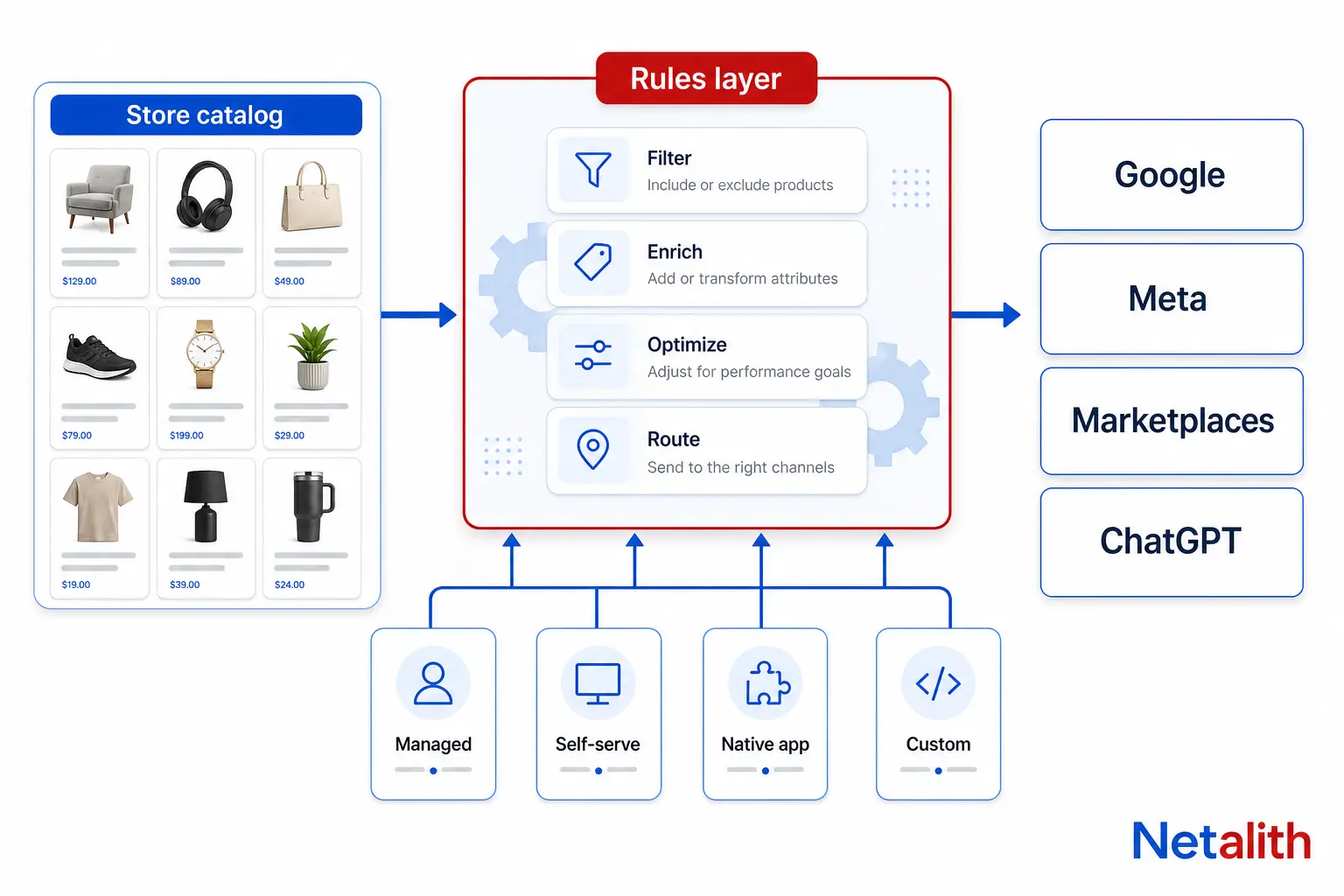
Every product feed setup has the same three parts: the catalog in your store, a rules layer that rewrites the data for each channel, and the delivery to the channel. The four routes differ in who runs the rules layer.
| Route | Who does the feed work | Cost shape | Fits | Breaks down when |
|---|---|---|---|---|
| Self-serve feed tool | You or your marketer | Monthly licence, scales with SKUs and channels | Teams that want control and can spare a few hours a month | Nobody on the team owns the feed |
| Self-serve tool plus managed add-on | The vendor, inside a tool you can also edit | Licence plus service fee | Stores that want hands-off at a smaller scale than Feedonomics targets | You need many marketplaces with order sync |
| Native channel apps | The app, straight from store data | Free | One store, one or two channels, clean catalog data | Channels need titles or categories your store data does not hold |
| Custom feed pipeline | Code you own, built once | Build cost plus maintenance, no licence | Unusual catalog logic, or a channel no tool supports well | You need 20 marketplaces next quarter |
Self-serve feed tools: DataFeedWatch, GoDataFeed and Channable
These are the direct Feedonomics competitors most sellers shortlist. The table shows what each vendor's own pricing page stated on . Prices change, so confirm before you sign.
| Tool | Published pricing | How the price scales | Trial |
|---|---|---|---|
| Feedonomics | Not published | SKU count, channel type, number of channels, service level. No percentage of revenue. | Quote only |
| DataFeedWatch | Shop $64/mo (1,000 SKUs, 3 feeds, 1 shop). Merchant $84/mo (5,000 SKUs, 10 feeds, 2 shops). Agency $239/mo (30,000 SKUs, 150 feeds, unlimited shops). Enterprise is custom. | By SKUs, feeds and shops. 17% off on yearly billing. | 15 days |
| GoDataFeed | Build-your-own plan. The Plus plan is shown at $99/mo. | $5 per extra 1,000 SKUs up to 50,000. $29/mo per extra PPC channel. $99/mo per extra marketplace channel, which needs the Pro plan or higher. | 14 days |
| Channable | No figures on the pricing page | A package (items, projects, channels) plus a Core plan (Standard, Plus or Pro) plus optional modules. | Free trial with no time limit. Activating channels needs a paid plan. |
DataFeedWatch vs Feedonomics
DataFeedWatch is the transparent option: every tier is on the page. At monthly billing the Merchant plan comes to $1,008 a year for up to 5,000 SKUs.
Count feeds, not just SKUs. Each channel-and-country output is another feed, so three feeds fill up fast once you sell in two countries. Size your plan by multiplying channels by markets first.
GoDataFeed vs Feedonomics
GoDataFeed prices ad channels and marketplaces differently, so your channel mix moves the bill more than your catalog size does. An extra marketplace costs more than three extra ad channels.
It also sells feed setup and full-service management as add-ons. That makes it the closest match if what you liked about Feedonomics was not touching the feed.
Channable vs Feedonomics
Channable is modular. Its own example package is 5,000 items, 2 projects and 6 channels, with the Core plan and modules priced on top. Because no figures are on the page, treat it like Feedonomics for budgeting: get the number in writing before you compare.
The cost these tables leave out is your time. A self-serve tool does nothing on its own. Someone has to write the rules, read the disapproval reports and fix them. If no one on your team owns that job, a cheaper licence buys you a neglected feed.
The free Feedonomics alternative: native channel apps
If you sell from one store to one or two channels, you may not need a feed tool at all. Shopify has the Google & YouTube app and Meta's Facebook & Instagram app. WooCommerce has Google for WooCommerce. They are free and sync products straight from the store.
What they lack is a real rules layer. They send what your store holds. That points to the judgment most feed comparisons skip:
A feed tool is a patch layer over catalog data. It exists to fix titles, categories and identifiers that are wrong or missing at the source. If you fix them at the source, in product titles, GTIN fields and custom fields, the patch layer has little left to do.
Native apps stop being enough when one product needs different titles per channel, when you sell in several countries with different prices, or when you add a channel the platform has no app for.
The custom route: a feed pipeline you own
The fourth alternative is to build the rules layer as code. A custom feed pipeline is a scheduled job with five parts:
- Extract the catalog from your store's API.
- Transform it with rules kept in version control, so every change is reviewable and reversible.
- Validate each item against the channel's spec before sending.
- Deliver through the channel's API or as a hosted file.
- Monitor disapprovals and alert you when the count jumps.
The trade is direct. You pay once to build it and stop paying a monthly licence. In return, you own the maintenance when a channel changes its spec, and channels do change, as the next section shows. Budget for that, or the saving is not real.
It fits when your catalog has logic a rule builder handles badly, such as bundles, made-to-order variants or prices computed from several sources, or when you need a channel that tools support poorly. It does not fit when the goal is to list on many marketplaces quickly. Buy a tool for that.
This is the route Netalith builds: custom product feeds for Google Merchant Center, Meta, Pinterest, Microsoft and OpenAI, priced to scope.
Two 2026 checks every alternative has to pass
Two platform changes this year matter more than any feature checklist. Ask about both before you choose.
It must already run on Google's Merchant API
Google's Content API for Shopping reached its sunset date on . According to Google's Content API sunset timeline, requests without an active extension began failing intermittently with HTTP 410 Gone on , and every endpoint shuts down in early 2027.
Established feed tools should have migrated already. Ask anyway, and get a yes in writing. The real exposure is older custom code: an in-house script or a legacy plugin that still calls the Content API is failing some of its requests right now.
Moving is not a find-and-replace. The Merchant API splits products into two resources, a writable ProductInput for the data you submit and a read-only Product for the processed result, and it requires an API data source in the account before you can insert anything.
It should be able to produce an OpenAI product feed
ChatGPT is now a shopping surface with its own feed format. OpenAI's product feed reference defines a nested structure, not the flat one-row-per-product file that Google and Meta accept.
| Level | Required fields |
|---|---|
| Feed header | feed_id, account_id, target_merchant, target_country |
| Product | id, variants |
| Variant | id, title |
| Nested objects | Price needs amount and currency. Media needs type and url. Barcodes need type and value. |
The spec also carries seller data that Google's feed does not ask for in the same way: a seller name plus links to your privacy policy, terms of service, refund policy, shipping policy and FAQ.
A tool that only maps columns cannot emit this by renaming fields. Ask each vendor whether OpenAI is a supported export today, not a roadmap item.
How to switch away from Feedonomics without losing listings
The risk in switching is not the new tool. It is losing rule logic that lives inside the old one. Work in this order:
- Read the contract first. Check the term and notice period before you start, so the overlap you need is covered.
- Capture the output. Download the current feed for every channel. That file is the only complete record of what the rules do.
- Keep product IDs identical. Channels treat a changed ID as a new product, and the old item's performance history does not follow it.
- Rebuild, then diff. Recreate the rules in the new setup and compare its output with the captured file, field by field: title, price, availability, GTIN, category.
- Switch one channel at a time. Start with the lowest-revenue channel and watch disapprovals before moving the next.
- Cancel last. Give notice only after every channel has run cleanly on the new setup.
One gotcha: if Feedonomics also routes marketplace orders back to your store, a feed tool does not replace that. Order sync is a separate integration, and you need its replacement live before the cutover.
Which Feedonomics alternative fits your store
| Your situation | Route to take |
|---|---|
| One store, Google and Meta only, catalog data is clean | Native channel apps |
| Up to a few thousand SKUs, someone on the team will own the feed | DataFeedWatch or another self-serve tool with published pricing |
| You want hands-off, at a smaller scale | A self-serve tool with a managed add-on, such as GoDataFeed |
| Catalog logic no rule builder handles, or a channel tools support poorly | Custom feed pipeline |
| Large catalog, many marketplaces, order sync, no internal feed owner | Stay with Feedonomics |
The last row is deliberate. If Feedonomics runs many marketplaces plus order routing for you and nobody in-house wants that job, switching to save on the licence usually costs more in labour than it saves.
If you are not sure which row you are in, request a free quote from Netalith. Send your platform, SKU count and channel list, and you will get a straight answer on whether a custom feed makes sense or a tool is the better buy.
FAQ
Frequently asked questions
Is there a free Feedonomics alternative?
Yes, for small setups. Shopify's Google & YouTube app, Meta's Facebook & Instagram app and Google for WooCommerce are free and sync products straight from your store. They have no real rules layer, so they work when your catalog data is already clean and you sell on one or two channels.
How much does Feedonomics cost?
Feedonomics does not publish prices. Its pricing page says pricing varies by SKU count, channel type, number of channels and service level, that it never takes a percentage of revenue, and that you need to request a custom quote.
Is DataFeedWatch cheaper than Feedonomics?
Nobody can say without your Feedonomics quote, because Feedonomics pricing is not public. DataFeedWatch publishes its tiers: as of October 8, 2026 they start at $64 per month for 1,000 SKUs and 3 feeds. The bigger difference is the work: DataFeedWatch is self-serve, so your team builds and maintains the feed rules.
Will switching feed tools hurt my Google Shopping performance?
It should not, if you keep every product ID identical. Channels treat a changed ID as a new product, so its performance history does not carry over. Capture your current feed output first, rebuild the rules, compare the two outputs field by field, and switch one channel at a time.
Does a Feedonomics alternative need to support Google's Merchant API?
Yes. Google's Content API for Shopping reached its sunset date on August 18, 2026, requests without an active extension began failing intermittently on September 1, 2026, and full shutdown is set for early 2027. Any tool or custom script still calling the Content API is on borrowed time.
When is a custom product feed better than a feed tool?
When your catalog has logic a rule builder handles badly, such as bundles or prices computed from several sources, or when you need a channel that tools support poorly. You pay once to build it and drop the monthly licence, but you own the maintenance when a channel changes its spec.