CedCommerce Alternative: 4 Routes Compared on Live 2026 Pricing
Looking for a CedCommerce alternative? Compare 4 routes on live 2026 pricing: Shopify Marketplace Connect, one-bill apps and custom integration.

Long Nguyen
Fullstack Developer · AI Engineer · Researcher
The short answer: which CedCommerce alternative fits
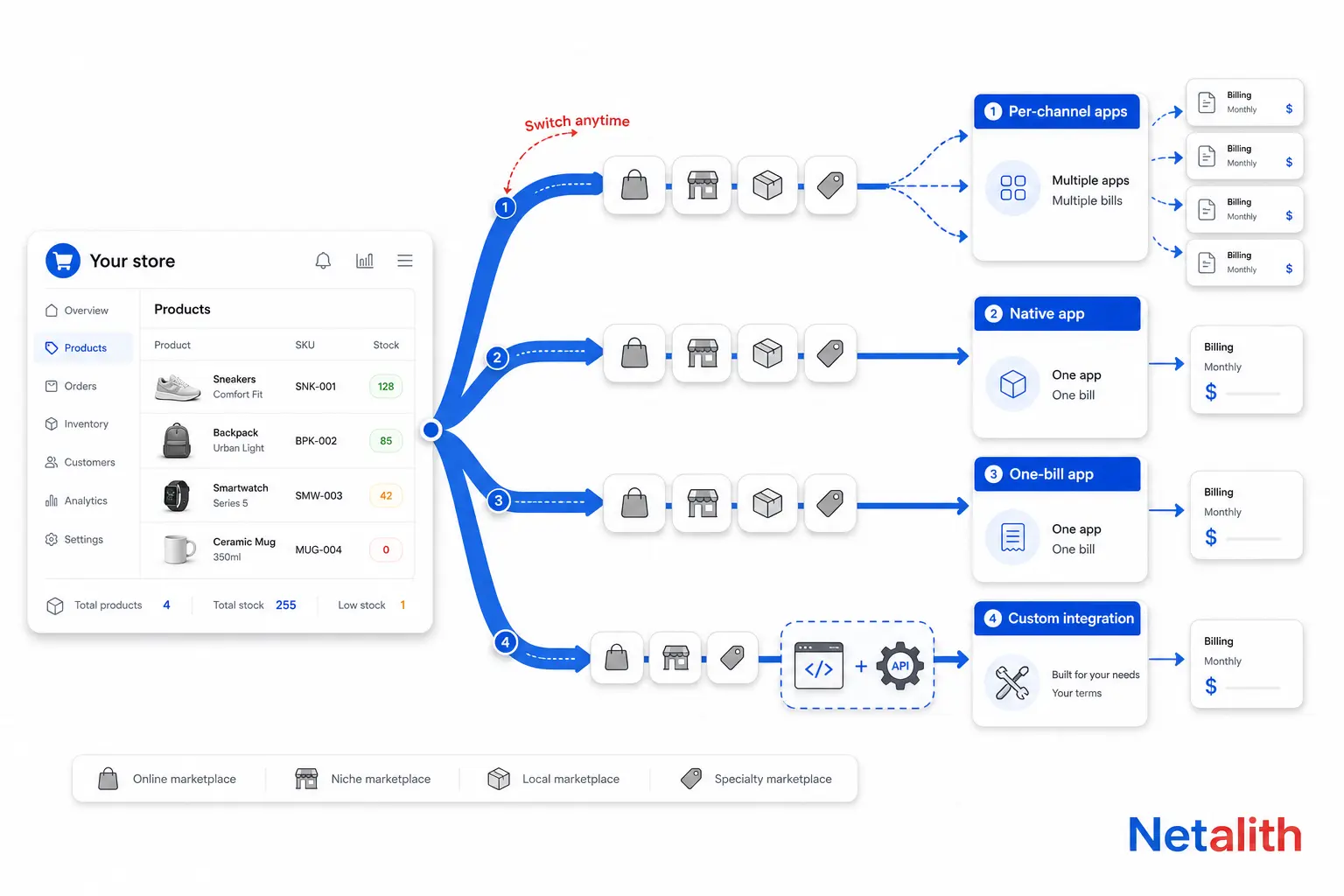
There is no single best CedCommerce alternative, because CedCommerce is not a single product. On Shopify it is 14 separate apps, one per channel, each installed, configured and billed on its own. The right replacement depends on what is pushing you out:
- Too many separate bills and dashboards: move to an app that puts every channel on one subscription, such as Shopify Marketplace Connect, Sellbrite or LitCommerce.
- Order tiers that punish growth: pick an app priced on a capped fee or on listings instead of orders.
- A workflow no app supports (an ERP as the source of truth, kits and bundles, per-channel pricing formulas): build a private integration on the marketplace APIs.
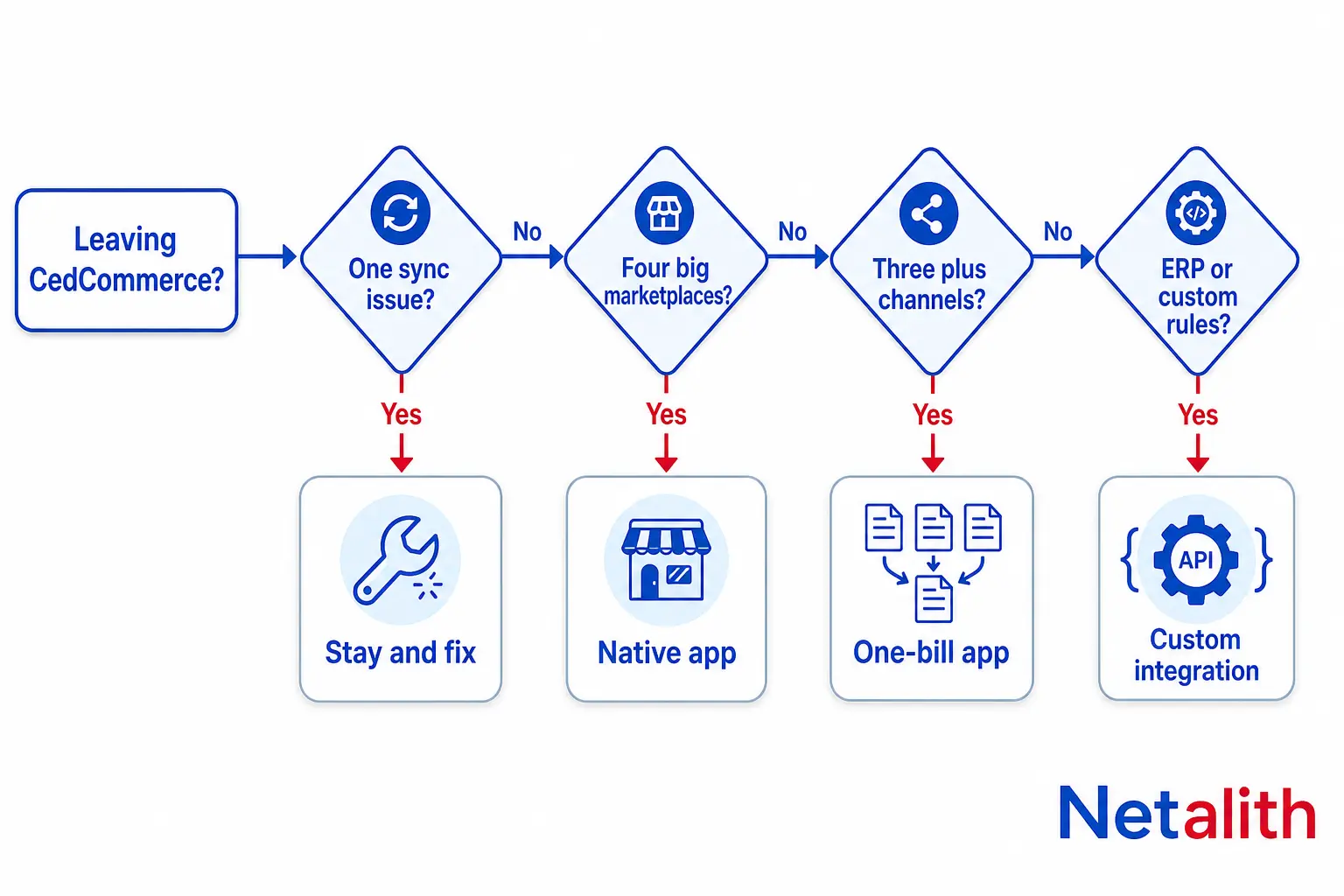
- One bad sync and nothing structural: stay. CedCommerce's Amazon app holds 4.6 stars across 1,162 reviews and a Built for Shopify badge, and switching carries its own risk.
Every price in this article was read from the live Shopify App Store listings on . Pricing is the detail most likely to have changed by the time you read this, so confirm on the listing before you commit.
Why sellers look for a CedCommerce alternative
The usual reason is structure, not quality. CedCommerce's Shopify catalogue is one connector per channel: Amazon, TikTok Shop, Etsy, eBay, Walmart, Walmart Canada, Fruugo, OnBuy, Kaufland and Temu, plus feed apps for Google Shopping and Facebook, an Amazon MCF app and an Amazon importer. Sell on four of those marketplaces and you run four apps.
That has three practical costs:
- Separate order meters. Each app counts and bills its own orders, so you can sit near the top of a tier on every channel at once.
- Repeated setup. Category mapping, templates and price rules are rebuilt per app.
- Several tools writing the same stock. Every connector adjusts the same Shopify inventory. When a number looks wrong, you have to work out which app moved it.
The same structure is also CedCommerce's strength. A dedicated app goes deeper on its one channel, and CedCommerce covers marketplaces that most all-in-one tools skip, such as Kaufland, OnBuy and Fruugo. If you sell on one or two channels and need that depth, the per-app model is a fair trade.
CedCommerce pricing: what the Amazon Channel app costs
Each CedCommerce app publishes its own plans. These are the tiers on the Amazon Channel listing, the one we checked in full:
| Plan | Price per month | Orders synced per month | Products | Cost per order at the cap |
|---|---|---|---|---|
| Free | $0 | 50 | Up to 100, one Amazon account | Listed with a $0.2 per-order charge |
| Beginner | $19 | Up to 100 | Up to 5,000 | $0.19 |
| Beginner | $49 | Up to 500 | Up to 5,000 | $0.10 |
| Growth | $99 | Up to 1,000 | Up to 10,000 | $0.10 |
Two things to read from this. First, the jump from 500 to 501 orders roughly doubles the bill for that one channel. Second, this is the bill for Amazon only: the eBay, Walmart, Etsy and TikTok Shop apps each carry their own plan on top. The listing does not explain how the free tier's per-order charge applies, and it links to further pricing options that we did not check.
CedCommerce alternatives compared: price and channels on one bill
The useful comparison is not feature lists. It is what one bill covers.
| Option | How it bills | Listed pricing | Channels on one bill | Rating (reviews) |
|---|---|---|---|---|
| CedCommerce Amazon Channel | Per app, by order tier | Free tier, then $19, $49 and $99 per month | 1 (Amazon) | 4.6 (1,162) |
| Shopify Marketplace Connect | Percentage of synced orders | First 50 synced orders free, then a 1% fee, capped at $99 per month | Amazon, Walmart, eBay, Target Plus | 4.1 (2,117) |
| Sellbrite | By order tier | Free up to 30 orders, then $19 (100 orders), $59 (500), $99 (2,000) | Unlimited channels: Amazon, eBay, Etsy, Google, Walmart | 3.9 (121) |
| LitCommerce | By listings and channels | From $29 per month: 3 channels, 1,000+ listings, unlimited order sync | 3 on the listed plan, chosen from Amazon, eBay, Etsy, TikTok Shop, Walmart, Temu and more | 4.8 (972) |
How to read it:
- Sellbrite keeps order tiers but lists unlimited channels on every plan, and its $99 tier covers 2,000 orders where CedCommerce's Amazon app covers 1,000 on one channel. Its rating is the lowest of the four.
- LitCommerce removes the order meter. The listed plan is labelled pay as you go, so expect cost to move with listings and channels instead. That suits a small catalogue with high order volume and works against a very large one.
- Marketplace Connect is the only one made by Shopify, and the only one where the bill stops at a fixed cap.
Feed and channel-management platforms such as Feedonomics, ChannelEngine and Linnworks sit above these for very large catalogues. We did not price-check them for this article, so they are left out of the table.
Shopify Marketplace Connect vs CedCommerce: where the free app wins and loses
Marketplace Connect is often called the free CedCommerce alternative. It is free to install, not free to run. The table below assumes the 1% fee is charged on each synced order's value and compares one Amazon channel at two average order values (AOV).
| Amazon orders per month | CedCommerce Amazon Channel | Marketplace Connect at $30 AOV | Marketplace Connect at $60 AOV |
|---|---|---|---|
| 100 | $19 | $15 | $30 |
| 300 | $49 | $75 | $99 (cap) |
| 500 | $49 | $99 (cap) | $99 (cap) |
| 1,000 | $99 | $99 (cap) | $99 (cap) |
The result runs against the common advice. On a single channel, CedCommerce's flat tiers are cheaper through the middle of the range: at 300 to 500 Amazon orders you pay $49 against $75 to $99. The 1% fee reaches its cap at about 380 orders with a $30 AOV and about 215 orders with a $60 AOV. The picture flips for low-priced goods: below roughly a $20 AOV, the 1% fee at 300 orders comes in under $49.
Marketplace Connect wins when you sell on more than one of its four marketplaces. Its $99 cap covers Amazon, Walmart, eBay and Target Plus together, while CedCommerce bills each of those apps separately.
It loses in two places:
- Coverage. The listing names four marketplaces. Etsy and TikTok Shop are not among them, and the listing's own related-apps rail shows CedCommerce's Etsy app.
- Reported reliability. About 15% of its ratings are one star (310 of 2,117), against about 6% for CedCommerce's Amazon app (72 of 1,162). Read the most recent reviews for your marketplace before moving.
When a custom marketplace integration is the better CedCommerce alternative
Apps assume your store is the source of truth and your catalogue fits their fields. A private integration, built for your account only, is worth pricing when that assumption fails:
- Stock and prices live in an ERP or warehouse system, not in the store.
- You sell kits or bundles, so one marketplace order must decrement several component SKUs.
- Each channel needs its own price formula, stock buffer or warehouse allocation rule.
- You want orders, fees and listing data in your own database for reporting.
- You already pay top-tier plans on several per-channel apps and still work around their limits.
One cost fact matters here. Amazon announced a fee structure for its Selling Partner API (SP-API): a $1,400 annual fee plus usage tiers based on GET call volume. It applies to third-party developers who offer applications to other sellers. Amazon's SP-API fee announcement states that sellers and vendors using SP-API directly for only their own business will not incur additional SP-API fees. The same page says fee implementation has been delayed, with updated timelines to follow. App vendors carry that cost; a private integration for your own account does not.
The engineering is where the money goes. Amazon's documentation on SP-API usage plans and rate limits describes a token bucket per operation, with a rate and a burst limit that mostly apply per seller and application pair. It also says an application cannot completely avoid being throttled, and that some limits adjust over time. In practice a private integration needs:
- A job queue that throttles per operation and retries HTTP 429 responses with back-off, with no hardcoded timers.
- Order intake driven by notifications instead of polling, as Amazon recommends.
- Batch work through the Feeds and Reports APIs instead of one call per SKU.
- Order import that is idempotent, keyed on the marketplace order ID, so a retry never creates a second order.
- A place where rejected listings and their issues are visible to the person who can fix the data.
The first build is the smaller cost. Keeping up with API deprecations on every marketplace you connect is the larger one, and it is the main reason an app is the right answer for a standard catalogue on one or two channels.
Netalith builds private marketplace integrations for Amazon SP-API, eBay, Walmart, Etsy and other channels, priced to scope.
How to switch from CedCommerce without overselling
Most damage in a switch comes from two tools running at once. The order below avoids that.
- Export first. Save SKUs, marketplace listing IDs, and current price and quantity per channel, plus the mapping and template settings in each CedCommerce app.
- Clean SKUs. New tools match existing listings to store products by SKU. Missing or duplicated SKUs are the main cause of duplicate listings after a move.
- Link, do not republish. Import your live marketplace listings into the new tool and link them to products. Publishing fresh listings creates duplicates and, on channels where history belongs to the listing, such as eBay, discards it.
- One inventory writer at a time. Turn off inventory and price sync in CedCommerce before turning it on in the new tool. Two writers make stock oscillate and cause oversells.
- One order importer at a time. If both tools import the same marketplace order, the store gets two orders and stock is deducted twice. Cut over at one moment, in a quiet hour.
- Test one SKU per channel. Change a quantity, watch one real order arrive, and confirm tracking flows back to the marketplace.
- Remove the old app last. Check what it does to listings on uninstall, keep it idle through one clean fulfilment cycle, then remove it so billing stops.
Which CedCommerce alternative to choose
| Your situation | Route |
|---|---|
| One or two marketplaces, standard catalogue, support is working | Stay on CedCommerce |
| Shopify store selling on two or more of Amazon, Walmart, eBay, Target Plus | Shopify Marketplace Connect |
| Three or more channels including Etsy or TikTok Shop, and you want one subscription | A one-bill multichannel app such as Sellbrite or LitCommerce |
| Source of truth outside the store, bundles, custom rules, or your own data layer | A private integration on the marketplace APIs |
If you cannot tell which row you are in, send your channels, monthly order volume and what breaks today through Netalith's free quote form. If an app solves it, we will say so.
FAQ
Frequently asked questions
What is the best CedCommerce alternative for Shopify?
It depends on your channels. For two or more of Amazon, Walmart, eBay and Target Plus, Shopify Marketplace Connect puts them on one bill capped at $99 per month. For Etsy, TikTok Shop or three or more channels, a one-bill multichannel app such as Sellbrite or LitCommerce fits better. If your stock lives in an ERP or you sell bundles, a private integration is the realistic option.
Is there a free CedCommerce alternative?
Shopify Marketplace Connect is free to install and syncs the first 50 marketplace orders each month at no charge, then takes a 1% fee capped at $99 per month. Sellbrite lists a free plan for up to 30 orders per month. Both figures were read from the Shopify App Store on 7 October 2026.
How much does CedCommerce cost?
Each CedCommerce app is billed separately. On 7 October 2026 the Amazon Channel app listed a free tier for 50 orders per month, then $19 for up to 100 orders, $49 for up to 500 and $99 for up to 1,000. Other channels such as eBay, Walmart and Etsy use their own apps and plans.
Is Shopify Marketplace Connect cheaper than CedCommerce?
Not always. On a single Amazon channel with a $30 average order value, 300 orders cost about $75 on Marketplace Connect against $49 on CedCommerce. Marketplace Connect becomes cheaper when you sell on several of its four marketplaces, because one $99 cap covers all of them.
Does a custom Amazon integration have to pay SP-API fees?
Amazon states that sellers and vendors using SP-API directly for only their own business will not incur additional SP-API fees. The announced $1,400 annual fee and usage tiers target third-party developers who offer apps to other sellers, and Amazon has said fee implementation is delayed.
How do I switch from CedCommerce without overselling?
Clean your SKUs, link existing marketplace listings in the new tool instead of republishing them, and never let two tools sync inventory or import orders at the same time. Turn sync off in CedCommerce before turning it on elsewhere, test one SKU per channel, and remove the old app last.