Salesforce Commerce Cloud vs Shopify (2026): Pricing, Features, and Which to Choose
Salesforce Commerce Cloud vs Shopify compared for 2026: pricing models, architecture, B2B and headless features, and how to pick the right platform.

Long Nguyen
Fullstack Developer · AI Engineer · Researcher
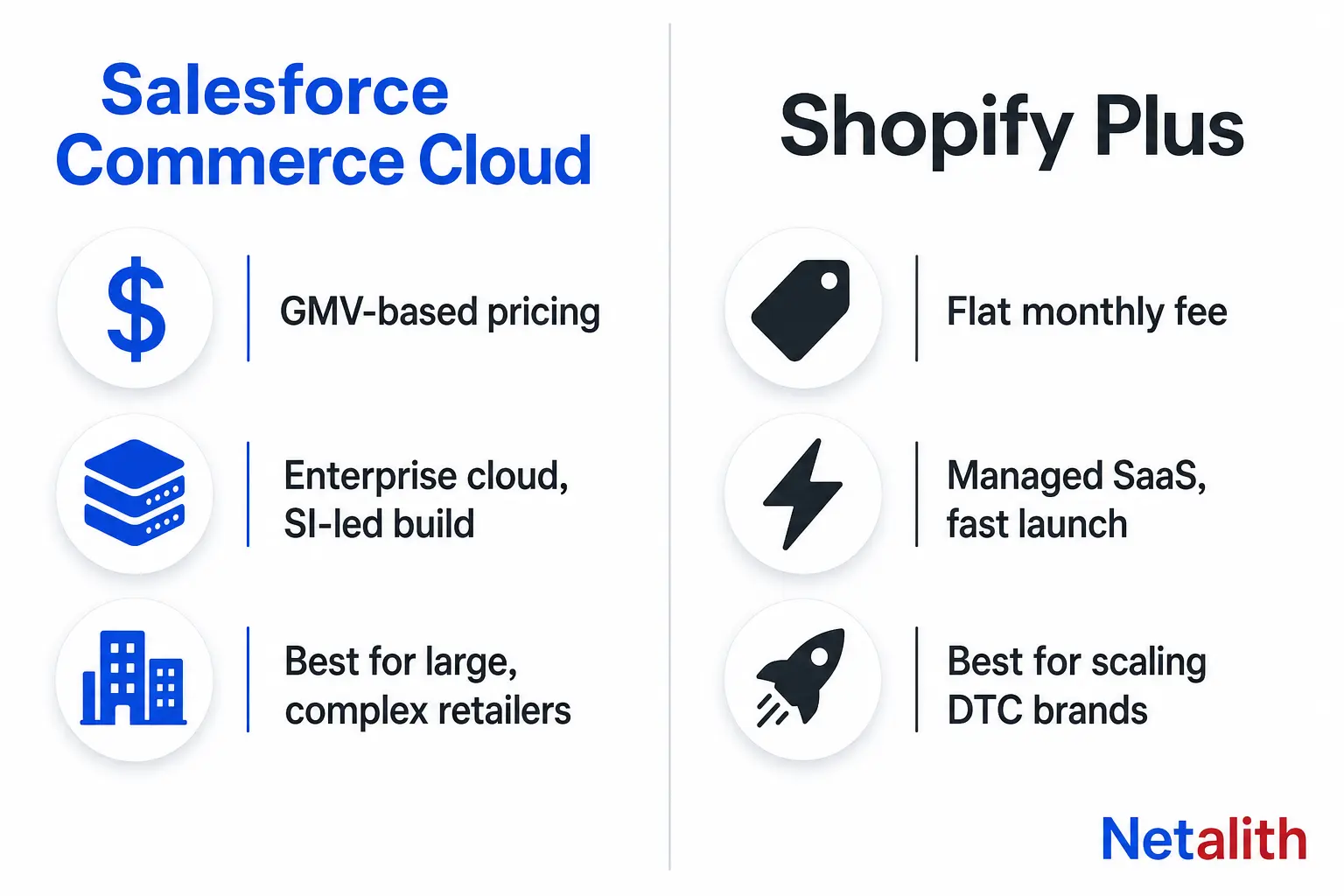
Salesforce Commerce Cloud vs Shopify at a Glance
Both platforms sell themselves as the answer for growing ecommerce brands, but they are built for different starting points. Salesforce Commerce Cloud (the platform most people still call SFCC, formerly Demandware) is priced and engineered around large, complex, often B2B-plus-B2C retailers already inside the Salesforce ecosystem. Shopify, including Shopify Plus, is a fully managed SaaS platform built to get a store live fast and scale it without a dedicated implementation team.
| Dimension | Salesforce Commerce Cloud | Shopify / Shopify Plus |
|---|---|---|
| Pricing model | Quote-based, tied to Gross Merchandise Value (GMV); editions listed as “Contact for pricing” | Flat platform fee starting at $2,300–$2,500/month on Plus, moving to a variable fee at high volume |
| Typical buyer | Enterprise B2C/B2B retailers already using Salesforce CRM, Marketing Cloud, or Service Cloud | DTC and wholesale brands scaling from seven to nine figures in annual revenue |
| Storefront architecture | Storefront Reference Architecture (SFRA) cartridges, or a decoupled Composable Storefront over the Salesforce Commerce API | Managed Liquid storefront, or a React-based headless stack over Shopify’s own APIs |
| Typical time to launch | 6–18 months with a systems integrator | Weeks to a few months, even for complex builds |
| B2B capability | Native, deep — dedicated B2B Commerce editions | Built into Shopify Plus: company accounts, custom price lists, payment terms |
| Ecosystem lock-in | Tight coupling with Salesforce CRM, Marketing Cloud, Einstein AI | Shopify App Store, Shopify Audiences, Shopify Functions |
Architecture: How Each Platform Is Actually Built
The pricing difference between these two platforms is downstream of a real architectural difference, and it is worth understanding before you compare a single dollar figure.
Salesforce Commerce Cloud ships two supported storefront paths. The default is SFRA (Storefront Reference Architecture), a server-rendered, cartridge-based storefront that a certified SFCC developer extends. The alternative is Composable Storefront: a decoupled frontend built with the open-source PWA Kit (React) and deployed on Salesforce’s Managed Runtime, talking to the B2C Commerce instance through the Salesforce Commerce API (SCAPI). Salesforce’s own developer documentation describes this as a way to separate storefront and user experience from data and business logic, and to compose in third-party search or CMS providers alongside the core commerce engine.
Shopify takes a simpler mental model: one managed storefront layer that you theme and extend with apps, plus an optional headless path. On Shopify Plus, that headless path is a React-based headless stack you can deploy at no extra platform cost, hosted anywhere you choose, alongside the option to keep using Shopify’s own storefront and checkout.
Practitioner read: SFRA and Composable Storefront give you server-side control that pays off when you have genuinely custom business logic — complex pricing rules, multi-entity B2B catalogs, region-specific promotions engines. That control has a cost: you need certified SFCC developers, and every cartridge upgrade is a project. Shopify’s opinionated core trades some of that low-level control for an engine that a two- or three-person dev team can operate, with most customization happening in apps or the storefront layer rather than in the checkout and pricing engine itself.
Pricing: Salesforce Commerce Cloud vs Shopify Plus
Neither vendor publishes a simple price you can drop into a spreadsheet, but the two pricing philosophies are genuinely different.
Shopify Plus pricing
Per Shopify’s official Plus pricing page (checked ), the base platform fee is $2,300 USD/month on a 3-year term or $2,500 USD/month on a 1-year term for standard setups. More complex, higher-volume businesses move to a variable platform fee based on revenue and business model, negotiated directly with Shopify’s sales team. On transaction fees: if you use Shopify Payments as your primary gateway, you pay only card processing fees at the lowest rate on the platform; if you use a third-party processor, you pay that processor’s fees plus 0.20% to Shopify. Your main store plus nine expansion stores are included in the base fee; additional stores for the same brand cost an extra $300/month each. Migration itself is not charged by Shopify, though implementation partners and custom development are a separate line item.
Salesforce Commerce Cloud pricing
Salesforce’s own Commerce Cloud pricing page does not list flat numbers at all — B2C and B2B Commerce editions route straight to “Contact us”. In practice, implementation partners consistently describe the model as a negotiated base license fee combined with a percentage of GMV, so your platform bill grows with your revenue rather than staying fixed. On top of the license, budget separately for a systems-integrator-led implementation (commonly a six- to eighteen-month project), ongoing certified-developer support, and any additional Salesforce clouds (Marketing Cloud, Service Cloud, Order Management) the build depends on.
What this means for total cost of ownership
The headline Shopify Plus number is close to an all-in platform cost for a standard build; the real spend shows up in apps, themes, and integrations layered on top. The SFCC number is intentionally incomplete until you have a quote, because the license itself only covers part of the total spend — implementation and ongoing development are typically the larger line items. If you cannot get a straight answer on total first-year cost from either vendor or their partner, that is itself a signal to keep negotiating before you sign.
B2B and Headless Commerce: Feature Comparison
Both platforms now treat B2B and headless as first-class capabilities rather than bolt-ons, but they reach that capability differently.
| Capability | Salesforce Commerce Cloud | Shopify Plus |
|---|---|---|
| B2B storefronts | Dedicated B2B Commerce editions with multiple shop fronts, account hierarchies, and negotiated pricing | Company accounts, custom price lists, and payment terms built into the same back office as your DTC store |
| Order management | Salesforce Order Management, sold and licensed separately | Native order management, plus optional integrations for complex fulfillment |
| Headless / composable | Composable Storefront: PWA Kit + Managed Runtime over SCAPI | React-based headless stack over Shopify’s Storefront APIs, no extra platform fee |
| AI personalization | Einstein AI, deeply tied to Salesforce’s broader CRM data | Shopify Audiences and Shopify Magic, scoped to commerce data |
| Custom checkout logic | Server-side scripting inside the SFCC instance | Shopify Functions and Checkout Extensibility (Plus-only) |
The practical difference shows up in who owns the integration work. SFCC’s B2B and Einstein capabilities are strongest when a business is already running Salesforce Sales or Service Cloud, because the commerce data and the CRM data live in the same ecosystem. Shopify Plus’s B2B tools are strongest when a business wants wholesale and DTC running from one back office without standing up a second platform, and is willing to trade some of SFCC’s CRM-native depth for a much shorter path to launch.
Is Salesforce Commerce Cloud or Shopify Better for Smaller and Fast-Growing Stores?
For dropshipping stores, early-stage DTC brands, or any business below roughly seven figures in annual GMV, Salesforce Commerce Cloud is rarely the right question to be asking. It is not just that SFCC costs more — it is that the entire model, from the multi-month implementation to the GMV-linked licensing, assumes a business that can absorb a large fixed cost before revenue scales into it. Dropshipping-style workflows — supplier integrations, automated order routing, variable-margin catalogs — are native territory for Shopify’s app ecosystem, while on SFCC the same workflow becomes a custom integration project.
Shopify (Advanced or Plus, depending on volume) fits this segment because the cost structure scales with the business instead of preceding it, and a small team can run the storefront without a dedicated development bench. The point at which Salesforce Commerce Cloud starts to make sense is usually when a brand has outgrown a lean team’s ability to operate the store, is already deep in the Salesforce ecosystem, or has B2B complexity that a general-purpose SaaS platform genuinely cannot model well.
Where Adobe Commerce Fits Into the Comparison
Any serious enterprise platform shortlist eventually adds a third name: Adobe Commerce (built on the former Magento Open Source core). It sits in a different spot on the cost-versus-customization curve than either platform above. Unlike Shopify and Salesforce Commerce Cloud, Adobe Commerce is typically licensed rather than revenue-shared, and it can be run cloud-hosted through Adobe or self-managed on your own infrastructure — an option neither Shopify nor SFCC offers, since both are fully managed SaaS. That flexibility comes with the same trade-off SFCC has: you need a development team to operate it, and most implementations run through a systems integrator. Teams evaluating all three usually end up choosing between “fully managed and fast” (Shopify), “Salesforce-native and enterprise-integrated” (Commerce Cloud), and “maximum architectural control” (Adobe Commerce) — rarely between all three on price alone.
How to Choose Between Salesforce Commerce Cloud and Shopify
Strip away the marketing and the decision usually comes down to four questions:
- Are you already running Salesforce CRM, Marketing Cloud, or Service Cloud? If yes and the commerce data needs to flow natively into that ecosystem, SFCC’s integration depth is hard to replicate on Shopify.
- What is your realistic GMV over the next 12–24 months? Below the high seven figures, Shopify Plus’s cost structure and speed to launch generally outweigh SFCC’s enterprise depth.
- Do you have (or can you fund) a dedicated development team? SFCC and Composable Storefront implementations assume ongoing certified-developer support; Shopify Plus is designed to be operable by a lean team.
- How complex is your B2B model? Multi-entity, multi-catalog B2B with heavy negotiated pricing leans SFCC; wholesale-plus-DTC from one back office leans Shopify Plus.
Migrating a live store between either platform is a project in its own right — catalog structure, historical order data, and SEO equity all need a deliberate plan, not just a data export. That is the part of this decision most teams underestimate, and it is where hands-on ecommerce platform and migration work tends to save the most time: mapping the existing catalog and integrations before committing to either platform, not after.
If you are still weighing Salesforce Commerce Cloud against Shopify for your own store, a free consultation is a low-commitment way to pressure-test the decision against your actual GMV, team size, and integration needs before you sign a multi-year contract with either vendor.
FAQ
Frequently asked questions
Is Salesforce Commerce Cloud more expensive than Shopify?
In almost every case, yes. Shopify Plus publishes a starting price of $2,300–$2,500 per month, while Salesforce Commerce Cloud is quote-only, priced as a negotiated license fee plus a percentage of your GMV. SFCC implementations also typically require a systems-integrator-led build costing far more than the license itself, which Shopify Plus generally does not require for a standard launch.
Can Salesforce Commerce Cloud do headless commerce like Shopify?
Yes. Salesforce offers Composable Storefront, built on the open-source PWA Kit (React) and deployed on Managed Runtime over the Salesforce Commerce API. Shopify offers a comparable React-based headless stack included at no extra platform cost on Shopify Plus. Both are genuine headless options; SFCC's requires more setup and Salesforce-specific expertise.
Does Shopify Plus support B2B and wholesale like Salesforce Commerce Cloud?
Shopify Plus has native B2B tools — company accounts, custom price lists, and payment terms — running from the same back office as your DTC store. Salesforce Commerce Cloud's B2B Commerce editions go deeper for multi-entity, multi-catalog B2B operations, but require a separate license and more implementation work.
Is Salesforce Commerce Cloud good for dropshipping?
Not typically. SFCC's pricing and implementation model assumes an already-established, higher-GMV retailer, and it has no native dropshipping workflow — supplier and order-routing integrations become custom projects. Shopify's app ecosystem is built around exactly this workflow, which is why most dropshipping and early-stage DTC stores run on Shopify rather than SFCC.
How long does it take to launch on Salesforce Commerce Cloud vs Shopify?
A typical Salesforce Commerce Cloud implementation with a systems integrator runs six to eighteen months. A Shopify or Shopify Plus launch, including a custom theme and integrations, usually takes weeks to a few months, even for fairly complex builds.
Should I consider Adobe Commerce instead of Shopify or Salesforce Commerce Cloud?
Adobe Commerce is worth a look if you want maximum architectural control and are open to self-hosting or Adobe-managed cloud hosting rather than a fully managed SaaS platform. It sits between Shopify (fastest, most managed) and Salesforce Commerce Cloud (deepest CRM integration) on the cost-versus-customization spectrum, and like SFCC, it needs a dedicated development team to operate well.