Shopware vs Shopify (2026): Pricing, Features, and Which to Choose
Shopware vs Shopify compared on 2026 pricing, architecture, B2B tooling, and ecosystem — a practical breakdown to help you choose the right platform.

Long Nguyen
Fullstack Developer · AI Engineer · Researcher
Shopware vs Shopify at a Glance
Shopware and Shopify solve the same problem — running an online store — from opposite ends of the build-vs-buy spectrum. Shopify is a fully managed SaaS platform: you rent the whole stack, including hosting, and trade flexibility for near-zero ops. Shopware is an open-source commerce framework with paid editions layered on top: you can self-host the free Community Edition or pay for a managed plan, but either way you're closer to the code.
| Dimension | Shopware | Shopify |
|---|---|---|
| Origin / core market | Germany — dominant in DACH B2B and B2C | Canada — dominant in North America and UK DTC |
| Hosting model | Self-hosted (free) or Shopware-managed cloud (paid) | SaaS only, no self-hosting option |
| Core technology | PHP / Symfony, open-source core | Closed-source, Liquid + Admin/Storefront APIs |
| Entry price | Free (Community Edition, self-hosted) | $29/mo (Basic, billed annually) |
| Best fit | EU-based B2B/B2C merchants needing deep customization | DTC brands that want to launch fast and scale globally |
Pricing Compared: Editions, Fees, and Hidden Costs
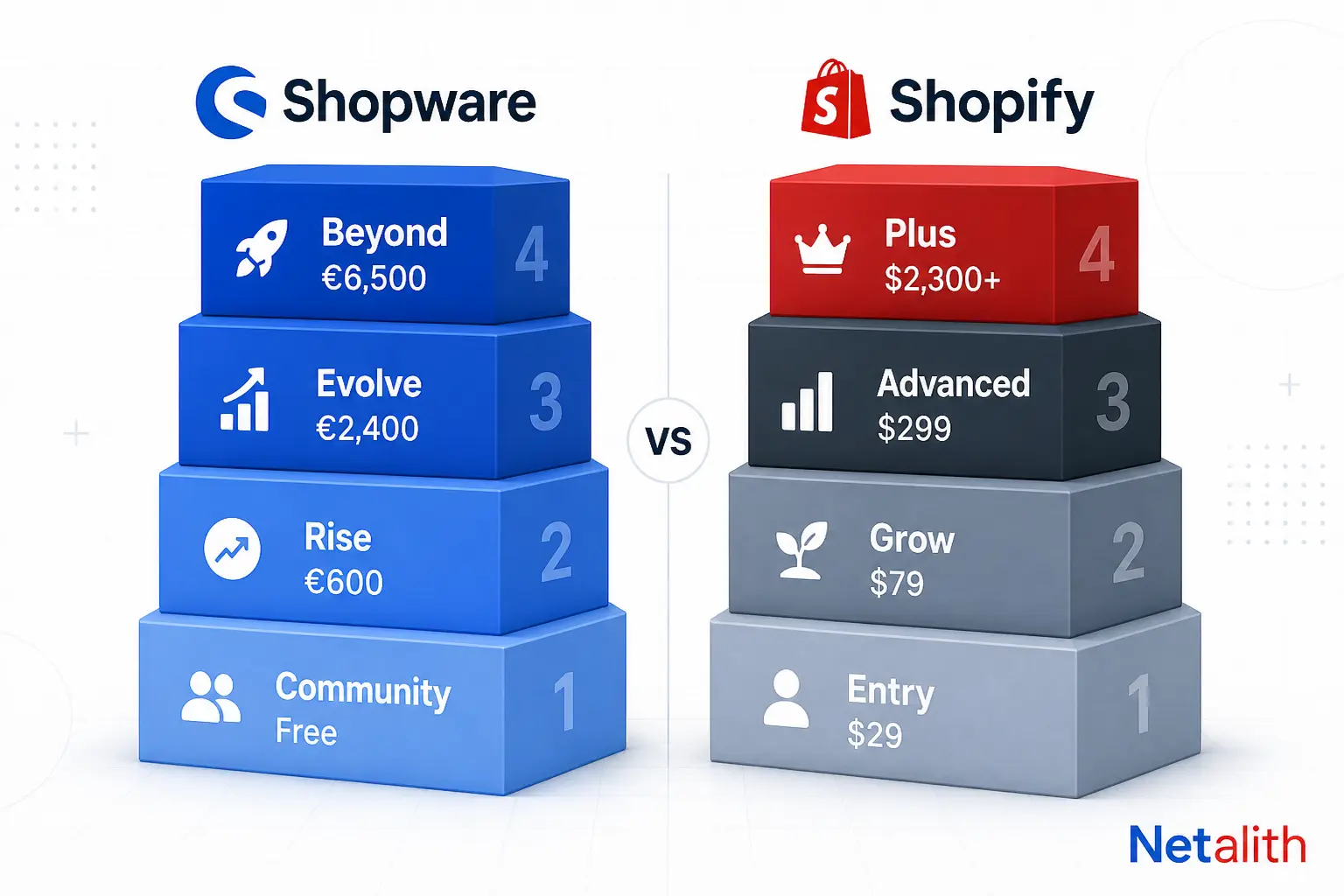
Sticker price is the least useful number in this comparison — both platforms structure cost around gross merchandise value (GMV) and feature tiers, not a flat subscription. Here's what each vendor lists on its own Shopify pricing page and Shopware pricing page as of 2026.
| Shopify plan | Price (annual billing) | Online card rate | Staff accounts |
|---|---|---|---|
| Basic | $29/mo | 2.9% + 30¢ | Owner only |
| Grow | $79/mo | 2.7% + 30¢ | +5 |
| Advanced | $299/mo | 2.5% + 30¢ | +15 |
| Plus | From $2,300/mo (3-yr term) | From 2.25% + 30¢ | Unlimited |
| Shopware edition | Price (excl. VAT) | Support | Headline features |
|---|---|---|---|
| Community Edition | Free | Community only | Full open-source core, self-hosted |
| Rise | From €600/mo | 8h reaction, email | Shopware AI copilot, 3D product previews, unlimited channels |
| Evolve | From €2,400/mo | 4h reaction, phone | Everything in Rise + native B2B Components, advanced search |
| Beyond | From €6,500/mo | 1h reaction, dedicated manager | Everything in Evolve + multi-inventory, subscriptions, digital sales rooms |
Two things get lost when people compare these numbers side by side. First, Shopify's rate declines with plan tier apply to every transaction, so a high-volume store's real cost is dominated by processing fees, not the subscription — the break-even on upgrading from Grow to Advanced alone sits well into six figures of monthly volume. Second, Shopware's Community Edition being "free" only covers the license; you're still paying for hosting, a developer or agency to build and maintain the storefront, and any commercial plugins — for a professional self-hosted Shopware store, that off-license spend typically dwarfs the license line entirely.
Architecture: Composable and Self-Hosted vs Fully Managed SaaS
This is the decision that actually predicts which platform will frustrate you in eighteen months.
Shopware ships an open-source core built on PHP and the Symfony framework. You can run the Community Edition on your own servers with zero license cost, which means your dev team owns the checkout logic, the data layer, and the deployment pipeline outright — nothing is rate-limited by a vendor's API quota, because there is no external API boundary between your code and the storefront. The trade-off is that you now own uptime, security patching, and scaling, which is exactly the work a managed plan (Rise/Evolve/Beyond) exists to take off your hands.
Shopify has no self-hosted option at any price. Every store — from a $29/mo Basic shop to a Plus enterprise account — runs on Shopify's own infrastructure, and merchants customize through Liquid theming, the Admin/Storefront GraphQL APIs, and (on Plus) checkout extensibility via Shopify Functions. That closed boundary is the whole value proposition: you never touch a server, and Shopify absorbs Black Friday traffic spikes for you. It also means anything the API doesn't expose, you can't build — a real constraint for merchants with unusual pricing logic, complex approval workflows, or ERP integrations that need bidirectional, low-latency data access.
B2B and Enterprise Capabilities
If B2B is even a secondary channel, this section decides the comparison for you.
| Capability | Shopware | Shopify |
|---|---|---|
| Native B2B suite | Included from Evolve — budgets, rights & roles, quote requests | Company accounts + catalogs, native from Basic up |
| Catalog limits | Unlimited on Evolve/Beyond | Up to 3 catalogs (Basic/Grow/Advanced), unlimited on Plus |
| Customer-specific pricing | Rule-based pricing engine (Evolve/Beyond) | Company-level price lists (Plus) |
| Approval workflows | Native, core-integrated | Requires Plus + custom build or app |
Shopware's B2B Components are native to the core rather than bolted on through an app, which matters the moment you need a purchasing approval chain that spans budgets, roles, and multiple cost centers — something Shopify only approaches at the Plus tier, and typically still needs a partner app or custom checkout extension to fully replicate. Shopify's advantage is that its B2B tooling is available from the entry-level Basic plan at $29/mo, so a merchant testing a wholesale channel alongside DTC doesn't need to commit to enterprise pricing just to turn catalogs on.
Ecosystem, Apps, and Marketplace Integrations
Shopify's app marketplace is larger, more standardized, and backed by a bigger partner/agency talent pool — for common needs (reviews, upsells, subscriptions, loyalty), you're almost always installing an app rather than building one. Shopware's plugin store is smaller, but because the core itself is open, plugins can hook directly into cart and checkout logic in ways a sandboxed Shopify app can't — which is why Shopware shows up disproportionately often behind ERP-heavy operations (SAP, Sage, custom PIMs) in the DACH region, where that depth of integration is worth the smaller ecosystem.
Marketplace and multi-channel selling — Amazon, eBay, TikTok Shop, and the rest — is where the gap narrows: both platforms connect to the major channels, either natively or through well-supported apps, and the real differentiator becomes how cleanly your store platform's API integrates with those marketplace APIs rather than which storefront you picked.
Where Magento, BigCommerce, and WooCommerce Fit In
Anyone shortlisting Shopware and Shopify usually has these three in the same tab.
| Platform | Model | Closest to | Best for |
|---|---|---|---|
| Magento Open Source (Adobe Commerce) | Self-hosted, open-source or licensed enterprise | Shopware | Large, dev-heavy catalogs that need deep customization and can staff the ops |
| BigCommerce | SaaS | Shopify | Merchants who want Shopify's hosted model but more native B2B/API headroom on lower tiers |
| WooCommerce | Self-hosted WordPress plugin | Shopware Community Edition | Content-led stores already on WordPress, lowest cost to start |
The short version: Magento and Shopware compete for the same self-hosted, customization-first buyer, with Shopware generally cheaper to operate and Magento carrying a heavier ops and security-patching burden. BigCommerce and Shopify compete for the same "don't make me think about servers" buyer, with BigCommerce's edge being fewer transaction-fee surprises and more built-in B2B at lower tiers. WooCommerce is the outlier — free to start, but every hosting, security, and scaling decision Shopify or Shopware's managed plans handle for you becomes your responsibility.
Which Region and Business Type Each One Fits
Shopware's roots in Germany show up in the product: native multi-VAT handling, GDPR-first data residency options through EU-based managed hosting, and an agency/developer base concentrated in DACH. If your store sells primarily into the EU — especially with a B2B or distributor channel — that local ecosystem of implementation partners is worth more than it looks on a feature sheet.
Shopify's strength is breadth: it's the default choice across North America and the UK, has the deepest bench of themes, apps, and freelance/agency talent, and its checkout is tuned and continuously optimized against the largest sample size of live stores in the industry. A DTC brand launching into the US or UK market gets to market faster on Shopify almost every time.
Which One Should You Choose
| If you're… | Lean toward |
|---|---|
| A DTC brand launching fast into the US/UK market | Shopify |
| An EU-based B2B or distributor business with complex pricing/approval rules | Shopware (Evolve or Beyond) |
| Bootstrapped and want zero license cost, comfortable owning infra | Shopware Community Edition |
| Scaling past $10M GMV and want the deepest app/agency ecosystem | Shopify Plus |
| Need checkout-level customization an app sandbox can't reach | Shopware |
Neither platform is objectively better — they're optimized for different ownership models. If you're still weighing this against a live migration (moving marketplace listings, historical orders, and existing integrations), that's usually the harder half of the decision; it's worth getting a second opinion on the platform and integration fit for your specific catalog and channels before committing to a build.
FAQ
Frequently asked questions
Is Shopware cheaper than Shopify?
The license can be — Shopware's Community Edition is free and self-hosted, versus Shopify's $29/mo minimum. But once you add hosting, developer or agency time, and plugins, a professional self-hosted Shopware store often costs more in total than an equivalent Shopify Basic or Grow subscription, because Shopify's fee bundles hosting and infrastructure that Shopware leaves to you.
Can I self-host Shopify the way I can self-host Shopware?
No. Shopify is SaaS-only at every tier, including Plus — there's no license you can install on your own servers. If self-hosting is a hard requirement, Shopware's Community Edition or a platform like Magento Open Source are the options, not Shopify.
Is Shopware or Shopify better for B2B selling?
Shopware's B2B Components (budgets, approval workflows, rule-based pricing) are native to the core from the Evolve plan up, which suits complex purchasing chains out of the box. Shopify offers B2B catalogs from its entry-level plan, which is enough for straightforward wholesale, but complex approval workflows generally need Shopify Plus plus a custom build or partner app to match what Shopware ships natively.
Does Shopware work well for merchants outside Europe?
It can, but it's a smaller ecosystem outside the DACH region — fewer local agencies, less pre-built regional tax/shipping tooling for markets like the US. Shopify's app and partner ecosystem is deeper for North American and UK-specific needs, which is why most US-first DTC brands default to it.
How hard is it to migrate between Shopware and Shopify?
The product catalog and customer data migrate reasonably cleanly with the right tooling either direction, but the harder part is usually rebuilding checkout logic, marketplace/API integrations, and any custom B2B workflows that relied on Shopware's open core or Shopify's specific app stack — that integration work, not the data move, is what determines the real project cost.