Amazon vs Walmart Marketplace: Fees, Approval, and Which Fits Your Business in 2026
Amazon vs Walmart Marketplace compared: referral fees, approval odds, fulfillment costs, and the API integration gap most seller guides skip.

Long Nguyen
Fullstack Developer · AI Engineer · Researcher
Amazon vs Walmart Marketplace at a Glance
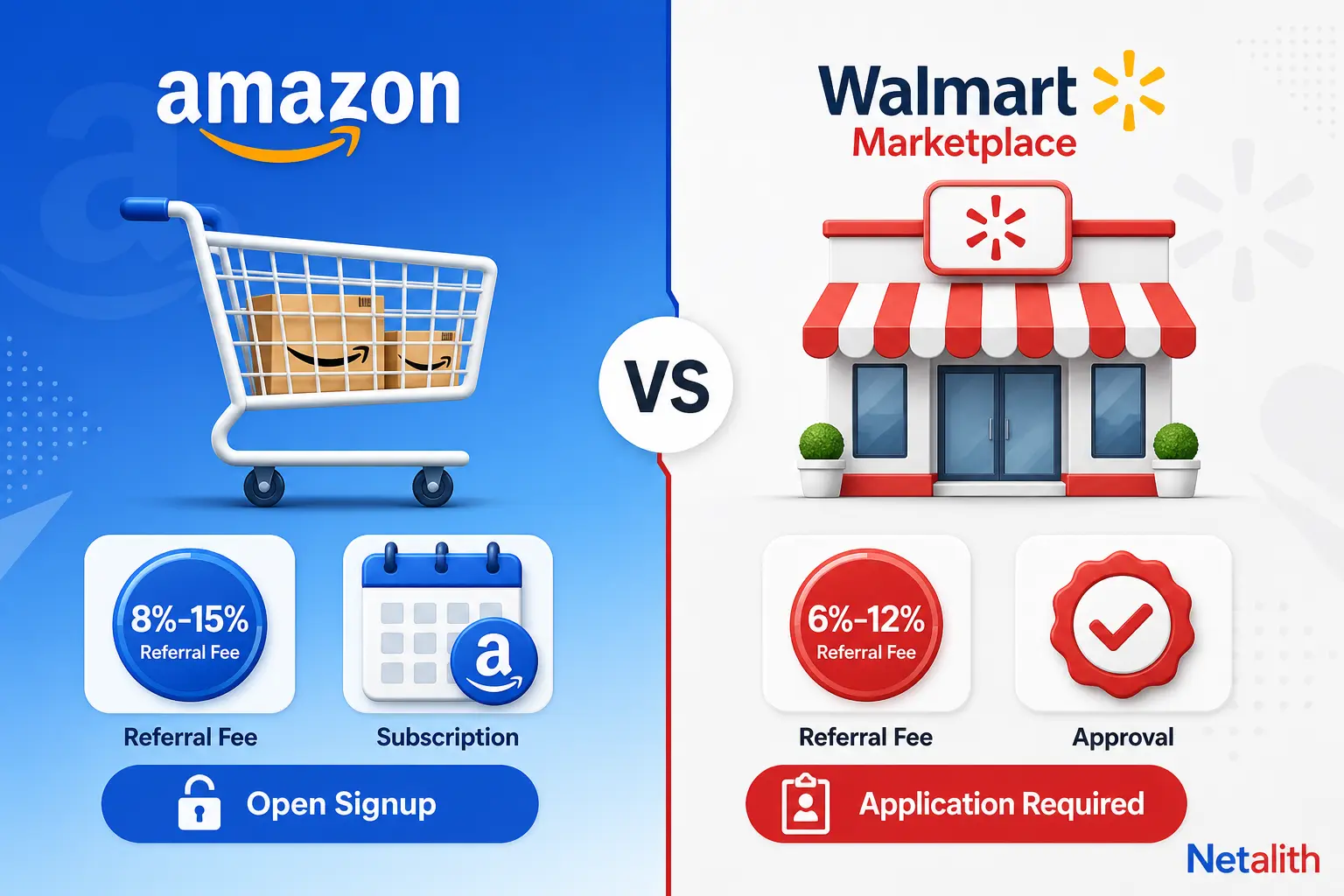
Both are third-party marketplaces bolted onto a retail giant's own storefront, but they run on different economics and different gatekeeping. Amazon lets almost anyone open a seller account today and start listing; Walmart makes you apply and prove yourself first. Here's the short version before the detail.
| Factor | Amazon | Walmart Marketplace |
|---|---|---|
| Who can join | Open signup, most categories | Application + approval required |
| Subscription fee | $39.99/month (Professional) or per-item (Individual) | No subscription fee |
| Referral fee range | 6%–45% by category, most 8%–15% | Mostly 5%–15% by category |
| Fulfillment program | Fulfillment by Amazon (FBA) | Walmart Fulfillment Services (WFS) |
| Catalog requirement | Match existing ASIN or create new | GTIN/UPC required for every SKU |
| Integration model | SP-API, near real-time | Item feeds, batch/async by default |
The rest of this article walks through why each row looks the way it does, and where the real friction sits once you're actually running listings on both.
Referral Fees and Subscription Costs Compared
Amazon's official fee schedule sets the Professional Selling Plan at $39.99 per month whenever you have active listings, with no monthly fee on the Individual plan (which instead charges a small per-item fee — worth it only under roughly 40 units a month). On top of that, Amazon takes a referral fee calculated as a percentage of the total sales price — item price plus shipping — and the rate is set per category. Most categories sit in the 8%–15% band, but a handful run much higher: Amazon Device Accessories tops out at 45%, and several media categories carry an additional flat closing fee per unit.
Walmart Marketplace charges no monthly subscription at all — you only pay when you sell. Its published referral fee schedule is also category-based: Apparel & Accessories runs 5%–15% depending on price tier, Consumer Electronics and Camera & Photo sit at 8%, Books and most general merchandise land at 15%. Nothing in Walmart's public schedule approaches Amazon's 45% outliers, so for categories that exist on both platforms, Walmart is often the cheaper seat at the table — sometimes by a meaningful margin, sometimes by almost nothing, depending on the specific category tier.
Walmart also runs a New-Seller Savings program for stores that go live under its current terms: a tiered referral fee discount — 20% off your first $50K in gross merchandise value, 30% off the next tier up to $500K, and 40% off above that — plus a partial discount on Walmart Fulfillment Services fees, all per Walmart's own onboarding documentation. It's a real incentive, but it's time-limited and GMV-tiered, not a permanent lower price, so model your margins on the standard rate once the promotional window closes.
| Amazon | Walmart Marketplace | |
|---|---|---|
| Monthly subscription | $39.99 (Professional) | $0 |
| Typical referral fee | 8%–15% (up to 45% in outlier categories) | 5%–15% across most categories |
| New-seller incentive | Varies by promotion | Tiered referral fee discount up to 40% off (time-limited) |
Getting Approved: Amazon's Open Door vs Walmart's Gatekeeping
This is the part most fee comparisons skip, and it's often the deciding factor for a new seller: whether you can actually get on the platform at all.
Amazon's account creation is largely self-serve. You register a seller account, pick a plan, and start listing in unrestricted categories immediately; only a subset of categories (grocery, certain medical devices, some collectibles) require prior approval, and that approval is category-specific rather than a gate on the whole account.
Walmart runs every applicant through review before they can list anything. Per Walmart's own seller onboarding guide, you need a U.S. business Tax ID or business license number (a Social Security Number alone isn't accepted), documents verifying your business name and address, a GTIN or UPC with a GS1 Company Prefix for every product, and either a U.S. warehouse capable of handling returns or enrollment in Walmart Fulfillment Services. Walmart also weighs "a history of Marketplace or eCommerce success" — in practice, a clean track record selling somewhere else (Amazon, your own DTC store) meaningfully improves approval odds. Reviews commonly take anywhere from a few days to a few weeks.
The practical read: if you're pre-revenue or testing a product for the first time, Amazon is the faster on-ramp. If you already have sales history and a clean UPC-mapped catalog, Walmart's gate is a real but passable one — and it filters out a lot of the low-effort competition that crowds Amazon listings.
Fulfillment: FBA vs WFS
Both platforms offer a pick-pack-ship program that also hands off customer service and returns: Fulfillment by Amazon (FBA) and Walmart Fulfillment Services (WFS). Structurally they're similar — you ship inventory in, they store and fulfill orders, you pay per-unit fulfillment and storage fees. The practical differences show up at the edges:
- Fee basis: FBA's fulfillment fee is driven by Amazon's size-tier system (weight and dimensional bands), which can penalize oversized-but-light items. WFS leans more on dimensional weight, which tends to be gentler on bulky, low-density products.
- Eligibility for the seller gate: using WFS on Walmart can substitute for the "U.S. warehouse with returns capability" requirement in the approval process — useful if you don't have your own returns operation.
- Program maturity: FBA has over a decade of tooling, third-party repricers, and prep-service ecosystems built around it. WFS is younger and its tooling ecosystem, while growing fast, is thinner — expect to lean on Walmart's own Seller Center more and third-party software less.
Neither program is inherently cheaper; it depends on your product's dimensional weight, sell-through velocity, and how much storage you carry between restocks. Model both against your actual SKUs before assuming either is the better deal.
The Integration Reality: SP-API vs Walmart's Item Feed System
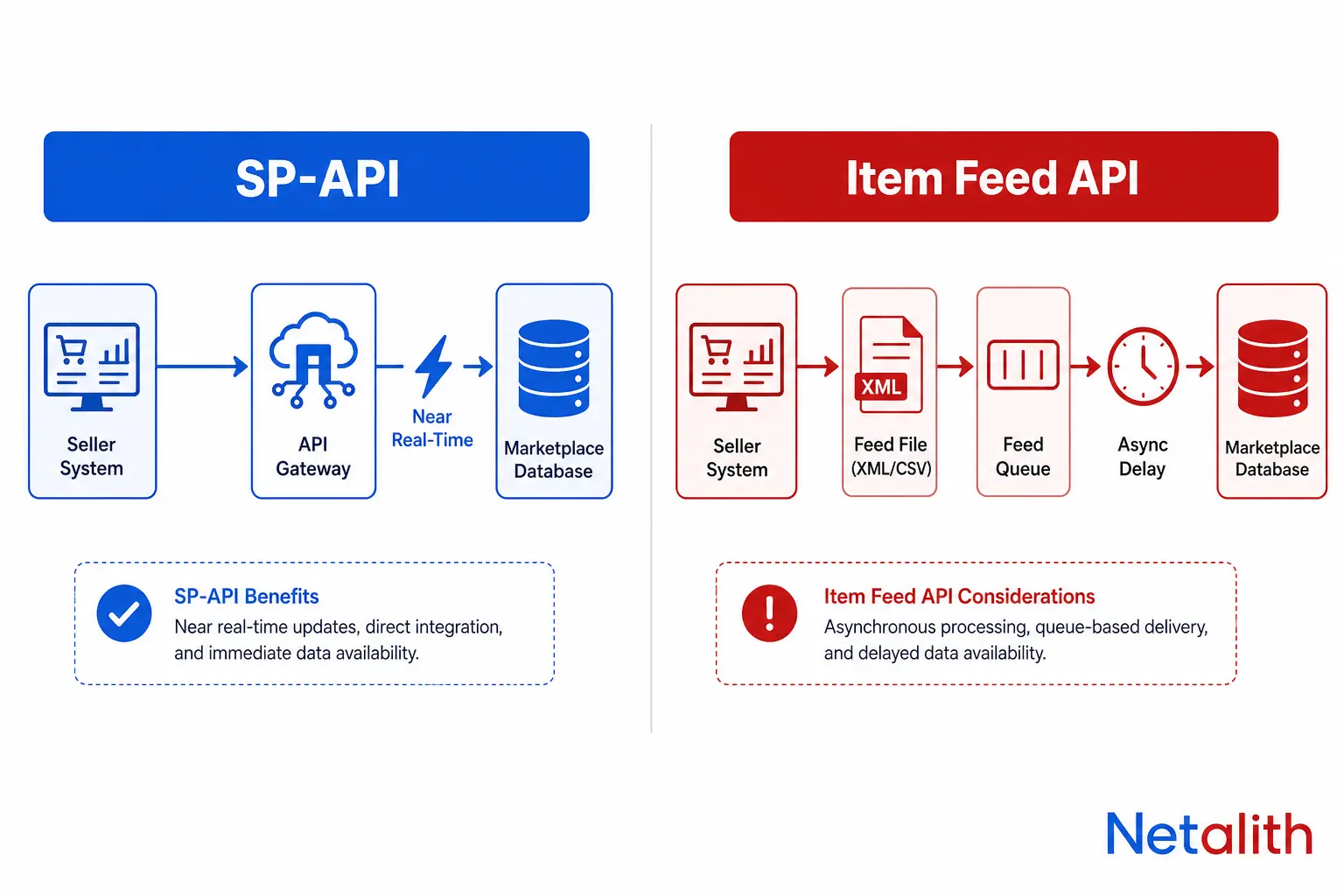
This is the part that fee-comparison articles almost never cover, and it's where the two platforms diverge the most for any seller running more than a handful of SKUs or syncing inventory across channels — which, for most growing sellers, is table stakes and where a lot of the practical friction actually lives.
Amazon's Selling Partner API (SP-API) is a modern REST API: OAuth2 authorization, per-operation rate limits, and increasingly near-real-time behavior for inventory and order updates through push notifications rather than polling. Listings, pricing, and inventory changes typically propagate in minutes. The catalog model also helps: for most products, you're matching an existing ASIN rather than creating a brand-new detail page, which cuts a lot of setup friction for commodity products.
Walmart's Marketplace API is improving but still leans heavily on an item-feed model for bulk catalog work: you submit a feed (an XML or JSON payload describing one or many items), and Walmart processes it asynchronously — often with a real delay before you can poll the feed status and see whether individual line items passed or failed validation. Two things make this meaningfully harder to build against than Amazon's model:
- GTIN-first catalog matching. Every SKU needs a valid GTIN/UPC mapped to Walmart's own item spec before it will publish. Private-label or unbranded products that sail straight onto Amazon can get rejected or held for review on Walmart until the GTIN and brand registry details line up.
- Delayed, batch-style error feedback. Because feed processing is async, a malformed attribute or category mismatch doesn't surface immediately the way a synchronous API error would — you find out on the next poll, sometimes an hour or more later. Any integration syncing inventory or pricing across both channels needs to account for that lag explicitly, or Walmart listings will quietly drift out of sync with what you actually have in stock.
If you're running a multi-channel operation — the same catalog listed on Amazon, Walmart, and elsewhere — the two platforms genuinely need different integration patterns, not a single client with two sets of credentials. That's the part worth budgeting engineering time for before you assume the two channels will just slot into the same sync job. Marketplace API integration and store troubleshooting is exactly the kind of work that gets underestimated at this stage.
Traffic, Competition, and Category Fit
Amazon remains the larger pool of buyers by a wide margin, and that cuts both ways: more demand, but also far more competition for the same listing, and advertising costs (Sponsored Products) that eat into margin fast on contested keywords. Walmart's third-party seller base has grown quickly in recent years, and for many categories the listing-level competition is still lighter — which tends to mean more stable pricing and less pressure to constantly reprice or advertise just to hold a Buy Box equivalent.
Category fit matters more than platform-wide averages. A product that's saturated on Amazon with dozens of near-identical listings might have a handful of competitors on Walmart in the same category. The inverse is also true in categories where Walmart has stricter brand or GTIN requirements that keep low-effort listings out. Check your specific category on both platforms rather than assuming either one is uniformly less competitive.
Which Should You Choose First? A Decision Framework
| Your situation | Start with |
|---|---|
| New product, no sales history anywhere | Amazon — you can list today and start gathering reviews and data |
| Established catalog with clean UPCs and a track record on Amazon or your own store | Walmart — you'll likely pass approval and can capture lower-competition demand |
| Bulky or dimensionally heavy products | Compare WFS against FBA fee tiers directly — WFS often wins here |
| Private-label or unbranded products without registered GTINs | Amazon first; register GTINs before applying to Walmart |
| Already selling on both, syncing inventory manually | Treat the SP-API/feed-API gap as an engineering problem, not a spreadsheet problem |
For most sellers, the realistic end state isn't "Amazon or Walmart" — it's both, sequenced so Walmart's approval requirements are already satisfied by the time you apply, and integrated so a single inventory change doesn't require manually updating two separate systems on two different update cadences. If you're weighing which marketplace API work to tackle first, or want a scoped plan before committing engineering time, get a quote on the right service for your setup.
FAQ
Frequently asked questions
Can I sell on both Amazon and Walmart Marketplace at the same time?
Yes, and most established sellers eventually do. There's no exclusivity requirement on either side. The main cost isn't permission, it's operational: keeping inventory, pricing, and listings in sync across two platforms with different APIs and update speeds.
Is it harder to get approved to sell on Walmart Marketplace than Amazon?
Generally yes. Amazon lets most sellers start listing immediately after registration. Walmart requires an application with business verification, a U.S. Tax ID, GTIN/UPC codes for your products, and typically a track record of ecommerce success elsewhere before you're approved.
Does Walmart Marketplace require GTIN or UPC codes for every product?
Yes. Walmart's onboarding requirements call for a valid GTIN/UPC with a GS1 Company Prefix for each SKU. Amazon doesn't universally require this in the same way, since many products can be matched to an existing ASIN instead of requiring a new catalog entry.
Which has lower fees, Amazon or Walmart Marketplace?
Walmart charges no monthly subscription fee, and its published referral fees mostly run 5% to 15% by category, without Amazon's higher outlier categories (up to 45%). Amazon's Professional plan costs $39.99 a month, with referral fees typically in the 8% to 15% range for most categories. For many product types the gap is small; for others, Walmart is meaningfully cheaper.
Do I need Walmart Fulfillment Services (WFS) to sell on Walmart Marketplace?
No. You can fulfill orders yourself if you have a U.S.-based warehouse with returns capability, which is one of Walmart's baseline approval requirements. WFS is an optional alternative that also satisfies that fulfillment requirement if you'd rather not run your own logistics.