Operating System Architecture: Monolithic, Microkernel, and Hybrid Designs
Explore different types of operating system architecture, including monolithic, microkernel, and hybrid designs. Learn how kernel structures manage hardware.

Long Nguyen
Fullstack Developer · AI Engineer · Researcher
Introduction to Operating System Architecture
When you power on a computer, the software that brings the physical hardware to life is the operating system. For those learning about computer science, the first question is often: what is an operating system at its core? Simply put, it is the crucial software bridge between user applications and physical hardware. Understanding operating system architecture is essential for any aspiring system administrator or IT student. This architectural framework dictates how software components interact, manage resources, and provide security.
In this guide, we will explore different types of OS design, from early monolithic models to modern microkernels, by examining the abstraction layers that make computers both powerful and secure. By the end of this tutorial, you will have a solid foundational understanding of system structure and how modern platforms maintain stability.
Core Components of a Modern Operating System
To grasp how computers function, we first need to look at the components of a modern operating system. The absolute foundation of this system architecture is the kernel, which acts as the central nervous system of the machine. A well-defined kernel structure ensures that CPU time, memory, and devices are allocated efficiently across the environment.
One of the primary responsibilities of the OS is hardware management, which includes CPU scheduling, memory allocation, and peripheral device control. Other essential components include device drivers, diverse file system types, and user interfaces that work together to create a cohesive system architecture.
Kernel vs. User Space
A critical concept within the overarching system structure is the strict division of kernel vs user space. Modern operating systems use system protection rings to enforce security, isolation, and stability. The kernel space operates in the innermost, most privileged ring, meaning it has direct, unrestricted access to the underlying hardware. Meanwhile, user space runs in a restricted ring, where applications like web browsers and text editors operate. If an application crashes in the user space, the separation prevents the entire system from failing.
Monolithic Kernel Architecture
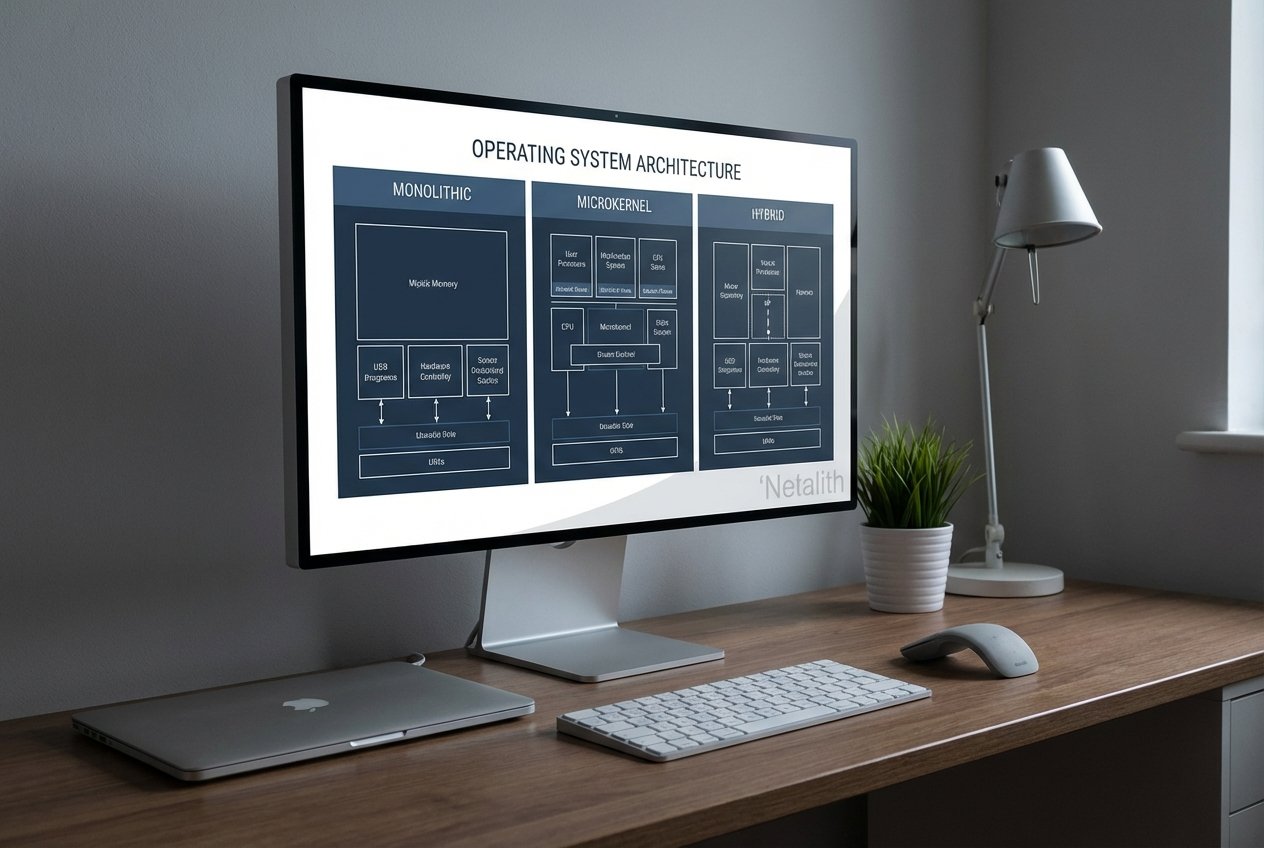
A monolithic kernel is a software architecture where all core operating system services—such as hardware management, memory management basics, process scheduling, and file systems—run simultaneously in the same memory space (the kernel space). Because everything operates within the highest of the system protection rings, communication between components is incredibly fast.
Classic examples of monolithic system structure include early UNIX and Linux. However, a major downside of a monolithic design is its vulnerability: a single bug or failure in a device driver can potentially crash the entire system, as all parts share the same elevated execution privileges.
Layered OS Design
Another historical approach to building an OS is the layered vs modular OS architecture. In a layered OS design, the system is organized into a strict hierarchy of abstraction layers. Layer 0 sits at the bottom as the physical hardware, and the highest layer represents the user interface. Each layer only communicates with the layer immediately below it.
These structured OS design patterns simplify debugging and system maintenance, as developers can isolate software issues to a specific layer. While highly organized and excellent for academic study, the strict layered approach can introduce performance overhead because data must pass sequentially through multiple abstraction layers to reach the hardware.
Microkernel Architecture
Seeking to improve reliability, developers engineered the microkernel architecture. This OS design drastically minimizes the kernel by moving non-essential services (like file systems, networking, and device drivers) out of the privileged ring and into the user space. The microkernel itself handles only fundamental tasks like basic inter-process communication (IPC) and minimal CPU scheduling.
Because most services run in user mode, a driver crash will not bring down the entire system, leading to high stability. Advanced concepts like the Exokernel push this even further by securely multiplexing hardware with minimal to no abstraction. While microkernels are highly secure, the frequent message passing required between the kernel and user space can impact overall system performance.
Hybrid Kernel Design
To get the best of both worlds, many modern platforms utilize a hybrid kernel design. This system structure combines the raw speed of a monolithic kernel with the stability and modularity of a microkernel. In a hybrid setup, critical services responsible for heavy hardware management run in kernel space to maximize performance, while other less critical services operate as modules that can be loaded dynamically.
By blending these abstraction layers, OS developers achieve high efficiency without completely sacrificing system security. Microsoft's Windows NT architecture and Apple's macOS (XNU) are prominent examples of this incredibly popular operating system architecture.
How OS Architecture Works: System Calls and Abstraction Layers
To deliver a complete how OS architecture works tutorial, we must examine how user-level applications actually request services from the privileged kernel. This communication is handled through the system call interface.
When an application needs to read a file, output audio, or allocate RAM, it cannot access the hardware directly. Instead, it triggers a secure software interrupt to the system call interface, asking the kernel to perform the action on its behalf. This interface provides crucial abstraction layers, ensuring that developers can write programs without needing to understand the specific physical hardware their software will run on. If you want to understand how an OS juggles thousands of these requests every second, exploring a process management tutorial is highly recommended.
Frequently Asked Questions
- What is an operating system architecture?
Operating system architecture refers to the fundamental structural design of an OS. It defines how the kernel interacts with user applications, manages physical hardware, and establishes security and communication pathways. - What is the main difference between a monolithic kernel and a microkernel?
In a monolithic kernel, all OS services run in a single, highly privileged memory space, making it fast but vulnerable to system-wide crashes. A microkernel architecture moves most services into user space, increasing stability at the cost of some performance. - What are abstraction layers in an OS?
Abstraction layers are software components that hide complex hardware details from user applications. They provide a simplified interface so developers can write software without worrying about the exact hardware executing the commands. - Why do many modern operating systems use a hybrid kernel design?
A hybrid kernel design balances performance and stability. It keeps essential tasks in the kernel space for speed, similar to monolithic designs, but allows dynamic loading of modules similar to a microkernel.
Conclusion
Mastering the core concepts of operating system architecture is a crucial stepping stone for anyone pursuing an IT career. From the rapid execution of monolithic kernels to the isolated stability of microkernels and the balanced approach of hybrid systems, understanding operating system architecture and components allows professionals to build and manage better software environments. As we look toward modern OS trends, the focus remains on enhancing security through better isolation while maintaining the high performance required by today's hardware. By grasping these fundamental abstraction layers and design patterns, you gain a deeper appreciation for the complex software that powers our digital world.