How to Save Money on Wedding Budget: 8 Proven Strategies
Learn how to save money on wedding budget by cutting guest counts, choosing off-peak dates, checking fees, and setting category caps.

Long Nguyen
Lập trình viên Fullstack · Kỹ sư AI · Nhà nghiên cứu
How to Save Money on Wedding Budget: Start With the Biggest Costs
Learning how to save money on wedding budget decisions starts with the categories that drive the final total. Venue and catering commonly account for 40–50% of wedding spending, so meaningful wedding savings usually come from major choices rather than trimming a few small line items.
Guest count, date flexibility, and venue contract terms create the largest opportunities to lower wedding costs. The eight strategies below focus on those high-impact decisions, along with overlooked fees, bar packages, desserts, contingency planning, and category caps.
- Reduce the guest count strategically.
- Choose an off-peak or weekday date.
- Compare venue contracts and audit extra fees.
- Control bar, dessert, and other wedding budget categories.
1. Reduce the Guest Count Strategically
Guest count is one of the fastest ways to reduce wedding costs because nearly every person adds a catering, bar, stationery, favor, and space-related expense. At approximately $290–$300 per guest, removing 50 guests could save about $14,600.
A smaller guest list may also let you choose a less expensive venue or a more efficient reception layout. Use clear rules so the process feels fair rather than personal.
- Limit plus-ones to spouses, fiancés, or long-term partners when appropriate.
- Set consistent family guidelines for children and extended relatives.
- Prioritize close relationships over distant acquaintances or obligatory invitations.
- Review the list in tiers and remove guests who are unlikely to remain part of your life.
2. Choose an Off-Peak or Weekday Wedding Date
Date flexibility can lower venue and vendor prices without changing the type of celebration you host. Peak-season Saturday weddings generally face the strongest demand, while off-peak dates, Sunday receptions, Fridays, and weekday weddings may offer better availability and pricing.
Ask each venue about seasonal rates and weekday packages rather than assuming the advertised rate applies to every date. Compare the complete package price, including food, rentals, staffing, and required services. A lower base rate does not always mean lower wedding costs if the package includes fewer essentials.
- Request quotes for peak-season Saturdays and at least two alternative dates.
- Ask about Sunday, Friday, winter, and other off-peak pricing.
- Compare inclusions and final totals, not just the venue rental fee.
3. Compare Venue Contracts Before Booking
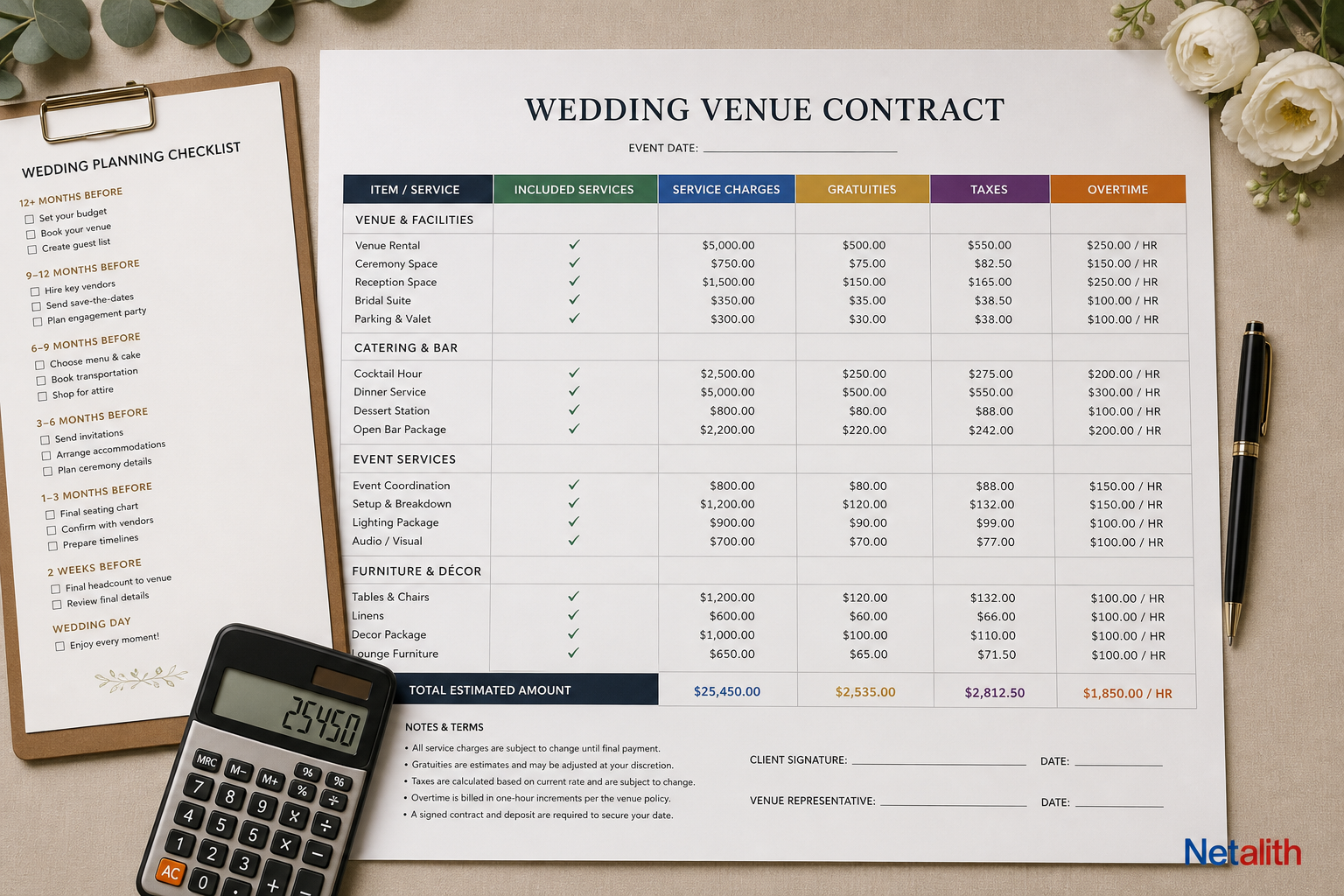
Wedding venue costs can vary widely because venues define “included” services differently. Before booking, request an itemized quote showing what is included in the base price and what will be billed separately.
Check the venue contract carefully before paying a deposit. A low initial quote can become expensive when required vendors, minimum spends, or rental charges are added.
- Confirm whether tables, chairs, linens, setup, cleanup, staffing, security, and rentals are included.
- Ask whether you must use specific caterers, bartenders, rental companies, or other vendors.
- Check food and beverage minimums, room fees, and minimum guest requirements.
- Review cancellation terms, deposit rules, payment deadlines, and rescheduling policies.
| Contract item | Question to ask |
|---|---|
| Rentals | Are tables, chairs, linens, glassware, and other equipment included? |
| Labor | Are setup, cleanup, servers, bartenders, and security included? |
| Required vendors | Can you choose outside vendors, or are approved providers required? |
| Minimums | Are there food, beverage, guest-count, or spending minimums? |
| Payment terms | When are deposits and remaining payments due, and what happens if plans change? |
5. Build a 5–10% Contingency Buffer
Set aside 5–10% of the total wedding budget from the beginning. This contingency buffer gives you room to handle changes without taking on debt or cutting essential plans late in the process.
Use the reserve for guest-count changes, rush orders, weather adjustments, replacement items, or vendor overtime. Keep it separate from planned wedding budget categories so it is not accidentally spent on upgrades before an actual need appears.
6. Control Wedding Bar Package Costs
Bar spending is often hidden inside the venue and catering category, but it can materially affect overall wedding savings. Costs rise with premium liquor, longer receptions, specialty cocktails, and additional staffing.
First ask whether the venue requires an in-house bar package or permits outside alcohol. Then compare the package types against your guest list, drinking preferences, and reception length.
- Compare beer-and-wine, limited-bar, and premium-liquor packages.
- Ask whether outside alcohol is allowed and whether corkage fees apply.
- Confirm whether specialty cocktails, mixers, ice, glassware, and bartenders are included.
- Check taxes, service charges, and gratuities separately.
- Consider limiting premium liquor or offering a signature drink instead of a full premium bar.
| Bar option | Best for | Cost questions |
|---|---|---|
| Beer and wine | Couples seeking a simple, lower-cost selection | Are quantities, mixers, glassware, staffing, and gratuities included? |
| Limited bar | Receptions offering selected spirits or a signature cocktail | What brands and mixers are included, and are specialty drinks charged separately? |
| Premium liquor | Guests who expect a broad, top-shelf selection | How do liquor upgrades, service charges, taxes, and overtime affect the final price? |
7. Choose a Lower-Cost Dessert Option
Dessert is a flexible wedding budget category where couples can save without reducing the guest experience. Compare the cost of a traditional tiered cake with dessert tables, mini cakes, cupcakes, or donuts.
Ask about serving fees, delivery, display rentals, and cake-cutting charges before comparing totals. If you want a formal cake moment, keep a small display cake and use less expensive desserts for guest servings.
- Request complete quotes for a tiered cake and alternative dessert formats.
- Confirm delivery, display equipment, cutting, and serving fees.
- Choose a dessert table or individual treats when they provide better value for your guest count.
- Use a small ceremonial cake while serving cupcakes, mini cakes, or donuts to guests.

8. Set Dollar Caps for Every Wedding Budget Category
Turn the total amount available into enforceable spending limits. A wedding budget calculator can assign dollar caps for venue and catering, photography, attire, flowers, music, stationery, transportation, and other wedding budget categories.
Track each category separately and require every increase in one area to be funded by a reduction in another. An automatically rebalancing calculator can help you test different scenarios before committing to deposits or upgrades.
- Enter the total amount you can spend, excluding money reserved for emergencies.
- Assign a specific cap to every major category.
- Record quoted, committed, and remaining amounts separately.
- Move money between categories only after reviewing the effect on the full budget.
- Recalculate scenarios when guest count, venue, or date changes.
A printed version of this system works the same way, without a formula to accidentally break. The Wedding Budget Planner Printable includes wedding budget and category sheets alongside a vendor tracker for quotes and deposits and a full payment schedule, so quoted, committed, and remaining amounts stay in one place as each vendor contract gets signed.

Wedding Savings Checklist Before You Sign
Use this final review before deposits become nonrefundable. The goal is to compare all-in prices and confirm that your assumptions still fit the available wedding budget.
- Confirm the final guest-count assumptions and date-specific pricing.
- Review venue inclusions, required vendors, minimum spends, and payment terms.
- Verify service charges, gratuities, taxes, delivery, setup, cleanup, and overtime terms.
- Check that the 5–10% contingency buffer remains untouched and available.
- Confirm that every wedding budget category still has a workable dollar cap.
- Recalculate the total using all-in prices rather than advertised starting prices.
CÂU HỎI THƯỜNG GẶP
Câu hỏi thường gặp
What is the fastest way to reduce wedding costs?
Reduce the guest count first, then compare off-peak dates and complete venue contracts. Headcount affects catering, bar service, stationery, favors, and venue size, making it one of the quickest high-impact changes.
How much can reducing the guest count save?
At an estimated $290–$300 per guest, cutting 50 guests could save approximately $14,600. The exact amount depends on catering, bar service, venue pricing, and other per-person charges.
Are weekday weddings cheaper than Saturday weddings?
They can be. Friday, Sunday, and weekday weddings often have lower demand than peak-season Saturdays, but couples should compare complete package prices, inclusions, minimums, and vendor fees before deciding.
What hidden venue fees should couples ask about?
Ask about service charges, gratuities, taxes, delivery, setup, cleanup, staffing, security, rentals, overtime, required vendors, minimum spends, and cancellation or rescheduling charges.
How much should be reserved for a wedding contingency buffer?
Reserve 5–10% of the total wedding budget. Keep this money separate for changes, rush orders, weather adjustments, replacement items, and unexpected vendor overtime.
How can couples lower wedding bar package costs?
Compare beer-and-wine, limited-bar, and premium-liquor packages; ask whether outside alcohol is permitted; and confirm the cost of mixers, specialty cocktails, staffing, taxes, service charges, and gratuities. A limited selection or signature drink can cost less than a full premium bar.