How to Remember to Pay Bills ADHD: 4 Reliable Strategies
Learn how to remember to pay bills ADHD-style with autopay, reminders, and a visible due-date list to prevent late fees and reduce stress.

Long Nguyen
Lập trình viên Fullstack · Kỹ sư AI · Nhà nghiên cứu
How to Remember to Pay Bills ADHD-Friendly
Learning how to remember to pay bills ADHD-friendly means building a system that does not depend on memory alone. Bill payments require working memory, sustained attention, and follow-through—areas that can make money management more difficult with ADHD.
The most reliable approach is to move payment information outside your brain. Automate recurring bills whenever possible, and use specific reminders and a visible due-date list for anything that still requires manual action. A useful test is: if you did nothing for a month, would your essential bills still be paid on time?

1. Automate Recurring Bill Payments
Automatic bill payments remove repeated tasks from your monthly ADHD finances. Set up autopay for recurring expenses whenever the biller and your account allow it. This can reduce the number of decisions and actions required each month.
Use direct deposit, or another dependable income schedule, so funds are available when automatic payments are withdrawn. Start with essential expenses and predictable recurring payments, since each automated bill requires less memory and follow-through.
- Choose eligible bills such as rent, utilities, insurance, subscriptions, and other predictable recurring charges.
- Confirm the payment date, funding account, and whether the amount is fixed or variable.
- Keep enough money available before the withdrawal date to reduce failed-payment risks.
- Check account balances and payment settings periodically so changes do not go unnoticed.
| Payment type | Helpful setup | What to check |
|---|---|---|
| Fixed recurring bill | Set up automatic bill payments | Withdrawal date and funding account |
| Variable essential bill | Use autopay if the account supports it | Monthly balance and amount changes |
| Manual-only payment | Create a recurring date-specific reminder | Processing time and confirmation |
2. Schedule Reminders for Manual Payments
Some bills cannot use autopay, or you may prefer to review them before paying. For these payments, create calendar or phone reminders tied to the actual due date. “Pay bills sometime this week” is vague; “Pay the bill on the 12th” gives your brain a clear action.
Set the reminder early enough to allow for processing delays, weekends, or bank holidays. When it appears, either complete the payment immediately or schedule it for the bill’s due date. Automate every eligible recurring charge first so only the exceptions remain manual.
- Use the bill’s specific due date rather than a general weekly reminder.
- Set a reminder several days ahead when processing time could matter.
- Include the bill name and payment amount in the reminder title.
- Mark the task complete only after the payment is submitted or scheduled.
3. Keep a Visible Due-Date List
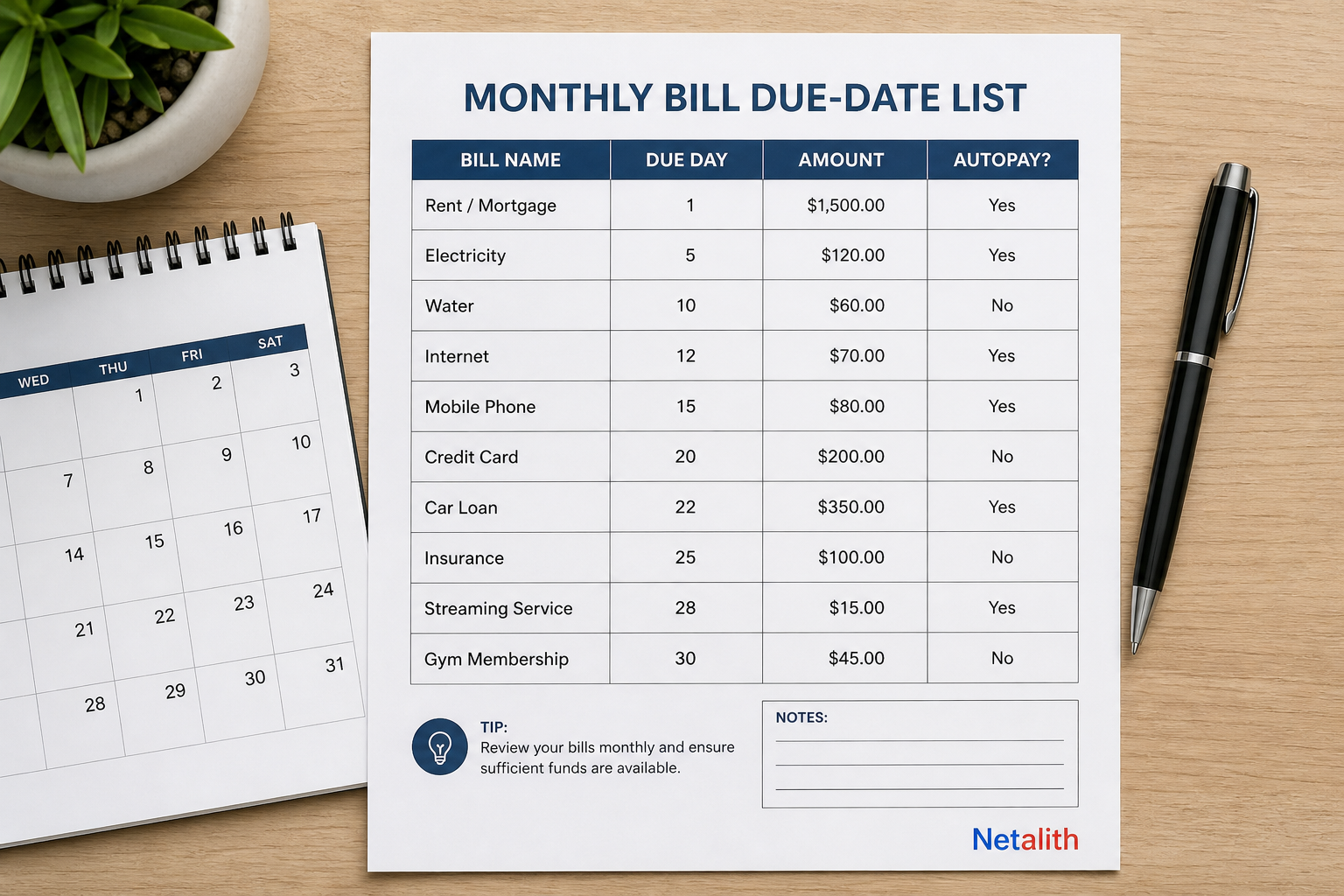
A due-date list creates one external reference for your monthly obligations. Record every bill name, due day, amount, and whether autopay is enabled. This prevents you from having to reconstruct your payment schedule from memory.
Place the list somewhere you regularly look, such as near your workspace or inside a frequently used digital finance tool. Update it whenever a bill, amount, payment date, or autopay setting changes. Use it as a quick monthly check rather than as another complicated tracking project.
- Bill name
- Due day
- Expected amount
- Autopay status
- Payment account, if useful for your system
If you'd rather not build this list from scratch, the ADHD budget planner printable includes a ready-made bill due-date reminder tracker.
4. Prioritize Essential Expenses First
When funds are limited or income is irregular, budget for essential expenses before discretionary spending. Rent, utilities, and minimum debt payments should be covered first rather than paid with whatever money remains at the end of the month.
If it helps protect bill money, consider separating savings and spending accounts. This can make the amount reserved for essential expenses easier to see and less tempting to spend. Prioritizing these obligations reduces late fees and lowers the risk of missed minimum payments.
- Fund rent or housing costs first.
- Cover utilities and other essential household services.
- Reserve money for minimum debt payments.
- Separate bill funds from everyday spending when that makes money easier to protect.
Test and Maintain Your ADHD Bill System
An ADHD-friendly financial system should reduce effort, not create another demanding project. Test it by asking whether every bill would be paid on time if you took no action for one month. If the answer is no, identify which payment still depends on remembering it manually.
Review the system after changes in income, bills, or account arrangements. Verify autopay settings, reminder dates, available funding, and the visible due-date list. The goal is not perfect manual tracking; it is a low-effort structure that reduces background stress and helps prevent late payment fees.
- Check whether every essential recurring payment is automated or clearly prompted.
- Find any payment that still relies entirely on memory.
- Confirm account funding and autopay details after income changes.
- Update reminder dates and the due-date list when bills change.
- Repeat the one-month “do nothing” test periodically.
A structured ADHD budget planner can serve as that external system, keeping autopay status, due dates, and reminders in one place instead of scattered across apps.
CÂU HỎI THƯỜNG GẶP
Câu hỏi thường gặp
Which bills should I automate first if I have ADHD?
Start with recurring essential expenses and minimum debt payments, such as housing, utilities, insurance, and predictable loan payments. Confirm that the funding account will have enough money before each withdrawal, then add other eligible recurring charges gradually.
What should an ADHD-friendly due-date list include?
Include each bill name, its due day, expected amount, and whether autopay is enabled. You can also note the payment account or processing lead time if those details help you act quickly.
How should I handle bills that cannot use autopay?
Create a recurring reminder for the exact due date, with enough lead time for processing. When the reminder appears, submit the payment immediately or schedule it for the due date, then confirm that it was accepted.
How does an external bill system help reduce late fees?
Automation handles eligible recurring payments without requiring monthly initiation, while date-specific reminders and a visible list support the remaining manual payments. Together, they reduce dependence on working memory and follow-through, which can lower the risk of missed deadlines and late fees.