How to Create a Small Business Budget: 4 Proven Steps
Learn how to create a small business budget by forecasting revenue, tracking fixed and variable costs, testing scenarios, and refining monthly.

Long Nguyen
Lập trình viên Fullstack · Kỹ sư AI · Nhà nghiên cứu
How to Create a Small Business Budget
Learning how to create a small business budget gives you a practical financial plan for a defined period, such as a month, quarter, or year. It projects revenue and expenses, then provides a baseline for comparing actual results and making better spending and cash-flow decisions.
A useful budget follows four steps:
- Forecast business revenue.
- Categorize fixed costs and variable costs.
- Calculate projected profit and assign each dollar a purpose.
- Review actual performance monthly and refine the plan.
This process supports everyday budgeting as well as broader small business financial planning. It can help you identify problems early, protect cash flow, and decide when growth spending or financing is affordable.
Step 1: Forecast Business Revenue
Start with a realistic revenue forecast for the budget period. Review historical sales, seasonal patterns, signed contracts, customer demand, pricing changes, and your current sales pipeline. Use the information that best explains how income is actually generated in your business rather than relying on an overly optimistic target.
If you are launching a new business without sales history, research competitor performance, market conditions, customer demand, and expected pricing. These estimates will be less certain, so document the assumptions behind them and revise them as real results become available.
When revenue is difficult to predict, prepare three estimates: conservative, expected, and optimistic. The conservative version helps test whether essential bills can still be covered, while the expected and optimistic versions show what additional profit or growth spending may be possible.
Step 2: Categorize Fixed and Variable Costs
Next, list every expense required to operate the business. Separating fixed costs from variable costs makes it easier to see which bills remain stable and which rise or fall with sales activity.
- Fixed costs: Rent, salaries, insurance, debt payments, subscriptions, and other recurring fees.
- Variable costs: Supplies, inventory, marketing, hourly wages, and other costs that change with sales or production.
- Often-missed expenses: Credit card processing fees, transaction charges, maintenance, and irregular operating costs.
- Owner and personal spending: Keep business expenses separate from personal spending so the budget reflects the company’s actual performance.
Practical expense tracking is essential. Record transactions consistently, save receipts, review bank and card activity, and assign each expense to the correct category. These habits make it easier to track business expenses and prevent small charges from distorting your projected profit.
Step 3: Calculate Projected Profit
Once revenue and expenses are estimated, subtract total expenses from total projected revenue:
Projected profit = total projected revenue − total projected expenses
Check whether expected income covers operating bills and leaves a reasonable profit. Then assign each dollar a purpose, including taxes, debt payments, emergency reserves, owner compensation, and reinvestment. This prevents apparently available money from being spent before important obligations are met.
Projected profit is an estimate, not a guarantee. If pricing, sales volume, supplier costs, or other assumptions change, update the calculation. A useful budget stays connected to current information instead of preserving an outdated target.
Step 4: Compare Actual Results and Refine Monthly
After each month, compare actual revenue and expenses with the budgeted figures. Regular reviews show whether sales are on track, which costs are rising, and whether cash-flow forecasting assumptions still make sense.
Investigate meaningful variances instead of treating the budget as a pass-or-fail test. A revenue shortfall might result from seasonality or a delayed contract, while higher expenses could reflect a one-time purchase or a lasting supplier price increase.
- Record actual income and expenses.
- Identify and explain significant differences from the budget.
- Update sales, cost, and cash-flow assumptions.
- Revise the next month’s forecast and spending limits.
A small business budget is a living plan, not a one-time exercise. Monthly refinement makes it more accurate and more useful for business finance decisions.

Use Scenario Planning for Better Decisions
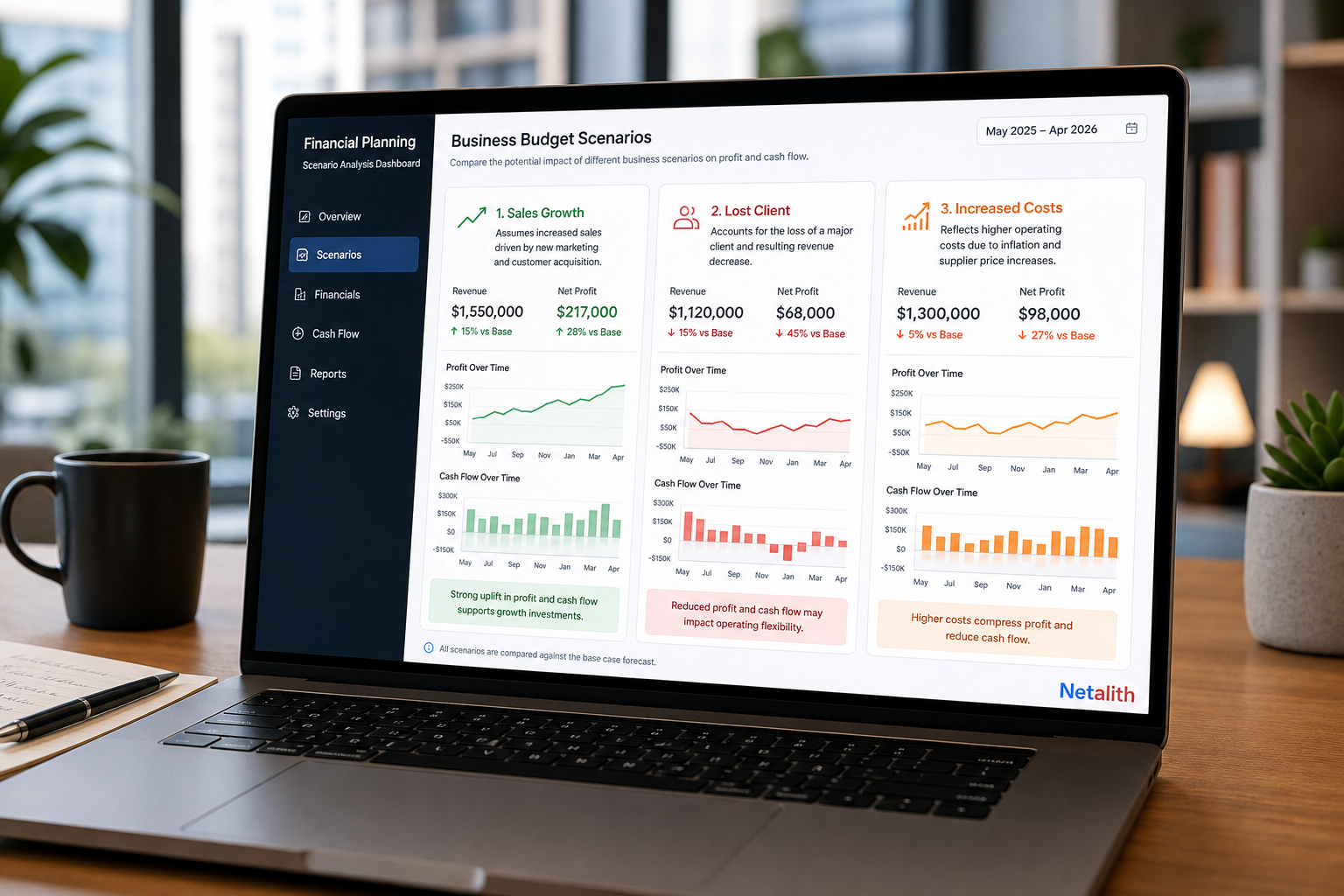
A budget can do more than track routine spending. Scenario planning lets you change important assumptions and see how each possibility could affect profit and cash flow before you commit.
- Model a sales increase to estimate whether additional inventory, staffing, or marketing would be affordable.
- Test the effect of losing a major client or experiencing a slower sales period.
- Estimate how higher supplier costs would affect margins and available cash.
- Add new debt payments to determine whether financing would remain manageable.
Compare each scenario’s impact on both projected profit and cash flow. A business can appear profitable on paper while lacking enough cash at the right time to pay suppliers, employees, taxes, or loan installments. Use these results to judge when expansion, financing, or hiring is financially realistic.
Build Growth and Financing Into the Budget
Do not budget only for maintenance. A sustainable growth budget includes planned investments while protecting essential bill coverage and cash reserves.
- Set aside a planned portion of revenue for coaching, training, or leadership development. The source recommendation is at least 2%.
- Create categories for marketing, equipment, technology, and other relevant growth investments.
- Document revenue and expense assumptions so loan or financing applications can be supported quickly when an opportunity arises.
- Balance growth spending with reserves, taxes, debt payments, payroll, and other essential obligations.
Growth contributions should be affordable under realistic revenue assumptions, not dependent on the best-case forecast. Reviewing them alongside cash-flow forecasts helps you invest without putting day-to-day operations at risk.
Choose the Right Budgeting Tools
The right tool depends on the complexity of your financial information and the level of forecasting you need. Start with the simplest option that produces reliable reports and can be maintained consistently.
| Tool | Best for | Considerations |
|---|---|---|
| Accounting software | Businesses whose financial data already lives in an accounting system | Often includes basic budget reports and reduces duplicate data entry. |
| Dedicated budgeting software | Businesses needing detailed cash-flow forecasting or advanced planning | Useful for scenario planning and more complex financial models. |
| Free business budget template | Simple financials with a limited number of categories | Low cost and flexible, but requires consistent manual updates. |
| Accountant | Budget development, tax planning, and interpretation of financial results | Helpful when decisions are complex or financial reports are difficult to interpret. |
Monthly Small Business Budget Checklist
Use this repeatable workflow to keep your budget current:
- Update revenue and expense data with actual results.
- Review fixed costs, variable costs, cash on hand, and upcoming obligations.
- Compare projected profit with actual performance and explain major variances.
- Run a scenario for any significant decision, such as hiring an employee or taking financing.
- Adjust the next forecast and confirm that growth contributions remain affordable.
Consistent monthly reviews turn a budget template or software report into an active management tool for cash flow, profitability, and growth.
CÂU HỎI THƯỜNG GẶP
Câu hỏi thường gặp
How often should a small business update its budget?
Review actual results against the budget every month. Update the forecast whenever sales, costs, contracts, staffing, financing, or other major assumptions change rather than waiting for the next annual planning cycle.
What should a new business use to forecast revenue without historical data?
Use competitor research, market conditions, customer demand, pricing, signed contracts, and your sales pipeline. Prepare conservative, expected, and optimistic estimates, then replace assumptions with actual results as the business generates data.
What is the difference between a business budget and a cash-flow forecast?
A business budget estimates revenue, expenses, and projected profit for a period. A cash-flow forecast focuses on when money is expected to enter and leave the business, helping determine whether cash will be available for obligations at specific times.
When should a business consider hiring employees based on its budget?
Consider hiring when realistic revenue can cover wages, payroll-related costs, and other ongoing obligations while preserving adequate reserves. Test the hire in a scenario plan to compare its effect on both projected profit and timing of cash payments.
Is accounting software enough, or is dedicated budgeting software necessary?
Accounting software is often sufficient when you need basic budget reports and your financial data is already organized there. Dedicated budgeting software becomes more useful when you need detailed cash-flow forecasting, scenario planning, or advanced financial models.