Ecommerce Website Maintenance Services: What I Actually Run Monthly on a Live Store
What ecommerce website maintenance services should cover: the six layers, a monthly checklist, PCI payment-script rules, performance budgets and pricing models.

Long Nguyen
Développeur fullstack · Ingénieur IA · Chercheur
What ecommerce website maintenance services actually cover
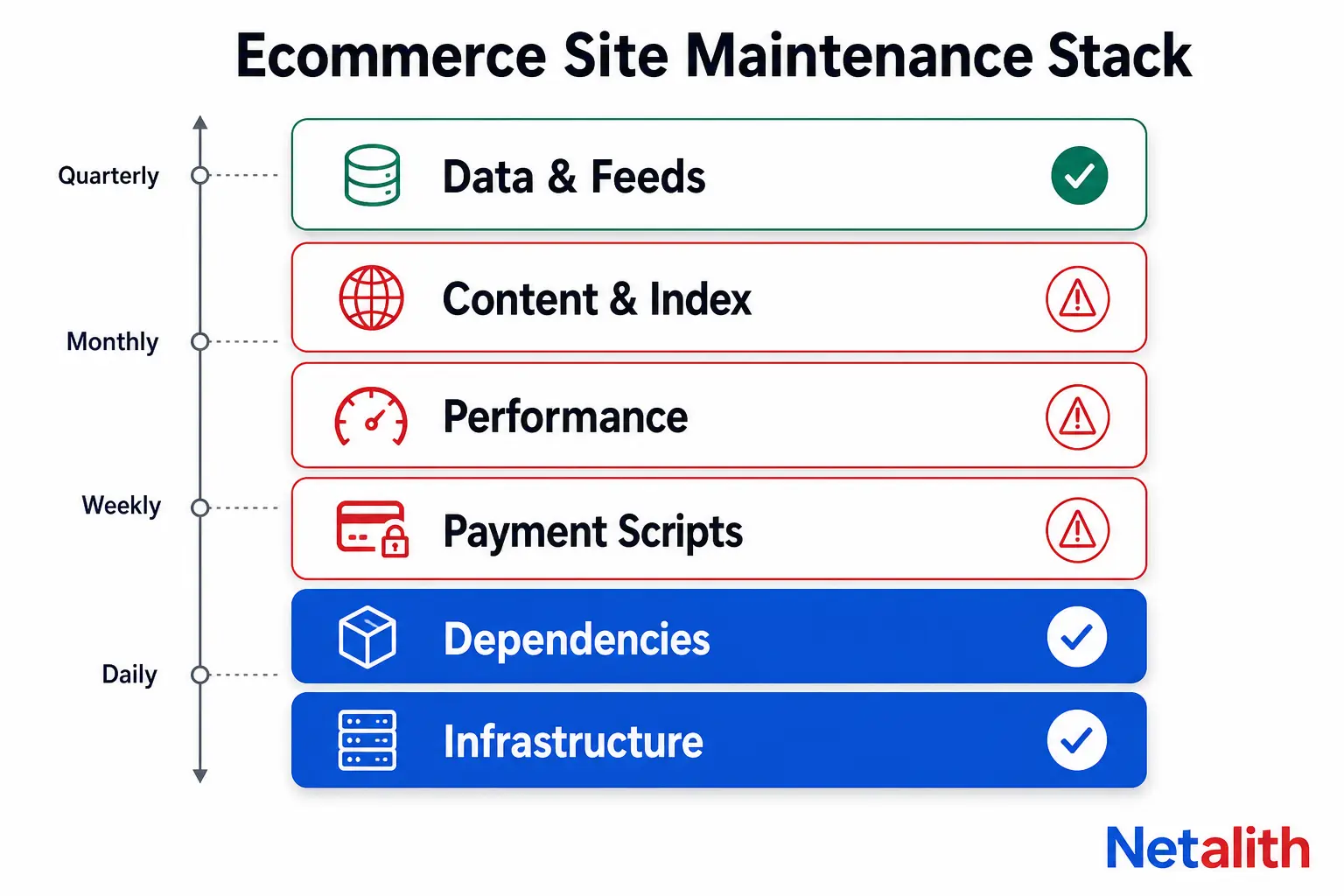
Most maintenance plans sold to store owners are hosting plus plugin updates with a nicer invoice. That is one layer out of six, and it is the layer least likely to cost you revenue when it fails.
Here is how I break the surface down on the stores I run. The column that matters is the last one, because the layers nobody owns are the ones that quietly bleed money.
| Layer | What actually breaks | Cadence | Usually owned by |
|---|---|---|---|
| Infrastructure & uptime | DNS, TLS renewal, CDN rules, origin down | Continuous monitoring | Host or agency — well covered |
| Platform & dependency updates | Breaking major versions, abandoned plugins, silent build failures | Monthly, plus out-of-band security patches | Agency — covered, often badly tested |
| Payment page & client-side scripts | Unauthorized or modified scripts on checkout pages | Weekly inventory + change alerts | Nobody on most small stores |
| Performance | Field metrics drifting past thresholds after a theme or app install | Monthly field data, per-deploy lab check | Split — so, nobody |
| Content & index health | Published pages that damage rankings, orphaned URLs, bad canonicals | Weekly Search Console review | Nobody — the owner publishes freely |
| Data & integrations | Feed rejections, stale prices, broken marketplace or ERP sync | Daily automated checks | Nobody until orders stop |
If a maintenance quote only prices rows one and two, you are buying hosting support. The next three sections are the rows that get skipped.
The 90% traffic drop that taught me maintenance is not a plugin-update job
I build and maintain a Ford auto-parts store that sells in Vietnam and internationally. Its organic traffic is unusually clean to reason about: buyers type a part number, the product page ranks, the buyer contacts the shop. Part-number and SKU queries drive nearly all of it.
In September 2026, clicks and rankings fell roughly 90% inside a few weeks. Nothing in a standard maintenance checklist went red. Uptime was green. Backups ran. TLS was current. No dependency had broken.
The cause was the shop owner publishing a batch of AI-generated articles on the blog attached to the store. Thin, duplicated-in-substance pages on a domain whose entire authority rested on narrow, hand-written product content. International impressions actually rose afterwards, but they converted at zero, because they were the wrong queries. The Vietnamese buyer traffic — the traffic that pays — collapsed.
Recovery is still in progress at the time of writing, which is the honest part of this story: this class of damage is slow to undo. What changed permanently is my scope of work. Publishing rights are a maintenance surface, the same as deploy rights:
- A publishing gate. New content on a commercial store gets reviewed before it goes live, or the client accepts in writing that ranking damage is out of scope.
- Clicks and impressions alerting. A week-over-week drop past a threshold raises an alert, instead of being noticed a month later when the phone stops ringing.
- An indexed-URL diff. A weekly list of what Google holds for the site, compared against the previous week. Pages appearing that nobody on the technical side knew about is the signal.
Ask any provider quoting you ecommerce website maintenance services what happens when rankings fall but nothing is technically broken. If the answer is that SEO is a separate product, you know which rows of the table above you are not buying.
Payment page script monitoring is now a maintenance task, not a one-off security project
This is the row almost every small-store maintenance plan is missing, and it is now a standing obligation rather than good practice.
PCI DSS requirements 6.4.3 and 11.6.1 target e-skimming: 6.4.3 covers managing and authorizing the scripts loaded on payment pages and verifying their integrity, and 11.6.1 covers detecting unauthorized changes to those pages. Both spent years as best practice and became required in assessments after , per the PCI Security Standards Council.
Two details that get misread constantly:
- An iframed, hosted payment page does not remove the problem. The guidance explicitly addresses merchants embedding a third-party payment iframe, because the parent page can still be used to attack the payment flow.
- Being eligible for SAQ A is not the same as the requirement disappearing. 6.4.3 and 11.6.1 were removed from SAQ A itself, but SAQ A merchants must instead confirm an eligibility criterion that their site is not susceptible to scripts affecting the payment environment — by their own means, a third party's, or written confirmation from the provider supplying the iframe. Somebody still has to check, and checking is maintenance work.
The practical version on a live store is unglamorous: keep an inventory of every third-party script with a recorded business justification, alert on any change to that inventory, and re-confirm it whenever a marketing tag, chat widget, review app or pixel is added. On a typical Shopify or WooCommerce store, marketing adds scripts far more often than engineering does — which is exactly why this belongs on a recurring calendar, not in a launch checklist.
What maintenance means on Shopify vs WooCommerce vs a custom or Odoo build
The platform does not change whether the six layers exist. It changes who is contractually on the hook for each, and that is what a maintenance plan should be priced against.
| Area | Shopify / hosted SaaS | WooCommerce / self-hosted | Custom or Odoo |
|---|---|---|---|
| Core platform patching | Platform | You | You |
| Apps / plugins / modules | You — app sprawl is the main performance and script risk | You — plus abandoned-plugin risk | You — fewer, larger dependencies |
| Server, PHP/Python runtime, DB | Platform | You or host | You |
| Theme / frontend upgrades | You — theme majors break customizations | You | You |
| Payment page scripts | You — apps inject scripts you did not write | You | You, with the most direct control |
| Backups and restore testing | Partial; export your own data | You | You |
| Realistic monthly effort, small store | Lowest | Highest per feature | Lowest once stable, spiky at upgrades |
The counter-intuitive one is Shopify. Owners assume a hosted platform means maintenance is handled, then install fourteen apps over two years. Every app is a script on the storefront, a possible checkout-adjacent script, and a recurring cost. The highest-return maintenance task I run on hosted stores is not patching — it is an app audit that removes what is no longer used.
Performance maintenance: hold a budget, not an opinion
Performance is where maintenance plans produce the most activity and the least measurable result, because "we optimized the site" is unfalsifiable. Replace it with a pass/fail budget against field data.
Google's Core Web Vitals give you that budget. The current stable set and their good thresholds, as documented by Google on web.dev, are LCP at 2.5 seconds or less, INP at 200 milliseconds or less, and CLS at 0.1 or less — assessed at the 75th percentile of page loads, segmented by mobile and desktop.
| Metric | Good threshold | What usually breaks it on a store |
|---|---|---|
| LCP | ≤ 2.5s | Unoptimized hero or product image; render-blocking app CSS |
| INP | ≤ 200ms | Chat widgets, review apps, heavy filter and variant scripts |
| CLS | ≤ 0.1 | Images without dimensions, late-loading banners and consent bars |
Two rules I apply, both learned the expensive way:
- Field data decides, lab data diagnoses. The 75th percentile of real sessions is the number in the contract. A lab score is only for finding the cause.
- Treat a build-tool upgrade as a change that needs verification, not a chore. On netalith.com I moved from a CDN-delivered CSS framework to a compiled stylesheet and went from 81 to 93 on Performance, with Accessibility, Best Practices and SEO at 100. The trap was the upgrade itself: running the newer major of the CSS CLI against a config written for the previous major produced an incomplete stylesheet with no error. The build passed. The page was visually broken in places nobody had opened yet. Any dependency that generates assets can fail silently like that, which is why the post-deploy check is a real render comparison, not a green CI tick.
The ecommerce maintenance checklist I actually run
Written as a schedule, because the value is in the cadence rather than the list. Anything not on a calendar is not maintenance.
Daily (automated, alert-only)
- Uptime and checkout transaction probe — a synthetic add-to-cart, not just a homepage ping
- Product feed and marketplace sync error counts
- Error-rate and 5xx threshold alerts
- Payment page script inventory diff
Weekly
- Search Console: clicks, impressions, and newly indexed or dropped URLs versus last week
- Security patches for anything with a published advisory — out of band, not deferred to the monthly window
- Order and payment failure review with the shop owner
Monthly
- Dependency and app updates on staging, then production, with a render comparison after deploy
- Core Web Vitals field data against the budget, mobile and desktop separately
- Restore test — restore the backup somewhere and open the store. An untested backup is a belief, not a backup
- Broken link, 404 and redirect-chain sweep, prioritized by pages that have revenue or links
Quarterly
- App and plugin audit: remove what is unused, replace what is unmaintained
- Third-party script justification review with marketing
- Access review: who still has admin, deploy and publishing rights
- Structured data and canonical spot-check across each template type
If that reads like more than a store owner wants to own, that is the honest reason ecommerce website build and operation gets outsourced: not the difficulty of any single task, but the cost of remembering all of them every month.
How ecommerce website maintenance services are priced — and what each model hides
Four models dominate. None is wrong; each one quietly misaligns incentives somewhere, and knowing where is how you negotiate.
| Model | Fits | The hidden cost |
|---|---|---|
| Break-fix hourly | Stable stores with low change volume | Nobody is paid to prevent anything; you only buy attention after revenue is already lost |
| Monthly retainer, fixed hours | Most small and mid stores | Unused hours vanish; busy months get rationed. Ask what rolls over and what counts as billable |
| Retainer plus SLA tiers | Stores where downtime has a known hourly cost | You pay for response speed whether or not you ever need it. Verify response time is defined and measured, not aspirational |
| In-house part-time developer | Stores past roughly one full-time workload | Single point of failure, plus zero coverage during leave — and the six layers still need someone who has seen them before |
Whatever model you pick, price the scope against the six layers rather than against hours. A retainer that covers twenty hours but excludes content and index health is cheaper on paper than one that includes them, and it is the one that let a 90% traffic drop happen on my watch.
One practical note for small stores: priced-to-scope is normal for this work, because a five-product store and a five-thousand-SKU catalog with marketplace sync are not the same job. Be suspicious of a flat monthly number quoted before anyone has looked at your store.
What to ask before signing a maintenance contract
Seven questions. The answers separate a maintenance partner from a hosting reseller faster than any proposal does.
- Which of the six layers is in scope, in writing? Especially payment page scripts and index health.
- What is the response time, and how is it measured? "Priority support" with no clock is marketing.
- When did you last test a restore, and how long did it take? The time matters more than the fact.
- How do updates reach production? If the answer does not include a staging environment and a post-deploy check, you are the test environment.
- What happens when rankings drop but nothing is broken? The question from section two.
- Who may publish and who may deploy? Both lists should be short and both should be reviewed.
- What do I keep if we part ways? Repository access, DNS control, backups in a format you can restore elsewhere.
Two red flags worth naming: a plan that bundles hosting and maintenance into one inseparable fee, which makes leaving expensive by design; and any provider who cannot tell you what they would check first if the store stopped taking orders right now.
If you are reading this because something already feels wrong but you cannot name it, a scoped look at your own store beats a generic checklist. That is what the $20 Audit + Roadmap is for — an audit of your site, a prioritized roadmap of what to fix in what order, and a checklist you can hand to whoever maintains it, delivered in 24–48 hours. Fix it yourself from the roadmap, or hand it to us.
FAQ
Questions fréquentes
What is included in ecommerce website maintenance services?
A complete plan covers six layers: infrastructure and uptime, platform and dependency updates, payment page script monitoring, performance against a Core Web Vitals budget, content and index health, and data or feed integrations. Most quotes only price the first two, so ask explicitly which of the other four are in scope and in writing.
How much do ecommerce website maintenance services cost?
Pricing follows four models: break-fix hourly, a fixed-hours monthly retainer, a retainer with SLA tiers, or an in-house developer. Real cost scales with catalog size, number of integrations and change volume, so a flat monthly figure quoted before anyone has looked at your store is a warning sign rather than a bargain. Scope the plan against the six maintenance layers instead of against hours.
Does a Shopify store need a maintenance plan?
Yes, just a different one. Shopify patches the platform and servers, but you still own apps, theme upgrades, the scripts those apps inject into the storefront and near checkout, performance, and content and index health. On hosted stores the highest-return recurring task is usually an app audit that removes what is no longer used.
Is SEO part of website maintenance?
Index health should be. Monitoring clicks, impressions and newly indexed or dropped URLs catches ranking damage that no technical check will flag, which is a distinct job from campaign-style SEO work. A store can have perfect uptime, current patches and valid TLS while its rankings collapse because of what was published on it.
Do I still need payment page script monitoring if I use a hosted checkout or iframe?
In most cases yes. PCI DSS requirements 6.4.3 and 11.6.1 became required in assessments after 31 March 2025 and the Council's guidance explicitly addresses merchants embedding a third-party payment iframe. Merchants eligible for SAQ A must instead confirm their site is not susceptible to scripts affecting the payment environment, which still means somebody has to check on a recurring basis.
How often should an ecommerce website be maintained?
Run it as a calendar, not a list: daily automated uptime, checkout probe and feed error alerts; weekly Search Console review and out-of-band security patches; monthly dependency updates, Core Web Vitals field check and a tested backup restore; quarterly app audit, script justification review and access review.