BigCommerce vs Shopify in 2026: Why the Fee Advantage Just Disappeared
BigCommerce vs Shopify for 2026: pricing, the new BigCommerce transaction fee, B2B tools, app ecosystem, and which platform fits your store.

Long Nguyen
Développeur fullstack · Ingénieur IA · Chercheur
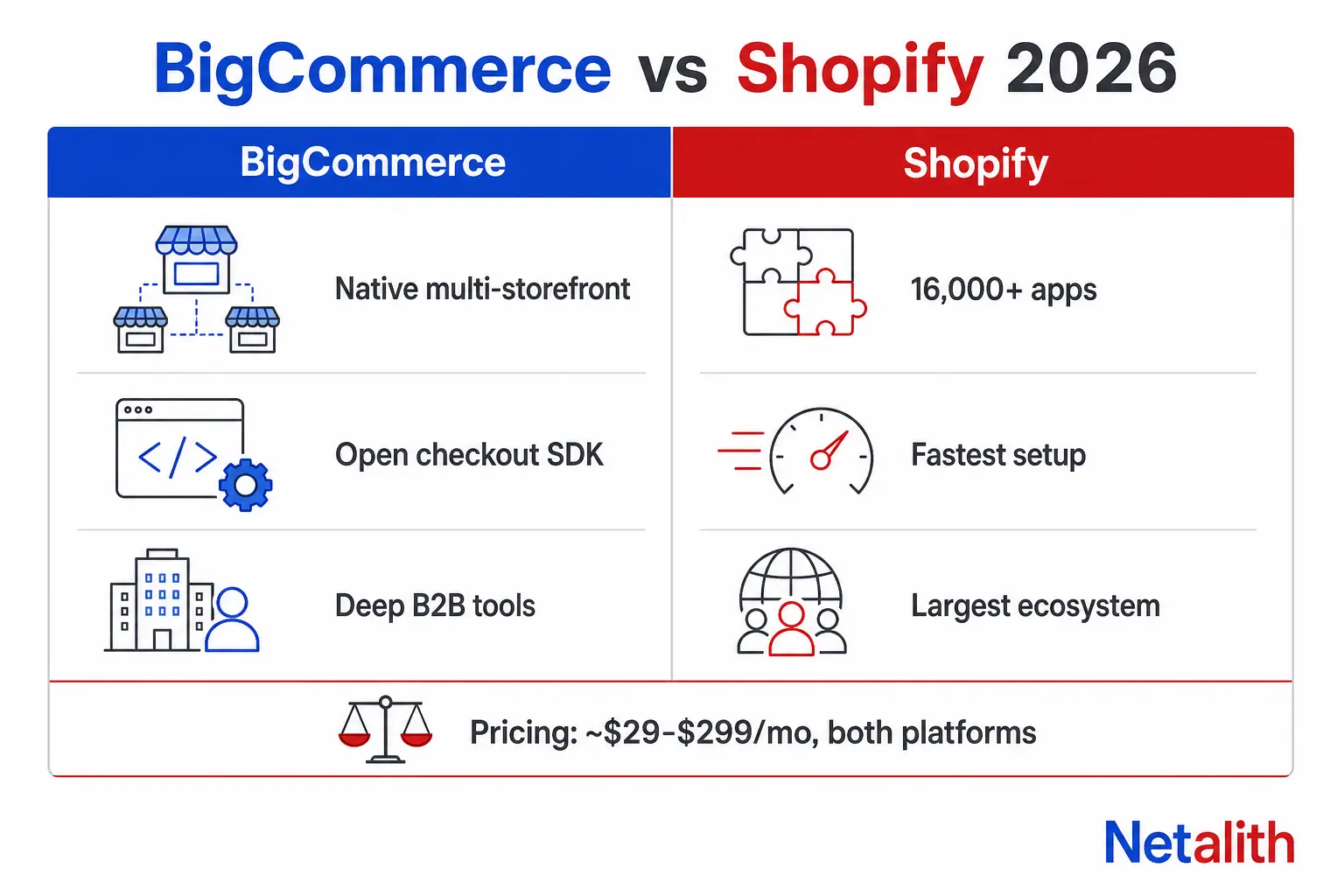
BigCommerce vs Shopify Pricing in 2026
Since June 1, 2026, the headline prices are effectively the same. BigCommerce renamed its plans (Standard to Core, Plus to Growth, Pro to Scale, Enterprise to Performance) and both platforms now list entry, mid, and high tiers at roughly $29, $79, and $299 per month on annual billing. That parity is new, and it changes how you should actually compare these two, because the old shorthand — "BigCommerce is cheaper, Shopify has more apps" — no longer holds on price alone.
| Tier | Shopify (annual) | BigCommerce (annual) |
|---|---|---|
| Entry | Basic — $29/mo | Core — ~$29/mo |
| Mid | Grow — $79/mo | Growth — ~$79/mo |
| High | Advanced — $299/mo | Scale — ~$299/mo |
| Enterprise | Plus — from $2,300/mo | Performance — custom quote |
The real difference sits below the sticker price, in how each platform scales your bill as you grow. Shopify prices almost entirely by feature tier: card rates step down at each level (2.9%, 2.7%, 2.5% + 30¢ on Shopify Payments per the official Shopify pricing page), and there is no revenue cap forcing an upgrade. BigCommerce prices by feature tier plus a trailing-12-month sales cap: Core auto-upgrades to Growth once GMV crosses $30,000, and Growth moves to Scale above $100,000, per the official BigCommerce pricing page. If your store is on a growth trajectory, model both curves against your projected 12-month GMV rather than just the plan you'd start on.
Transaction Fees: The Gap That Just Closed
For a decade, "no transaction fees" was BigCommerce's single loudest pitch against Shopify. That pitch is gone. As of June 1, 2026, BigCommerce charges an Open Payment Provider Fee on any order that doesn't go through its approved Embedded Payment Providers list (Stripe, PayPal/Braintree, Adyen, Checkout.com, and a short list of others): 2% on Core, 1% on Growth, 0.6% on Scale, custom on Performance. Route every order through an embedded provider and the fee is $0 — but that's now the same trade-off Shopify has always made with Shopify Payments.
| Plan tier | Shopify (non-Shopify Payments) | BigCommerce (non-embedded provider) |
|---|---|---|
| Entry | 2% | 2% |
| Mid | 1% | 1% |
| High | 0.6% | 0.6% |
Two details still separate them. First, Shopify waives its fee entirely on Shopify Payments, a single first-party gateway; BigCommerce waives its fee across 20+ embedded providers, so merchants with an existing processor relationship (say, a regional gateway Shopify doesn't support) have better odds of landing on the free side without switching who they bank with. Second, BigCommerce's fee applies to offline and manually keyed orders too, including purchase orders — a detail B2B sellers running phone or PO-based orders should model before assuming they're exempt.
B2B and Wholesale Features
This used to be BigCommerce's cleanest differentiator: native company accounts, tiered pricing, and purchase-order checkout on non-enterprise plans, versus Shopify gating almost all of it behind Plus at $2,300+/month. That gap narrowed sharply in April 2026, when Shopify rolled its foundational B2B toolkit out to Basic, Grow, and Advanced at no extra cost — company profiles, up to three B2B catalogs, volume pricing and quantity rules, vaulted cards, and net payment terms are now available without Plus.
What Shopify still reserves for Plus: unlimited catalogs, customer-specific (rather than market-level) catalog assignment, partial payments and deposits, and a dedicated wholesale registration workflow. BigCommerce's Scale and Performance tiers still go deeper on approval workflows, buyer hierarchies, and quote-to-cash than non-Plus Shopify does. So the honest framing for 2026: if your B2B need is company accounts, net terms, and a handful of price lists, either platform's mid tier now covers it. If you need complex buyer hierarchies, multi-level approvals, or true customer-level (not market-level) catalog pricing below enterprise pricing, BigCommerce still has the edge.
App Ecosystem and Store-Building Experience
Shopify's app store runs past 16,000 listings; BigCommerce's marketplace is smaller and more curated. In practice this cuts two ways. Shopify has an app for almost anything you'll want to bolt on — loyalty, subscriptions, upsells, freight quoting — which means faster time-to-launch but also a bigger recurring app bill as your stack grows, since features BigCommerce ships natively (multi-storefront, more granular product options, higher default file and variant limits) often require a third-party Shopify app plus its own monthly fee.
Store building itself favors Shopify for non-technical founders: the theme editor and onboarding flow are built for someone who has never touched HTML. BigCommerce's learning curve is steeper out of the gate, but it opens up its checkout for deep customization on every plan through the Checkout SDK — you can rework steps, fields, and logic without an enterprise contract. Shopify keeps that level of checkout control behind Plus, through Checkout Extensibility's sandboxed extensions. If you're a solo founder who wants to launch fast, that favors Shopify. If you have (or will hire) developers and want to own your checkout logic without paying for Plus, that favors BigCommerce.
Multi-Storefront and Scaling Beyond One Brand
If you run, or plan to run, more than one storefront — separate brands, regions, or a B2B/B2C split — this is where the platforms diverge most on cost. BigCommerce includes multi-storefront on its standard plans: up to five storefronts on Core and Growth, more on higher tiers, no separate per-store fee. On Shopify, native multi-store support effectively starts at Plus ($2,300+/month), which does bundle nine expansion stores into that price. For a brand already operating at Plus scale, that's essentially free multi-store. For a brand that wants two or three storefronts before it's grown into Plus-level revenue, BigCommerce is meaningfully cheaper to run that way today.
Which Platform Fits Your Business
Boiled down to the decision that actually matters for most merchants:
- Choose Shopify if you're a solo founder or small team who wants the fastest path from zero to a live store, the largest app selection to fill gaps as you grow, and you're comfortable paying for apps to replace what BigCommerce ships natively.
- Choose BigCommerce if you're running (or planning) multiple storefronts under one account, need deep native checkout customization without an enterprise contract, or run complex B2B operations that outgrow what Shopify's non-Plus B2B toolkit now covers.
- Either works for straightforward B2C stores under $30K in annual GMV using an embedded/first-party payment provider — at that scale the fee structures land in the same place, so pick on ecosystem fit and team comfort rather than price.
None of this is a one-time decision you're stuck with. We handle both directions — BigCommerce and Shopify store setup, migrations, and marketplace-API integrations — and the redirect maps, app replacements, and checkout rebuilds are almost always the part teams underestimate when they move platforms mid-year.
If you're still weighing which platform — or which service you'd even need to get there — get a scoped quote and we'll tell you plainly which move actually pays off for your numbers.
FAQ
Questions fréquentes
Is BigCommerce still cheaper than Shopify in 2026?
Not automatically. Headline plan prices now match at roughly $29/$79/$299 per month on both platforms, and since June 2026 BigCommerce charges its own 0.6%-2% fee on orders processed outside its approved Embedded Payment Providers, similar to Shopify's non-Shopify-Payments fee. BigCommerce can still be cheaper for merchants running multiple storefronts or heavy B2B/PO order volume, since those come standard on lower tiers.
Does BigCommerce still have no transaction fees?
Only when the order runs through one of BigCommerce's approved Embedded Payment Providers (Stripe, PayPal/Braintree, Adyen, Checkout.com, and others). Orders processed through any other gateway, including offline and manually keyed orders, are subject to the Open Payment Provider Fee introduced June 1, 2026: 2% on Core, 1% on Growth, 0.6% on Scale.
Which platform is better for B2B and wholesale selling?
It depends on complexity. Shopify extended core B2B tools (company profiles, net terms, up to three catalogs, volume pricing) to its Basic, Grow, and Advanced plans in April 2026, closing most of the gap for straightforward wholesale. BigCommerce still goes deeper on multi-level approval workflows, buyer hierarchies, and customer-level catalog pricing below enterprise pricing, so complex B2B operations may still fit BigCommerce better.
Can I migrate from BigCommerce to Shopify (or the reverse) without losing SEO rankings?
Yes, if every existing URL gets a 301 redirect to its new equivalent before the new store goes live. Missing redirects, not the platform switch itself, are the most common cause of ranking drops after an ecommerce migration. A structured migration covering product data, customer records, redirects, theme setup, and app replacement typically takes 4-6 weeks.
Which has more apps and integrations, BigCommerce or Shopify?
Shopify's app store is far larger, with over 16,000 listings versus BigCommerce's smaller, more curated marketplace. That gives Shopify merchants more off-the-shelf options for almost any feature, but it also means some functionality BigCommerce includes natively (multi-storefront, deeper checkout customization, higher default variant limits) requires a paid third-party app on Shopify.