TikTok Shop vs Instagram Shopping: Fees, Checkout & Reach Compared (2026)
TikTok Shop vs Instagram Shopping compared: checkout flow, fees, reach, and setup work — see which platform actually fits your store in 2026.

Long Nguyen
Développeur fullstack · Ingénieur IA · Chercheur
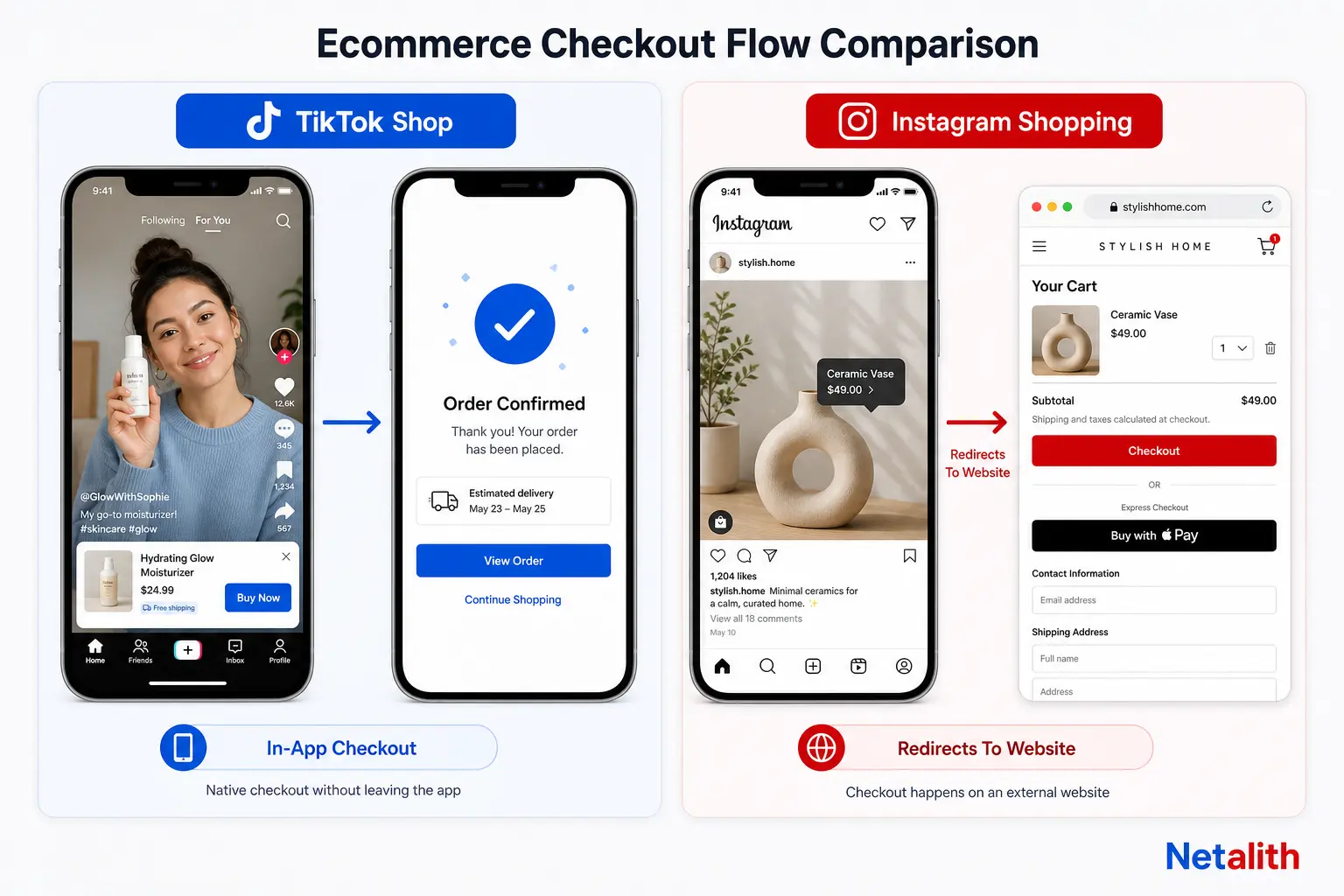
TikTok Shop vs Instagram Shopping: the checkout difference that decides everything
Every other comparison between these two platforms — fees, reach, content style — sits downstream of one structural fact: where the purchase actually happens.
TikTok Shop keeps the entire transaction inside the app. A viewer taps a product card under a video or LIVE stream, pays with a saved card or Apple/Google Pay, and the order confirms without ever leaving TikTok. That in-app checkout has been the platform's core bet since TikTok Shop launched in the US in September 2023, and it's still the default flow in 2026.
Instagram Shopping no longer works that way. Meta spent 2023 pushing merchants toward native, in-app checkout on Facebook and Instagram — then reversed course. Starting in June 2025, Meta began retiring native checkout on Shops and moving purchases back to the merchant's own website, with most shops transitioned by that September. Meta's own guidance to sellers confirms shoppers are now redirected off-platform to complete checkout, and that order management, payments, and returns are no longer handled inside Commerce Manager. In practice, a product tag on Instagram in 2026 is a high-intent link out, not a purchase button.
| Checkout mechanic | TikTok Shop | Instagram Shopping |
|---|---|---|
| Where payment happens | Inside the TikTok app | On the seller's own website (Shopify, WooCommerce, custom cart, etc.) |
| Who processes payment | TikTok's own payment infrastructure | The seller's payment processor (Stripe, Shopify Payments, PayPal, etc.) |
| Who owns order management, returns, disputes | TikTok Shop Seller Center | The seller's own store and support stack |
| Friction between discovery and purchase | One tap, no app switch | At least one redirect and a second checkout page |
This isn't a cosmetic difference. In-app checkout removes the single biggest drop-off point in social commerce — the redirect. Instagram Shopping in 2026 is closer to a very good discovery and retargeting channel that feeds your existing store than a self-contained storefront.
Fees compared: TikTok Shop referral fee vs Instagram Shopping's real cost
The two platforms don't charge for the same thing, which is why a straight percentage-to-percentage comparison is misleading.
TikTok Shop: one bundled referral fee
TikTok Shop charges a referral fee on every qualified order, and that single fee already includes payment processing — there's no separate transaction charge layered on top the way there is on many marketplaces. The standard US referral fee has moved several times since launch: 2% at launch in 2023, then raised to 8% per order starting July 1, 2024 after a phased increase from 6%, as TikTok communicated to sellers ahead of that change. Current published category tables list 5–6% for most goods as of mid-2026, with sellers in several markets reporting an increase toward 8% for some categories — the rate is category- and market-specific and worth re-checking in Seller Center before you price anything, since it has changed more than once in three years.
On top of the referral fee, real seller cost stacks:
- Creator/affiliate commission — seller-set, typically 5–25%+, and this is where most of TikTok Shop's real cost lives if you lean on creator-driven sales rather than organic reach.
- Fulfilled by TikTok (FBT) fees — per-unit pick-and-pack and storage charges if you use TikTok's own logistics instead of shipping yourself.
- Refund administration fee — a percentage of the referral fee, charged even on returned orders.
Instagram Shopping: no platform selling fee, but you carry everything else
Because checkout happens on your own site, Meta doesn't take a cut of the sale itself — there's no referral fee equivalent. What you pay instead:
- Your own payment processor's fee — typically around 2.9% + a flat fee per transaction on Shopify Payments, Stripe, or similar, whether the customer arrived from Instagram or anywhere else.
- Meta ad spend to get discovered — organic reach on shoppable posts and Reels exists, but Instagram Shopping's funnel now depends more heavily on paid promotion than it did when checkout was native, since the platform no longer gets a transaction-completion signal to reward organically.
- Your own fulfillment, returns, and customer service stack — all of it, since Meta stopped running any of this for Shops.
| TikTok Shop | Instagram Shopping | |
|---|---|---|
| Platform selling fee | ~5–8% referral fee (bundled, category-dependent) | None — Meta doesn't process the sale |
| Payment processing | Included in referral fee | Your processor's standard rate (~2.9% + flat fee) |
| Main variable cost | Creator/affiliate commissions | Ad spend to drive traffic to your site |
| Order ops & returns | Partly handled via Seller Center / FBT | Entirely on your own store |
The honest framing: TikTok Shop's fee is a known, visible line item you can model per order. Instagram Shopping's real cost is your existing ecommerce cost stack plus whatever you spend on Meta ads to get in front of buyers — harder to point to a single number, easy to underestimate.
How selling actually works on each platform
TikTok Shop is built around content that sells while someone is watching: shoppable videos, product pins on your profile, and LIVE shopping streams where a host demonstrates a product and viewers buy without leaving the stream. The algorithm can push Shop-tagged content to non-followers based on engagement, which is why cold-audience discovery-to-purchase happens faster here than almost anywhere else in social commerce — when it works, a video someone has never seen your brand before can convert in the same session.
Instagram Shopping is built around a catalog layered onto content you're already posting: product tags in feed posts, Stories, and Reels, plus a dedicated Shop tab on your profile. It rewards an established audience and aesthetic-led products more than cold discovery — someone tapping a tag on Instagram is more often a warm follower or a retargeted ad viewer than a stranger the algorithm just decided to show your product to.
What this means for product fit
| Product type | Tends to do better on | Why |
|---|---|---|
| Impulse buys, demo-friendly products, trending items | TikTok Shop | Video demonstration plus one-tap checkout minimizes the gap between "that's cool" and "bought it" |
| Considered purchases, higher AOV, lifestyle/aesthetic brands | Instagram Shopping | Warmer audience, higher trust from an established feed, less impulse-driven so the extra checkout step matters less |
| Products needing detailed spec comparison | Neither natively — drive to your own PDP | Both platforms are optimized for fast decisions, not research |
Audience and reach: who you're actually reaching
TikTok Shop's audience skews younger and more willing to buy directly from creator recommendations — the platform's whole design assumes discovery and purchase happen in the same scroll. Instagram Shopping's audience spans a wider age range and generally arrives with more purchase intent already formed, since they're often following your brand, retargeted by an ad, or coming from a Reel that took real production effort rather than pure algorithmic luck.
Neither platform is a substitute for the other in reach terms. TikTok Shop is stronger for cold-audience product discovery; Instagram Shopping is stronger for converting an audience you've already built elsewhere — email list, ads, or an existing Instagram following — into a sale on your own site.
Setup and technical requirements
Getting TikTok Shop live means registering in Seller Center, building a compliant product catalog, and choosing a fulfillment model — self-ship or Fulfilled by TikTok. Because checkout is native, most of the order lifecycle stays inside TikTok's own tools once you're set up.
Getting Instagram Shopping live now means two separate builds working together: a product catalog synced through Meta's Commerce Manager for discovery and tagging, and a fully functional storefront on your own domain that can actually take the payment when someone clicks through. If your store already runs on Shopify, WooCommerce, or a similar platform, catalog sync is usually straightforward. If you're selling from a marketplace-only setup with no real storefront of your own, Instagram Shopping in its current form has nothing to redirect to — that gap is exactly what pushes a lot of sellers toward getting proper marketplace and storefront integration work done before they invest ad spend in Instagram traffic that has nowhere good to land.
This is also where a lot of multi-channel sellers get their books wrong: TikTok Shop settlements arrive as a clean per-order report from Seller Center, while Instagram-driven revenue now shows up mixed into your general payment processor batch, indistinguishable from direct or email traffic unless you're tracking UTM sources or referral channel on every order.
Which platform fits your business
| Choose TikTok Shop first if… | Choose Instagram Shopping first if… |
|---|---|
| You don't have a fast, conversion-ready website yet | You already have a solid storefront and just need more qualified traffic to it |
| Your product demos well on video and benefits from an impulse buy | Your product is considered, higher-ticket, or benefits from brand trust built over time |
| You can commit to creator/affiliate partnerships or LIVE selling | You already have an engaged Instagram following or run Meta ads |
| You want one fee to model per order | You're comfortable owning payment processing, fulfillment, and returns yourself |
Most sellers who ask "which one" are really asking which one to start with, not which one to use forever. The two answers above are starting points, not a permanent choice.
Running TikTok Shop and Instagram Shopping together
The strongest multi-channel sellers don't pick one — they use TikTok Shop for cold discovery and impulse conversion, and Instagram to retarget the people who saw the product but didn't buy on the spot, sending them to the same storefront that now also has to serve Instagram's redirected checkout traffic. That only works cleanly if your product catalog, inventory, and order data are actually synced across both channels instead of managed by hand in two separate dashboards — which is usually the point where sellers running this stack manually start losing time (and money) to mismatched stock counts and duplicate order handling.
If you're weighing whether to build this out yourself or get the marketplace API and catalog-sync work handled properly across both channels and your storefront, Netalith's team can scope the right combination of services for your setup — whether that's just the TikTok Shop or Instagram integration, or the storefront work needed to make either one convert.
FAQ
Questions fréquentes
Do you still need your own website to sell on Instagram Shopping in 2026?
Yes. Meta phased out native in-app checkout on Facebook and Instagram Shops between June and September 2025. Product tags now redirect shoppers to your own website to complete the purchase, so a working storefront with its own checkout is required to sell on Instagram at all.
Can people still buy without leaving TikTok?
Yes. TikTok Shop's in-app checkout is still the default purchase flow in 2026 — shoppers pay inside the app without being redirected to an external site, which is the platform's main structural advantage over Instagram Shopping right now.
Which platform has lower fees for a new seller?
It depends what you count. TikTok Shop charges a bundled referral fee (roughly 5–8% depending on category and market) that includes payment processing. Instagram Shopping has no platform selling fee, but you pay your own payment processor's standard rate plus whatever you spend on Meta ads to drive traffic — costs that don't show up as a single line item the way TikTok's referral fee does.
Can I sell on both TikTok Shop and Instagram Shopping at the same time?
Yes, and many established sellers run both — TikTok Shop for cold-audience discovery and impulse conversion, Instagram for retargeting warmer audiences back to the same storefront. Doing this well requires keeping your product catalog and inventory synced across both channels rather than managing them separately by hand.
Which platform converts better for impulse-buy products?
TikTok Shop tends to convert impulse buys better because the purchase happens in the same session as the video that created the interest, with no redirect. Instagram Shopping's extra checkout step makes it better suited to considered purchases from an audience that already trusts your brand.