SentinelOne ou Microsoft Defender : prix et détection en 2026
Comparez SentinelOne et Microsoft Defender : tarifs 2026, licences, tests de détection indépendants et coût réel pour 50 postes.

Long Nguyen
Développeur fullstack · Ingénieur IA · Chercheur
SentinelOne ou Microsoft Defender : lequel choisir, et pour qui ?
Les deux produits sont des solutions EDR d'entreprise crédibles. La décision ne dépend presque jamais de celui qui détecte le plus de malwares, car les preuves publiques fiables sur ce point sont moins solides que ne le laisse entendre le marketing de chacun des éditeurs. Elle repose plutôt sur trois différences structurelles faciles à vérifier et difficiles à négocier.
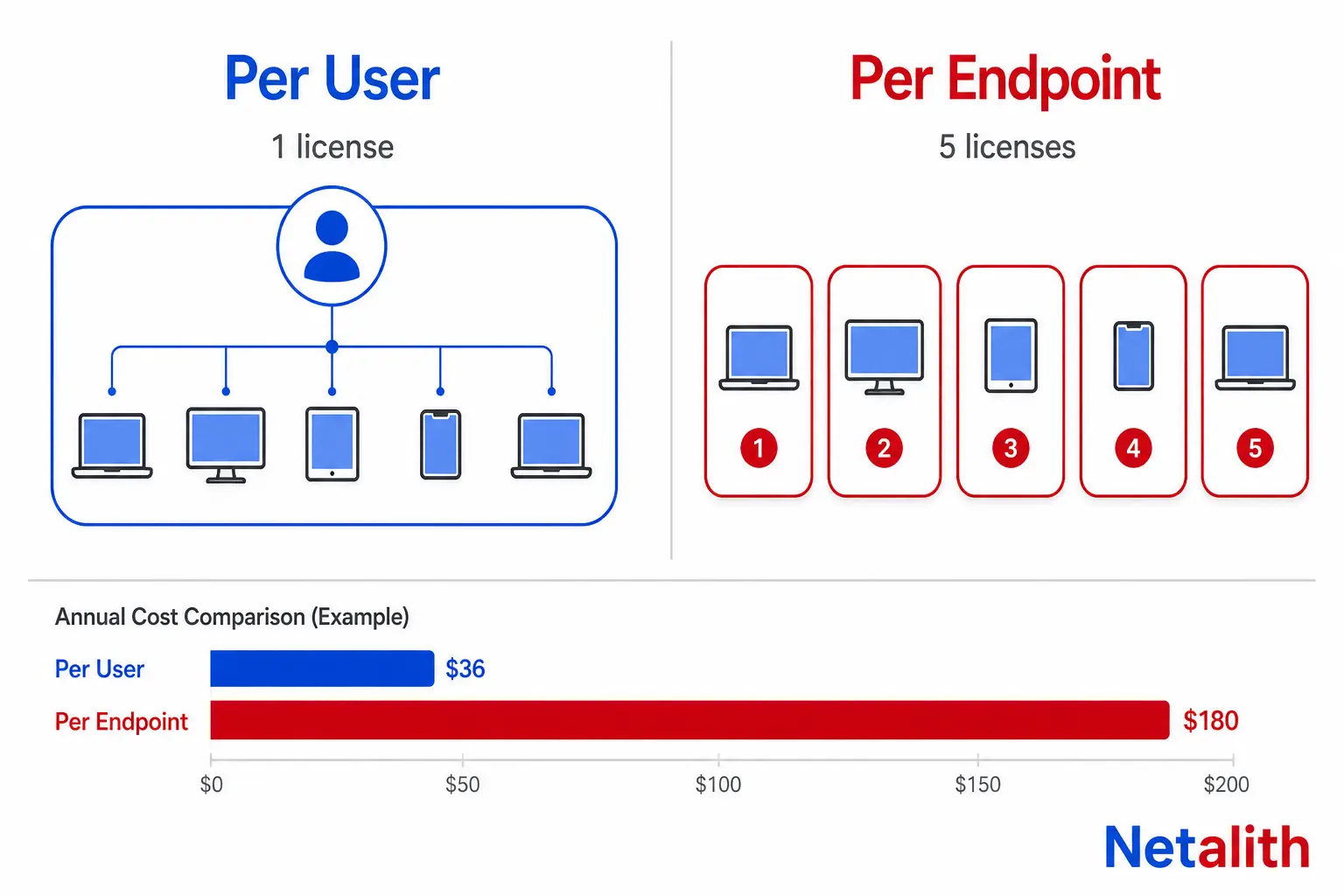
- L'unité de facturation. Microsoft facture par utilisateur, et une licence utilisateur couvre jusqu'à cinq appareils. SentinelOne facture par endpoint. Dans une flotte où les collaborateurs disposent d'un ordinateur portable et d'un téléphone, cette seule différence a plus d'impact sur la facture que la remise que vous obtiendrez.
- La place du produit dans votre environnement. Defender fait partie d'un écosystème Microsoft 365. Si vous payez déjà pour Business Premium ou E5, l'EDR pour endpoints est déjà compris dans vos coûts. SentinelOne est une plateforme autonome qui reste indépendante de l'écosystème si vous quittez Microsoft, et qui ne suppose pas l'utilisation d'Entra ID et d'Intune.
- La conservation des données et les services managés. Le niveau que la plupart des acheteurs choisissent chez SentinelOne conserve par défaut 14 jours de données. Les offres endpoint de Microsoft conservent les données pendant plusieurs mois. La chasse aux menaces managée et le MDR sont des options payantes chez les deux éditeurs.
En bref : si votre organisation est standardisée sur Microsoft 365 et ne dispose pas d'une équipe dédiée aux opérations de sécurité, Defender l'emporte largement sur le coût et l'intégration. Si votre environnement est mixte ou non-Microsoft, si vous avez besoin d'une conservation longue dès l'offre d'entrée de gamme, ou si vous voulez un fournisseur EDR qui ne soit pas aussi votre fournisseur d'identité, de messagerie et de système d'exploitation, SentinelOne justifie son prix supérieur. Voici les éléments qui l'expliquent.
Ce qui a changé dans le comparatif de 2026
La plupart des comparatifs SentinelOne-Microsoft Defender encore en circulation étaient exacts en 2024, mais ne le sont plus aujourd'hui. Quatre éléments ont évolué.
- Microsoft a renommé et reconditionné son module de sécurité. Ce que les acheteurs connaissaient sous le nom d'E5 Security add-on est désormais commercialisé sous le nom de Microsoft Defender Suite, au tarif de 12,00 $ par utilisateur et par mois en complément de Microsoft 365 E3. La principale page tarifaire de Defender met maintenant en avant cette suite et Microsoft 365 E5, et n'affiche plus les tarifs autonomes de Defender for Endpoint Plan 1 et Plan 2. Ces références autonomes existent toujours via des partenaires ; elles ne constituent simplement plus l'offre que Microsoft met en avant.
- Une suite équivalente est désormais disponible pour les petites entreprises. Defender Suite for Microsoft 365 Business Premium coûte 10,00 $ par utilisateur et par mois, ou 15,00 $ avec Purview Suite. C'est une évolution importante : les PME peuvent désormais accéder à une couverture de niveau XDR sans passer aux licences d'entreprise.
- La page tarifaire publique de SentinelOne a changé de présentation. Elle met désormais en avant trois niveaux : Singularity Complete à 179,99 $ par endpoint et par an, Singularity Commercial à 229,99 $, et Enterprise sur devis. Les anciens montants de 69,99 $ pour Core et 79,99 $ pour Control, repris dans tous les comparatifs, ne sont plus les prix mis en avant sur cette page.
- La mise à jour tarifaire de Microsoft 365 du a modifié le calcul des offres groupées. Microsoft 365 E5 est désormais affiché à 60,00 $ par utilisateur et par mois ; Business Premium reste à 22,00 $. Tout modèle de coût total établi avant juillet 2026 est obsolète.
Tarifs de SentinelOne et Microsoft Defender comparés
Voici les tarifs catalogue publiés sur les pages tarifaires respectives des éditeurs, en dollars américains, avec un engagement annuel. SentinelOne précise que les prix affichés concernent 5 à 100 postes de travail et que tous les achats passent par un partenaire agréé, dont les tarifs prévalent en cas de conflit. Considérez les deux colonnes comme des plafonds.
| Microsoft Defender | SentinelOne Singularity | |
|---|---|---|
| Unité de facturation | Par utilisateur, jusqu'à 5 appareils par licence | Par endpoint |
| Niveau EDR d'entrée de gamme | Defender for Business, 3,00 $ par utilisateur et par mois (300 utilisateurs maximum) | Singularity Complete, 179,99 $ par endpoint et par an (environ 15,00 $ par mois) |
| Niveau supérieur | Defender Suite for Business Premium, 10,00 $ par utilisateur et par mois | Singularity Commercial, 229,99 $ par endpoint et par an |
| Offre entreprise | Defender Suite avec E3, 12,00 $ par utilisateur et par mois, ou Microsoft 365 E5 à 60,00 $ par utilisateur et par mois | Singularity Enterprise, sur devis uniquement |
| Conservation des données par défaut | Plusieurs mois, et non plusieurs jours (Defender Suite for Business Premium indique 6 mois) | 14 jours avec Complete, 90 jours avec Commercial |
| Serveurs | Licenciés séparément ; les serveurs Defender for Business coûtent 3 $ par instance de serveur | Licenciés comme des endpoints au tarif du niveau choisi |
| Détection et réponse managées | Defender Experts, facturé séparément | Option avec Complete ; chasse aux menaces managée incluse à partir de Commercial |
| Essai gratuit | 30 jours, en libre-service | Demande de démonstration, sans essai public en libre-service |
Le tableau masque l'asymétrie la plus importante. Il faut donc l'énoncer clairement : une licence Microsoft à 3 $ par utilisateur et une licence SentinelOne à 15 $ par endpoint ne mesurent pas la même chose. Un utilisateur équipé d'un ordinateur portable, d'un ordinateur de bureau et d'un téléphone consomme une licence Microsoft et trois licences SentinelOne. Toute comparaison qui oppose 3 $ à 15 $ et parle d'un écart de cinq fois sous-estime l'écart pour les flottes riches en appareils, et le surestime pour les entreprises où chaque personne ne possède exactement qu'une seule machine.
Taux de détection de SentinelOne et Microsoft Defender : ce que montrent réellement les données
C'est ici que la plupart des comparatifs donnent discrètement une fausse impression de certitude. Voici l'état réel des informations publiques en 2026.
MITRE ne dispose d'aucune donnée récente de comparaison directe entre les deux produits
La dernière campagne ayant évalué les deux produits ensemble est MITRE ATT&CK Evaluations Enterprise 2024. Elle simulait les ransomwares LockBit et CL0P sur Windows et Linux, ainsi que des activités liées à la RPDC sur macOS, au cours de 16 étapes et 80 sous-étapes. C'était également la première campagne à injecter une activité légitime en arrière-plan afin de comptabiliser les faux positifs. Vingt et un éditeurs y ont participé, dont Microsoft et SentinelOne.
Pour la campagne de 2025, publiée en décembre 2025, Microsoft, SentinelOne et Palo Alto Networks se sont tous retirés, invoquant chacun le coût en ressources de la participation. Onze éditeurs ont été évalués sur des scénarios liés à Scattered Spider et Mustang Panda. Aucun des deux produits comparés ici n'y figure. Ainsi, tout article de 2026 qui cite les « derniers résultats MITRE » pour SentinelOne ou Defender s'appuie sur des données vieilles de deux ans, qu'il le précise ou non.
Les laboratoires commerciaux testent l'un des deux produits, mais pas les deux
Le Business Security Test du premier semestre 2026 d'AV-Comparatives a couvert 16 éditeurs, dont Microsoft. SentinelOne n'en faisait pas partie. SentinelOne ne participe pas régulièrement aux campagnes commerciales Business Security Test, ce qui signifie qu'il n'existe actuellement aucun test récent, contrôlé et réalisé par un tiers qui confronte ces deux produits au même échantillon.
Interprétez les pourcentages des éditeurs en tenant compte de la configuration
La propre affirmation de SentinelOne pour 2024 fait état d'une détection de 100 % sans délai et de 88 % d'alertes en moins que la médiane des participants. Allie Mellen, de Forrester, a publiquement rappelé que les affirmations de détection à 100 % dans les évaluations ATT&CK ne doivent pas être prises au pied de la lettre, car les éditeurs présentent certains résultats de manière sélective et activent des paramètres qu'aucun environnement de production ne laisserait fonctionner de cette façon.
La même réserve s'applique aux résultats de laboratoire de Microsoft, mais dans l'autre sens. AV-Comparatives publie la configuration demandée par chaque éditeur, et la version de Microsoft testée était optimisée : délai étendu pour la protection cloud, protection contre les applications potentiellement indésirables activée, envoi de tous les échantillons et extension Defender installée dans Chrome. Ce sont des paramètres raisonnables, mais ils ne correspondent pas à ceux d'un tenant non administré par défaut. Un Defender optimisé et un Defender par défaut sont deux produits différents, et cet écart dépend de votre configuration plutôt que de l'éditeur.
Conclusion pratique : n'achetez aucun des deux produits en vous fondant sur un pourcentage de détection en 2026. Il n'existe pas de chiffre récent permettant une comparaison directe. Choisissez en fonction de l'architecture, de la conservation des données, du coût d'exploitation et de la capacité réelle de votre équipe à administrer la console.
SentinelOne ou Microsoft Defender pour 50 endpoints : calcul réel
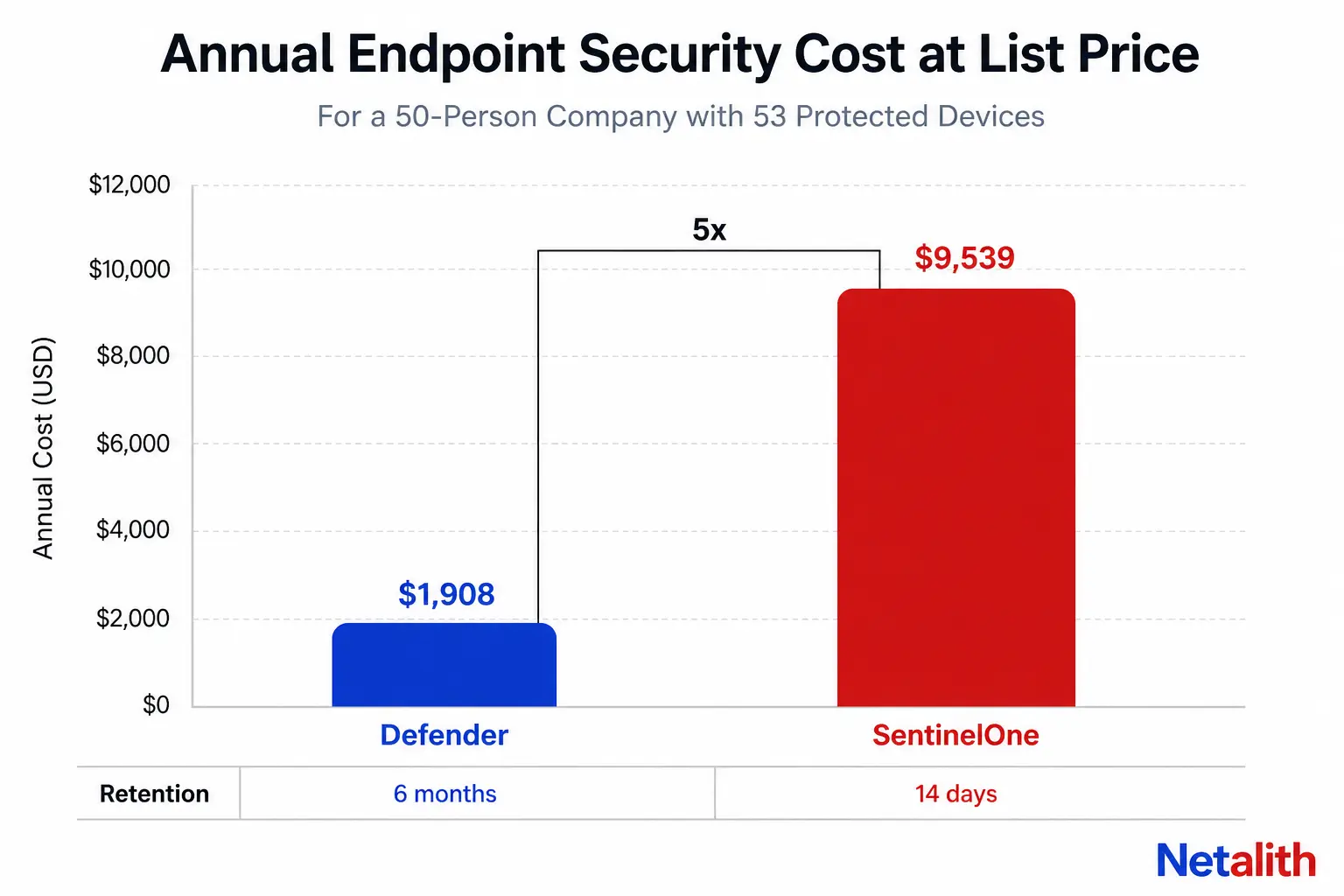
Prenons une flotte concrète : 50 salariés, 50 ordinateurs portables Windows, 3 serveurs Windows, un responsable informatique polyvalent et aucune équipe dédiée aux opérations de sécurité. Tarifs catalogue, engagement annuel, avant toute remise accordée par un partenaire.
| Poste | Option Microsoft | Option SentinelOne |
|---|---|---|
| Licences endpoints | 50 utilisateurs x 3,00 $ x 12 = 1 800 $ | 50 endpoints x 179,99 $ = 8 999,50 $ |
| Serveurs | 3 x 3,00 $ x 12 = 108 $ | 3 x 179,99 $ = 539,97 $ |
| Total annuel | 1 908 $ | 9 539,47 $ |
| Coût effectif par appareil protégé | 36 $ par utilisateur et par an, couvrant jusqu'à 5 appareils chacun | 179,99 $ par appareil et par an |
| Conservation des données incluse | Plusieurs mois | 14 jours |
L'écart est d'environ cinq fois au tarif catalogue, et il s'accentue plutôt qu'il ne se réduit dans la réalité. Si ces mêmes 50 personnes reçoivent un téléphone professionnel, le montant Microsoft ne change pas, car le deuxième appareil est compris dans la même licence utilisateur et Defender for Business couvre déjà Windows, macOS, iOS et Android. Ajoutez 50 appareils du côté de SentinelOne et vous augmentez la facture de 8 999,50 $.
Deux nuances importantes. Premièrement, le montant SentinelOne est un tarif catalogue ; le prix négocié avec un partenaire dans le cadre d'un engagement pluriannuel et d'un volume supérieur sera sensiblement plus bas, mais 50 licences vous donnent peu de poids pour l'obtenir. Deuxièmement, le montant Microsoft suppose que vous savez réellement administrer le tenant. Defender for Business est volontairement simplifié, avec un assistant de déploiement et des stratégies prêtes à l'emploi, mais un tenant mal configuré dont personne ne consulte les alertes ne représente pas une protection à 1 908 $. Intégrez la différence au temps de travail de quelqu'un plutôt que de la considérer comme une économie.
SentinelOne ou Microsoft Defender pour les petites entreprises
Pour les entreprises de moins de 300 utilisateurs, l'offre de Microsoft destinée aux PME est difficile à battre financièrement, et ses limites sont suffisamment précises pour être vérifiées en une après-midi.
- Defender for Business, à 3,00 $ par utilisateur et par mois, est limité à 300 utilisateurs, avec jusqu'à cinq appareils par utilisateur et aucun nombre minimal d'appareils. Il inclut un EDR avec interruption automatique des attaques, investigation et correction automatisées, gestion des vulnérabilités et antivirus nouvelle génération, et pas seulement un antivirus classique.
- Microsoft 365 Business Premium, à 22,00 $ par utilisateur et par mois, inclut directement Defender for Business, ainsi qu'Intune Plan 1, Entra ID Plan 1 et Defender for Office 365 Plan 1. Si vous utilisez Business Standard et envisagez de renforcer la sécurité des endpoints, comparez le passage à Premium avec l'achat d'un EDR autonome : le coût marginal de la suite de sécurité est moins élevé qu'il n'y paraît.
- La limite de 300 utilisateurs est appliquée au niveau du tenant, et non indicative. Si vous êtes en passe de la dépasser, préparez la migration vers les licences d'entreprise avant le renouvellement, et non après.
SentinelOne reste pertinent pour une petite entreprise dans trois cas : votre parc est principalement composé de macOS ou de Linux et Microsoft 365 n'est pas au cœur de votre environnement ; vous avez une exigence de conformité ou de cyberassurance imposant une conservation forensique plus longue que celle de votre niveau Microsoft, et les 90 jours de Commercial vous conviennent ; ou vous souhaitez que votre fournisseur endpoint soit indépendant du fournisseur de plateforme auquel vous confiez également le système d'exploitation et l'identité. Ce dernier argument relève de la gouvernance plutôt que de la technique, mais c'est une raison légitime de payer davantage.
SentinelOne ou Microsoft Defender pour les MSP
Pour les fournisseurs de services managés, la comparaison prend une autre forme : la question n'est pas de savoir quel produit protège le mieux, mais lequel peut être exploité de manière rentable sur des dizaines de tenants.
| Critère | Microsoft Defender | SentinelOne |
|---|---|---|
| Gestion multitenant | Microsoft 365 Lighthouse, pour les partenaires du programme CSP, avec vues inter-tenants des incidents et alertes et stratégies de référence | Gestion multitenant et contrôle d'accès basé sur les rôles dans chaque niveau publié |
| Compatibilité avec les clients | Simple uniquement si le client utilise déjà un tenant Microsoft 365 | Fonctionne de la même manière quelle que soit la suite de productivité du client |
| Modèle de marge | Marge réduite par utilisateur sur une référence à 3 $ ; la rentabilité vient du service managé qui l'accompagne | Le prix supérieur par endpoint laisse davantage de marge, avec en plus un programme MSSP |
| Homogénéité du parc | Les clients utilisant différents niveaux Microsoft disposent de capacités Defender sensiblement différentes | Un niveau, une console et les mêmes capacités pour tous les clients |
Le facteur décisif est généralement l'arbitrage entre homogénéité et coût. Un MSP exclusivement Microsoft peut tout gérer via Lighthouse avec un coût de licence presque nul et facturer la main-d'œuvre. Un MSP dont le portefeuille est hétérogène doit maintenir plusieurs configurations Defender différentes dans des tenants utilisant des niveaux de licence variés ; cette charge opérationnelle est précisément ce que la tarification homogène de SentinelOne permet d'éliminer. Évaluez le temps d'ingénierie, pas seulement le nombre de licences.
Coût total de possession : les postes qui font varier le montant
Le prix des licences est la partie du coût total de possession que les deux éditeurs publient, mais c'est rarement elle qui décide du budget. Voici les éléments qui le font réellement varier.
- La conservation au-delà de la durée par défaut. Les 14 jours de SentinelOne Complete sont courts pour un incident qui ne serait pas détecté pendant quinze jours, ce qui arrive dans la plupart des cas. Leur prolongation est une option payante, avec une tarification à la consommation pour le data lake que SentinelOne ne publie pas. Si vous avez une obligation réglementaire de conservation, chiffrez ce poste avant de comparer les niveaux, et non après.
- Les serveurs. Microsoft n'inclut jamais les serveurs dans une licence utilisateur ; Defender for Business servers est une option distincte à 3 $ par instance de serveur, tandis que la couverture des serveurs en entreprise passe par Defender for Cloud. SentinelOne facture le tarif du niveau choisi pour chaque serveur. Un environnement riche en serveurs peut modifier le classement.
- La détection managée. Aucun des deux niveaux d'entrée de gamme ne comprend une couverture humaine 24 h/24 et 7 j/7. Microsoft vend Defender Experts ; SentinelOne propose la chasse aux menaces managée et le MDR comme options avec Complete. Si vous ne disposez pas d'une équipe chargée des opérations de sécurité, ce poste n'est pas facultatif et il est souvent plus élevé que le prix de la licence.
- Les heures d'analyste. Le volume d'alertes que vous pouvez absorber est une contrainte réelle. C'est le seul aspect pour lequel le résultat 2024 de SentinelOne sur le rapport signal/bruit mérite d'être considéré comme une indication, même si le pourcentage ne peut pas être vérifié aujourd'hui.
- Les licences que vous possédez déjà. Si votre organisation utilise Microsoft 365 E5 à 60 $ par utilisateur et par mois, Defender for Endpoint Plan 2 est déjà payé. Le coût marginal de l'EDR Microsoft dans cet environnement est nul, et SentinelOne doit justifier son prix complet face à une solution gratuite, et non face à une offre à 3 $.
Comment décider en une après-midi
Répondez à ces quatre questions dans l'ordre : le choix s'impose généralement de lui-même.
- Que possédez-vous déjà ? Vérifiez si votre niveau Microsoft 365 inclut déjà Defender for Business ou Defender for Endpoint Plan 2. Si c'est le cas, exploitez-le correctement pendant 30 jours et mesurez les résultats avant d'acheter quoi que ce soit.
- Comptez les appareils, pas les personnes. Multipliez le nombre d'appareils par 179,99 $ et le nombre d'utilisateurs par 36 $. Le rapport entre ces deux montants correspond à votre véritable écart de prix, qui dépend de votre parc.
- Exprimez votre besoin de conservation en jours. Si la réponse dépasse 14 jours, SentinelOne Complete n'est pas le niveau que vous compariez et l'écart de prix se réduit.
- Identifiez la personne qui consultera les alertes. Si cette personne n'existe pas, les deux produits constituent un mauvais achat tant que vous n'avez pas ajouté la détection managée au devis.
Testez ensuite les deux solutions. Microsoft propose un essai en libre-service de Defender for Business pendant 30 jours ; SentinelOne organise des déploiements de preuve de concept par l'intermédiaire de ses partenaires. Deux semaines de vos propres données de télémétrie valent mieux que n'importe quel tableau comparatif, y compris celui-ci.
FAQ
Questions fréquentes
Microsoft Defender est-il suffisamment performant pour remplacer SentinelOne ?
Pour un environnement Microsoft 365 présentant un niveau de risque standard, oui. Defender for Business et Defender for Endpoint Plan 2 sont des solutions EDR complètes avec investigation automatisée, interruption des attaques et gestion des vulnérabilités, et non des antivirus allégés. Les cas où ils ne suffisent pas sont précis : les parcs où Windows est minoritaire, les exigences imposant un fournisseur de sécurité indépendant du fournisseur de plateforme, ou les workflows qui dépendent de fonctionnalités de SentinelOne comme son rollback et son modèle d'investigation Storyline. Fondez votre décision sur ces critères plutôt que sur un pourcentage de détection, car aucun test indépendant récent ne compare directement les deux produits.
Combien coûte SentinelOne par endpoint par rapport à Microsoft Defender ?
SentinelOne affiche Singularity Complete à 179,99 $ par endpoint et par an, et Singularity Commercial à 229,99 $, pour des déploiements de 5 à 100 postes de travail vendus par l'intermédiaire de partenaires. Microsoft affiche Defender for Business à 3,00 $ par utilisateur et par mois, soit 36 $ par an, avec une couverture allant jusqu'à cinq appareils par utilisateur. Comparer 180 $ par appareil à 36 $ par utilisateur sous-estime l'écart dans les flottes riches en appareils, car la licence Microsoft ne varie pas avec le nombre d'appareils tant que vous ne dépassez pas cinq appareils par personne.
Pourquoi les résultats MITRE ATT&CK de 2025 n'incluent-ils pas SentinelOne ni Microsoft Defender ?
Les deux éditeurs se sont retirés de la campagne Enterprise 2025, tout comme Palo Alto Networks, en invoquant le coût en ressources de la participation. Microsoft a annoncé son retrait à la mi-2025 et SentinelOne l'a confirmé en septembre 2025. La campagne de 2025 a évalué onze autres éditeurs sur des scénarios liés à Scattered Spider et Mustang Panda. La dernière campagne MITRE comprenant les deux produits est Enterprise 2024 ; tout comparatif actuel qui cite MITRE pour ces deux solutions s'appuie donc sur des données de 2024.
Combien d'appareils une licence Microsoft Defender couvre-t-elle ?
Les licences Microsoft Defender for Endpoint et Defender for Business couvrent jusqu'à cinq appareils clients par utilisateur, sur Windows, macOS, iOS et Android. Les serveurs sont exclus et nécessitent une licence distincte. Defender for Business est limité à 300 utilisateurs par tenant, sans nombre minimal d'appareils, et l'option serveurs est facturée 3 $ par instance de serveur.
Peut-on utiliser SentinelOne et Microsoft Defender en même temps ?
En partie. Sous Windows, Microsoft Defender Antivirus passe en mode passif lorsqu'un autre antivirus en temps réel s'enregistre sur la machine ; un agent SentinelOne et l'antivirus Microsoft intégré peuvent donc coexister sur le même ordinateur. L'exécution simultanée de deux agents EDR actifs disposant de toutes leurs capacités de réponse est différente et ne doit être réalisée qu'avec les recommandations des deux éditeurs, car les actions de correction concurrentes et la télémétrie dupliquée provoquent plus d'incidents qu'elles n'en résolvent. Lors d'une migration, planifiez soigneusement la période de chevauchement au lieu de laisser les deux solutions entièrement activées indéfiniment.
Quel est le meilleur rapport qualité-prix pour une entreprise de 50 endpoints ?
Au tarif catalogue, Microsoft est environ cinq fois moins cher pour 50 utilisateurs et trois serveurs : environ 1 908 $ par an contre environ 9 539 $ pour SentinelOne Singularity Complete. L'écart se réduit si vous avez besoin d'une conservation supérieure aux 14 jours de SentinelOne Complete, si votre parc est principalement non-Windows ou si vous ne disposez d'aucun tenant Microsoft 365 sur lequel vous appuyer. Il augmente si vos utilisateurs possèdent plusieurs appareils, car Microsoft facture par utilisateur et non par appareil.