TCP vs UDP: Differences, Reliability vs Latency, and When to Use Each Transport Protocol
Beginner-friendly guide comparing TCP vs UDP, explaining how each works, key differences, performance tradeoffs, and when to use each with real-world protocol and port examples.

Long Nguyen
Fullstack Developer · AI Engineer · Researcher
Introduction
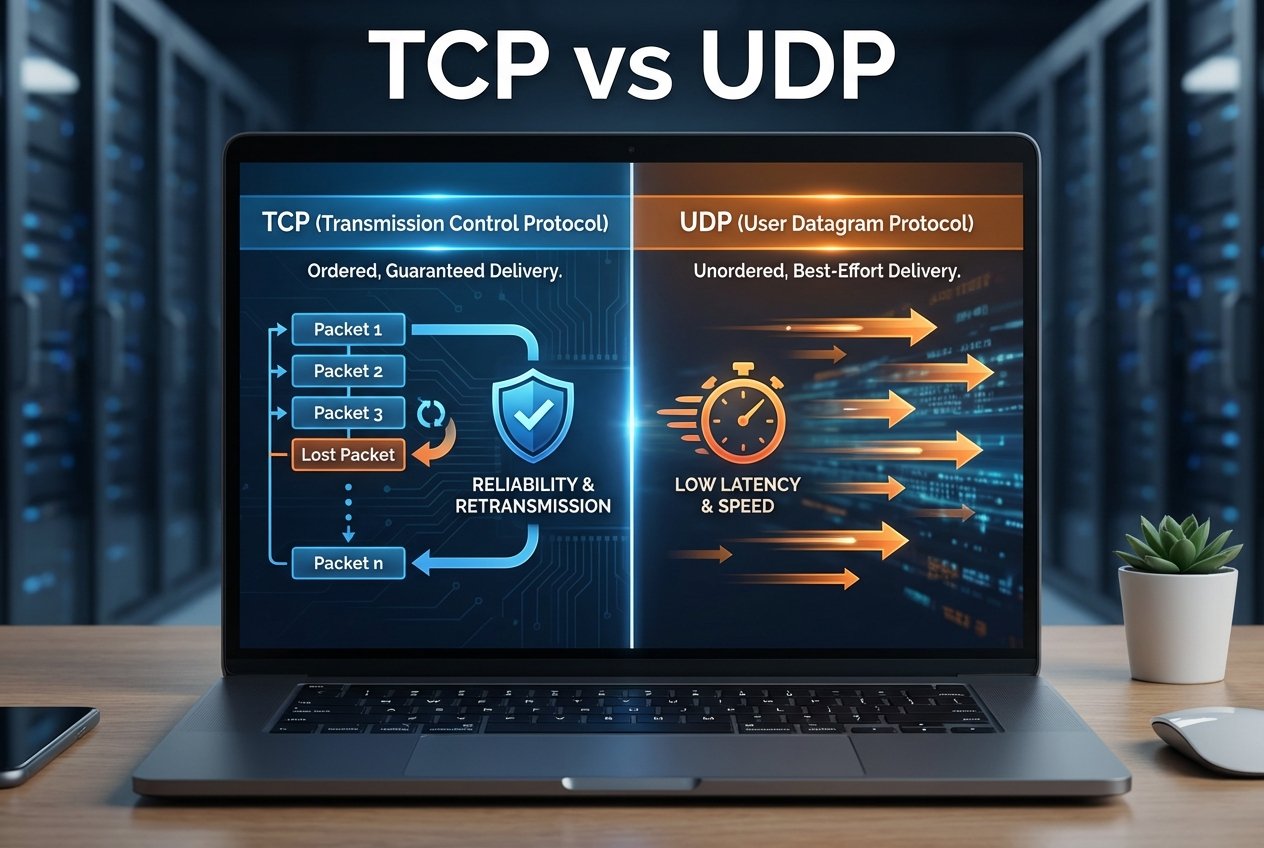
TCP vs UDP is one of the most important comparisons in networking fundamentals and transport layer protocols. If you’re new to computer networking basics, understanding how TCP and UDP handle reliability, ordering, and speed will help you choose the right protocol for real applications like web browsing, DNS, VoIP, gaming, and streaming.
This guide explains where these protocols fit in the OSI model vs TCP/IP model, how each works, and how to think about the latency vs reliability tradeoff when designing or troubleshooting systems.
What Is TCP vs UDP in the Transport Layer?
TCP (Transmission Control Protocol) and UDP (User Datagram Protocol) are transport protocols that carry data between applications running on different hosts. In the TCP/IP model, they live in the transport layer; in the OSI model, they map roughly to Layer 4.
The transport layer is responsible for:
- Port addressing so the right application receives the data (e.g., DNS, HTTP, HTTPS)
- Data units: TCP uses segments (byte-stream semantics), UDP uses a UDP datagram (message-oriented)
- Delivery behavior: reliability, ordering, and packet loss behavior depend heavily on whether you use TCP or UDP
In simple terms: TCP is connection-oriented, while UDP is connectionless.
How TCP Works (Reliable, Ordered Delivery
TCP provides a reliable, ordered byte stream. It uses retransmission, ordering (sequence numbers), flow control, and congestion control to deliver data correctly across imperfect networks.
Connection establishment and teardown (three-way handshake
TCP creates a connection using the three-way handshake:
Client → Server: SYN
Server → Client: SYN-ACK
Client → Server: ACK
Connections typically close with FIN/ACK. An RST can terminate a connection abruptly. This connection state enables TCP’s reliability and ordered delivery.
Reliability mechanisms (ACKs, ordering, retransmission
TCP reliability relies on:
- ACKs to confirm received data
- Sequence numbers to maintain ordering
- Retransmission timers and duplicate ACK signals to recover from loss
- Sliding window flow control so a fast sender doesn’t overwhelm a receiver
When loss occurs, TCP retransmits missing data to preserve correctness. The downside is that retransmission and congestion recovery can increase latency—an important part of the latency vs reliability tradeoff.
How UDP Works (Fast, Connectionless Datagrams
UDP is a lightweight, connectionless protocol that sends independent messages called datagrams. UDP does not provide built-in retransmission, ordering, or flow control; it’s often described as stateless transmission at the transport layer.
Stateless transmission and UDP datagrams
Each UDP datagram stands alone. Because there’s no handshake and the header is small, UDP typically has lower overhead and can reduce end-to-end delay in real-time scenarios.
The tradeoff is application-visible packet loss behavior: datagrams may be dropped, duplicated, or arrive out of order, and UDP won’t correct that automatically.
When UDP is preferred (low-latency, real-time apps
UDP is commonly chosen when timely delivery matters more than perfect reliability—especially when the application can tolerate or conceal loss:
- DNS queries (fast request/response)
- VoIP and real-time communications (latency and jitter matter most)
- Online gaming (real-time state updates)
- Live streaming scenarios where delay is worse than minor artifacts
- SNMP monitoring queries in many environments
Key Differences: TCP vs UDP
These are the most practical TCP and UDP comparison differences to consider when selecting a transport protocol.
Connection-oriented vs connectionless
TCP is connection-oriented: it maintains per-connection state and negotiates a session before data transfer. UDP is connectionless: no session setup, and each datagram is independent. This is a central point in any TCP and UDP comparison.
Ordering and retransmission (packet loss behavior
TCP provides in-order delivery and retransmits lost segments. UDP provides neither ordering nor retransmission by default. On UDP, if ordering or reliability is required, the application (or a higher-level protocol) must provide it.
Congestion control and flow control
TCP includes congestion control and flow control to adapt to network conditions and receiver capacity. UDP has no built-in congestion control—applications must be careful to avoid overwhelming the network, especially at scale.
Overhead, header size, and performance implications
UDP’s smaller header and lack of connection state reduce overhead and can improve performance in latency-sensitive paths. TCP’s additional mechanisms add overhead but make delivery more robust, especially when the network is lossy or congested.
When to Use TCP vs UDP (Practical Examples
When to use TCP and UDP comparison comes down to what your application values most: correctness and completeness (TCP) or speed and timeliness (UDP).
Use TCP — web, email, file transfer, databases
- HTTP/HTTPS (TCP 80/443) for reliable delivery of web content and encrypted sessions
- Email protocols like SMTP/IMAP/POP3 for message integrity
- File transfer (FTP, SFTP) where corruption or missing bytes are unacceptable
- Database connections that depend on ordered, reliable streams
Use UDP — DNS, VoIP, gaming, streaming
- DNS (UDP 53) for most lookups; TCP 53 for zone transfers or large responses
- VoIP and real-time media where retransmission delays hurt user experience
- Gaming where frequent state updates matter more than perfect delivery
- Streaming workflows that prioritize low latency and can smooth loss with buffering
Performance Tradeoffs: Latency vs Reliability
The latency vs reliability tradeoff is the core decision point. TCP increases reliability using retransmission and congestion control, but those features can add delay when packets are lost or networks are congested. UDP minimizes protocol-added delay, but the application must tolerate loss, handle reordering, or add its own recovery strategy.
Also consider jitter and effective throughput: TCP can achieve strong throughput on stable links, while UDP can maintain smoother real-time delivery when paired with buffering, pacing, or error concealment.
Common Application Protocols and Ports (Examples
Knowing TCP vs UDP ports and protocols helps with troubleshooting, firewall rules, and NAT policies. Common examples include:
- TCP 80 (HTTP), TCP 443 (HTTPS)
- TCP 25 (SMTP), TCP 110 (POP3), TCP 143 (IMAP)
- UDP 53 (DNS queries), TCP 53 (DNS zone transfer / fallback)
- UDP 123 (NTP), UDP 161 (SNMP), UDP 5060 (SIP signaling)
Implementation Tips for Developers and Admins
- Socket programming: use
SOCK_STREAMfor TCP andSOCK_DGRAMfor UDP. - NAT and port forwarding: TCP mappings are stateful; UDP mappings often expire faster—review NAT timeouts for UDP-heavy apps.
- Error handling: with UDP, plan for loss and reordering (sequence numbers, timeouts, or application-level acknowledgments).
- Retransmission strategies: tune TCP timeouts carefully, and for UDP consider forward error correction or selective retries if the use case requires higher reliability.
Summary: TCP vs UDP — Which Should You Choose?
TCP vs UDP is ultimately a choice between reliability and timeliness. Pick TCP for ordered delivery and correctness (web, email, file transfer, databases). Pick UDP for low-latency, real-time delivery where small losses are acceptable (DNS, VoIP, gaming, some streaming). If your needs fall in between, you may combine UDP with application-level reliability features.
FAQs
Is TCP always more reliable than UDP?
TCP is designed to be reliable at the transport layer (ordering and retransmission). UDP can be reliable only if the application or a higher-level protocol adds reliability mechanisms.
Which is better for streaming: TCP or UDP?
It depends on the streaming goal. For low-latency live delivery, UDP is often preferred. For buffered playback where completeness matters more than delay, TCP can work well.
Is UDP good for gaming?
Yes for many real-time games, because UDP avoids retransmission delays and can keep updates timely even with occasional loss. In summary, a strong TCP vs UDP strategy should stay useful long after publication.