How to Save Money on Baby Essentials: Practical Ways
Learn how to save money on baby essentials with smarter diaper, formula, food and gear choices, plus safety tips for used items and car seats.
Drake Nguyen
Founder & Research Lead
How to Save Money on Baby Essentials Without Cutting Necessities
Learning how to save money on baby essentials starts with deciding what your baby genuinely needs, rather than relying only on coupons or chasing every promotion. A deliberate plan can reduce costs without sacrificing safety, nutrition, or comfort.
The biggest savings usually come from reviewing each category separately. Recurring supplies, feeding, baby gear, safety purchases, and registry discounts all offer different opportunities. Expensive upgrades often address parental anxiety or convenience more than a baby's basic needs.
- Identify must-have items before shopping or creating a registry.
- Compare the total cost of ownership, including refills, laundry, storage, and replacement parts.
- Choose store brands, bulk purchases, or used items when quality and safety can be verified.
- Delay convenience upgrades until you know they solve a real problem.
Lower Diaper Costs and Wipe Spending
Diapers are one of the largest recurring baby expenses. Families may use roughly 2,500–3,000 diapers during the first year, so even a small per-diaper saving can add up quickly. Compare subscription-and-save offers, store brands, bulk packages, and available coupons rather than assuming the biggest package is the best value.
Disposable wipes can add approximately $150–$300 per year. Reusable cloth wipes can lower that cost when used at home, especially for diaper changes and messy hands. Wash them with other household laundry and keep a supply of disposable wipes for travel or situations where convenience matters most.
- Calculate the price per diaper, not just the package price.
- Check whether a subscription discount remains worthwhile after delivery fees or changing sizes.
- Use bulk buying only when you have storage space and expect to use the size before your baby outgrows it.
- Try reusable cloth wipes at home to reduce ongoing wipe spending.
Cloth Versus Disposable Diapers: Which Costs Less?
Cloth diapers typically require an upfront investment of about $200–$400, while disposable diapers create a higher cumulative cost over time. Depending on laundering, usage, and how long the system is used, cloth diapers may reduce total diaper spending by approximately 60–70%.
Those savings are not automatic. Include detergent, water, electricity, drying, storage, replacement pieces, and your time when comparing cloth versus disposable diapers. Childcare providers may not accept cloth, and disposable diapers are often simpler for travel, overnight use, or illness. The lower-cost choice is the one your household can use consistently.
| Option | Typical cost consideration | Practical factors |
|---|---|---|
| Cloth diapers | About $200–$400 upfront; potentially 60–70% lower total diaper spending | Requires laundering, storage, and planning |
| Disposable diapers | Higher cumulative cost, but subscriptions, store brands, and bulk purchases can help | Convenient for childcare, travel, and changing sizes |

Save on Formula, Baby Food, and Feeding Supplies
Cost-conscious feeding choices can preserve nutrition while reducing unnecessary spending. FDA-regulated store-brand formula and warehouse-club formula are nutritionally equivalent to name-brand formula for babies without special medical requirements. Ask your pediatrician before switching if your baby has allergies, feeding difficulties, or another individual need.
Once solids begin, plan for approximately $30–$50 per month for baby food and feeding supplies, depending on how much your baby eats and what equipment you already own. Homemade baby food purees can cost less than packaged options, but the calculation should include preparation time, storage, cleanup, and equipment.
- Compare store-brand and name-brand formula by price per ounce.
- Buy formula from a reliable retailer and follow preparation and storage directions.
- Use washable bibs and spoons that can serve through multiple stages.
- Combine homemade foods with convenient packaged options when that fits your schedule and budget.
When Homemade Baby Food Purees Actually Save Money
Homemade baby food purees are most economical when you prepare them from foods your family already buys. A blender or food processor may cost roughly $30–$150 before ingredients are included, so buying a dedicated appliance for occasional use may erase the expected savings.
Prepare small batches, portion them safely, and freeze servings when appropriate. Compare the ingredient cost with packaged food, then add the value of preparation, storage, cleanup, and wasted-food time. If making food becomes a demanding extra task, a combination of homemade and prepared foods may provide a better overall value.
Spend Less on Baby Gear and Technology
Baby gear savings come from prioritizing function over features. Used strollers, high chairs, and carriers can be sensible purchases when their condition, parts, and safety information are verifiable. Avoid paying for features that duplicate something you already own or that you may rarely use.
Travel-system bundles that pair a matching stroller and car seat often save approximately $100–$200 compared with buying the pieces separately. For monitors, a basic audio monitor may cost about $50 and cover the essential job, while an advanced video monitor may cost roughly $400. Extra sensors and app features can provide reassurance, but they are not automatically necessities.
- Prioritize items that solve a daily care or transport need.
- Compare bundle prices with separate prices, including accessories you would otherwise need to buy.
- Consider whether a feature improves safety or mainly adds convenience.
- Look for clean, complete used gear when its history and condition can be checked.
| Gear choice | Cost comparison | Best savings approach |
|---|---|---|
| Travel system | Often saves about $100–$200 versus separate purchases | Compare the bundle with the individual stroller and car-seat prices |
| Audio monitor | About $50 for basic monitoring | Choose it when sound alerts meet your needs |
| Advanced video monitor | May cost roughly $400 | Buy only if the additional features provide meaningful value |
Buying Used Baby Gear Safely
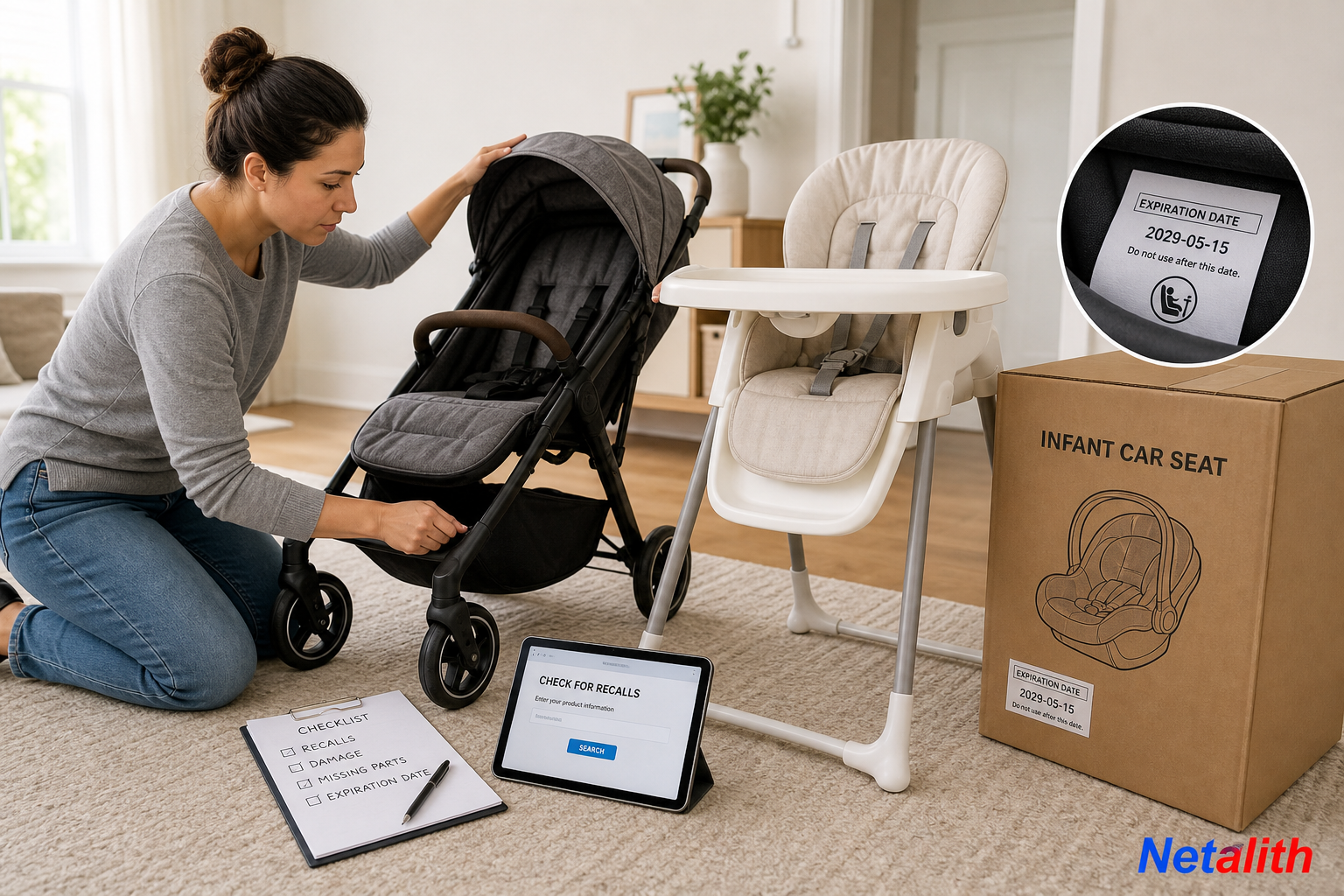
Buying used baby gear safely requires more than checking whether an item looks clean. Before paying, check for recalls, missing parts, cracks, broken fasteners, damage, difficult-to-clean materials, and available manufacturer instructions. Do not buy an item if you cannot identify its model or confirm that it is complete.
Strollers, high chairs, and carriers are common candidates for secondhand savings when inspected carefully. Ask how the item was stored and used, clean it according to its instructions, and replace worn parts only when the manufacturer provides approved replacements.
- Confirm the model, age, and recall status.
- Inspect frames, straps, buckles, wheels, trays, and attachment points.
- Reject gear with structural damage, missing safety parts, or an unknown cleaning history that cannot be addressed.
- Keep car seats out of the used-buying category: purchase them new because crash history is difficult to verify and seats typically expire after about six years.
Why Car Seat Expiration and Crash History Matter
Car seats face conditions that make secondhand purchases unusually risky. Temperature changes inside vehicles can degrade seat materials over time, even when the exterior looks undamaged. A seat involved in a crash may also have hidden damage.
- Check the expiration date printed on the seat or listed in its documentation.
- Confirm the model information and recall status.
- Review the manufacturer’s installation instructions.
- Do not use a seat with an unknown crash history, missing information, or an uncertain expiration date.
Use a Baby Registry to Reduce Upfront Costs
A registry works best as a baby registry essentials list, not a catalog of every product available. Add what your baby will need early, such as a safe sleep space, feeding basics, diapers, and a new car seat. This helps relatives contribute toward useful items instead of creating duplicates.
Many retailers offer a completion discount of approximately 10–20% on eligible items left near the end of the registry period. Check the retailer’s rules, timing, exclusions, and purchase limits before relying on the discount. High-cost necessities such as a car seat and crib can also be listed as group gifts so several relatives can share the cost.
- Build the registry around early needs and realistic quantities.
- Compare the completion discount with normal sale prices before purchasing.
- Use group-gift options for expensive, safety-critical necessities.
- Avoid adding products solely because they are popular or heavily promoted.
A Practical Baby Budget Checklist
Use this process before making purchases so your baby budget reflects both recurring expenses and one-time gear costs.
If you'd rather work from a ready-made template than build this checklist from scratch, the Baby Budget Planner Printable includes dedicated registry, nursery, and monthly expense tracking pages — so every diaper subscription decision, formula estimate, or used-gear purchase from this list has a place to actually get logged and compared against your budget.
- Estimate recurring costs for diapers, wipes, formula or food, and feeding supplies.
- Separate must-have purchases from convenience upgrades, and delay nonessential items until a real need appears.
- For each item, decide whether buying used, buying in bulk, choosing a store brand, or using a completion discount is appropriate.
- Reserve safety-critical purchases, especially the car seat, for new products with known dates, model information, and histories.
- Review the budget after the first few weeks and adjust purchases to your baby’s actual routine.