How to Make a Budget for Beginners: 4 Simple Steps
Learn how to make a budget for beginners with four practical steps, from tracking take-home pay to building a starter emergency fund.

Long Nguyen
Développeur fullstack · Ingénieur IA · Chercheur
How to Make a Budget for Beginners
Learning how to make a budget for beginners does not require a finance degree, specialized app, or complicated spreadsheet. A simple written plan can show you how much money comes in, where it goes, and what needs attention.
Budgeting directs your income toward short-, medium-, and long-term goals instead of leaving every purchase unexplained. This is especially useful if you are living paycheck to paycheck because even a basic plan can help you identify pressure points and create room for saving.
Step 1: Calculate Your Take-Home Pay
Start with the money you can actually use. Review recent paychecks and record your monthly take-home pay—the amount received after taxes, insurance, retirement contributions, and other deductions—not your gross salary.
If your income changes from month to month, use a conservative average based on recent months. This helps prevent you from budgeting against an unusually high income period.
Treat this figure as the total available for essential bills, flexible spending, debt payments, and saving.
- Add the post-tax income from each regular paycheck.
- Include reliable side income only if you can reasonably expect it.
- Use a lower, conservative monthly estimate for irregular income.
Step 2: Track Monthly Expenses
Next, learn how to track monthly expenses by keeping a spending log for one or two months. Record every purchase as it happens, including small transactions that are easy to overlook.
Include recurring bills, subscriptions, cash spending, debt payments, groceries, meals out, and occasional purchases. The goal is to create an honest snapshot of your current money management—not to change your behavior immediately.
Skipping this step is a common reason budgets fail. Without real spending information, it is easy to underestimate flexible expenses or forget annual and irregular costs.
- Record the date, amount, and type of every purchase.
- Include recurring bills and subscription charges.
- Track cash purchases and debt payments.
- Review the log for patterns without judging yourself.
Step 3: List Essential Bills and Housing Costs
Separate necessary expenses from flexible spending by listing your essential bills. Start with housing costs, utilities, food, insurance, transportation, minimum debt payments, and other expenses required for basic living.
Compare the total necessities with your take-home pay. When essential costs are roughly half of income or less, you generally have more room for savings goals and flexible spending. This is a diagnostic, not a guarantee that every household will fit the same pattern.
A common guideline is to keep housing costs below about 30% of income. Use that figure to identify pressure points rather than treating it as an absolute rule.
If essential costs are too high, look first for ways to reduce essential expenses before cutting all discretionary spending. Reviewing housing, transportation, insurance, utilities, and recurring services may reveal the largest opportunities.
- Housing and utilities
- Groceries and other basic food costs
- Insurance and healthcare
- Transportation
- Minimum debt payments and other required bills
Step 4: Assign Money to Needs, Wants, and Savings
Turn your expense data into a working budget by grouping each expense into needs, wants, or savings and debt goals. Do not overthink every category boundary: make a reasonable decision, then adjust it during your monthly review.
The 50/30/20 rule offers a useful starting reference. It assigns about 50% of take-home pay to needs, 30% to wants, and 20% to savings or debt goals.
| Category | Starting share | Examples |
|---|---|---|
| Needs | 50% | Housing, utilities, food, insurance, and transportation |
| Wants | 30% | Dining out, entertainment, hobbies, and nonessential shopping |
| Savings and debt goals | 20% | Emergency savings, retirement contributions, and extra debt payments |
The percentages can be adjusted to fit reality. If your essential expenses are high, you might begin with a 60/30/10 budget and gradually increase savings as your situation improves. The goal is a sustainable plan, not perfect numbers.

Build a Starter Emergency Fund
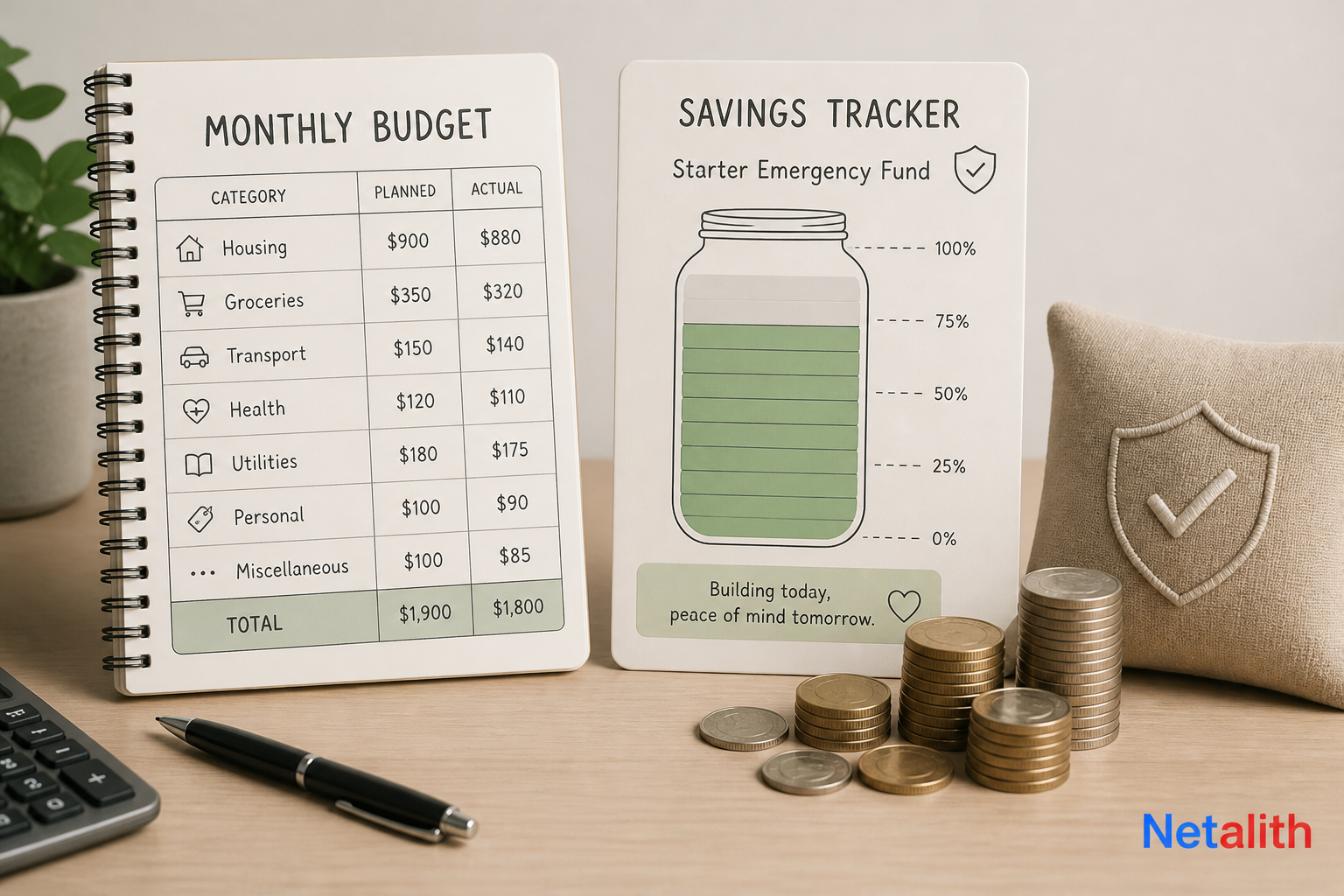
Once your budget is established, make a starter emergency fund your first savings priority before pursuing less urgent goals. Choose an initial target that feels achievable rather than waiting until you can save a large amount.
Automate a small contribution from each paycheck. Even modest deposits can build a useful cash buffer and reduce the need to rely on credit when an unexpected bill, repair, or loss of income occurs.
This fund supports the broader goal of moving away from living paycheck to paycheck by giving unplanned expenses a place in your financial plan.
- Choose a realistic starter target.
- Set up an automatic transfer after each paycheck.
- Keep emergency savings separate from everyday spending money.
- Replenish the fund after using it for a genuine emergency.
Review and Adjust Your Monthly Budget
A budget works best as a living document rather than a test you pass once. At least monthly, compare your actual spending with the amounts you planned.
Revise categories when your income, housing costs, bills, or priorities change. If you overspend, treat the result as information for the next version of the budget—not as a personal failure.
Use each review to find recurring expenses you can reduce and redirect the freed money toward savings, debt repayment, or another goal.
- Compare planned and actual spending.
- Identify categories that regularly exceed their limits.
- Update the budget after changes in income or bills.
- Redirect savings from reduced expenses toward your priorities.
FAQ
Questions fréquentes
What should I do if my essential expenses exceed 50% of take-home pay?
Treat the 50% figure as a diagnostic rather than a strict requirement. Review housing, transportation, insurance, utilities, and other recurring essentials first, then reduce or renegotiate costs where possible. Adjust wants and savings temporarily while working toward a more sustainable balance.
Is the 50/30/20 rule realistic for everyone?
No. It is a starting framework, not a universal requirement. Households with high housing costs, debt, or irregular income may need a different split, such as 60/30/10, and can increase savings gradually as their circumstances improve.
How long should I track expenses before making a budget?
Track spending for at least one full month so recurring bills and typical purchases are included. Two months can provide a more reliable picture, especially when expenses vary or some bills are paid less frequently.
How much should I save for a starter emergency fund?
Choose an initial amount that feels achievable within your current budget, then contribute automatically from each paycheck. Starting with a manageable target is more useful than delaying savings while waiting to afford a large emergency reserve.
How often should I review my budget?
Review it at least once a month by comparing planned amounts with actual spending. Also revisit it whenever your income, housing costs, bills, or financial priorities change.