AI Agent for Website: What It Handles 24/7 and What to Ask Before You Buy
An AI agent for your website can consult, recommend products and qualify leads 24/7. What it handles, what it costs, and the questions to ask before buying.

Long Nguyen
Développeur fullstack · Ingénieur IA · Chercheur
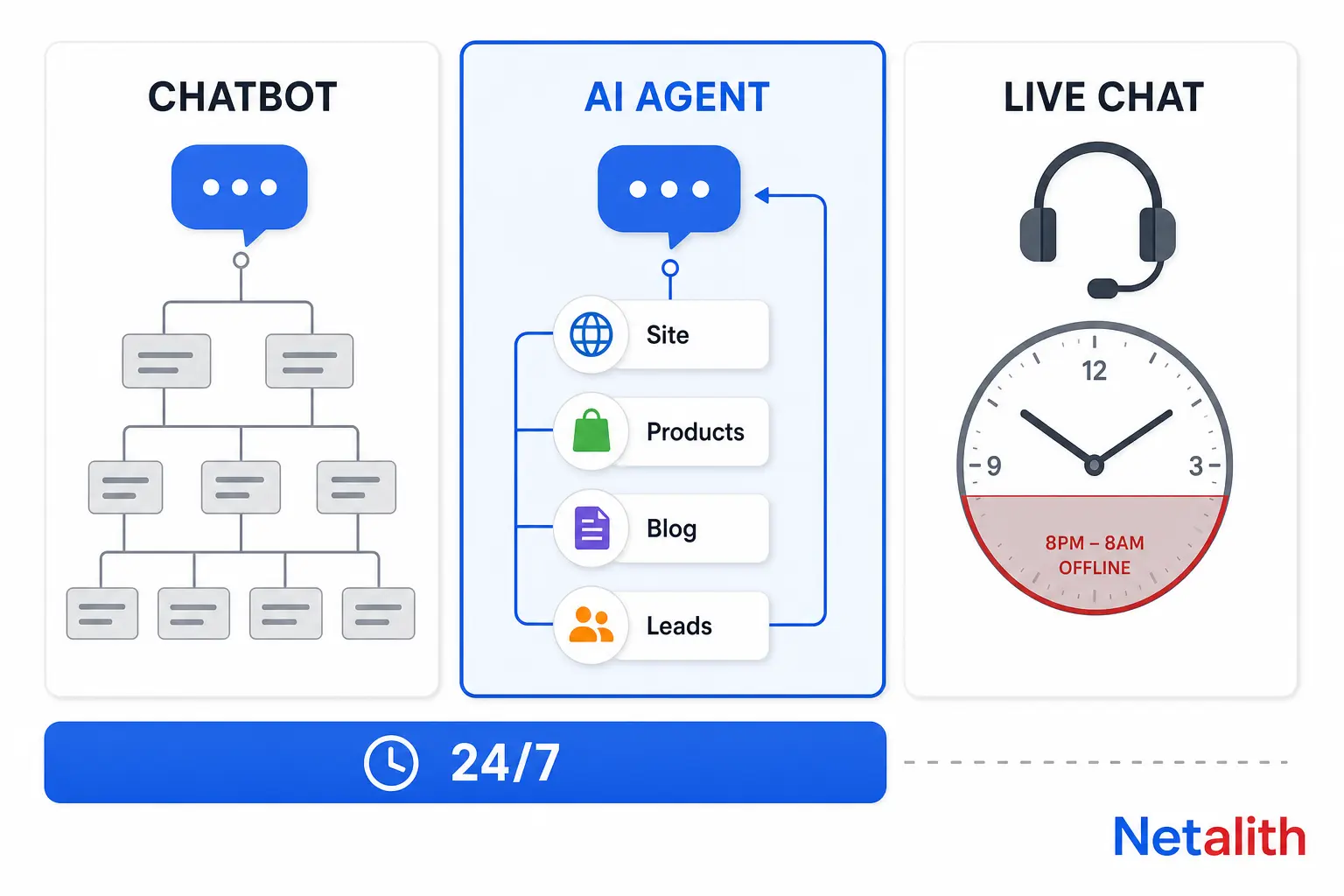
What an AI agent for a website actually is, and how it differs from a chatbot
The words are used interchangeably by people selling both, so start with the distinction that decides whether you get value.
| Rule-based chatbot | AI agent | Live chat | |
|---|---|---|---|
| Understands | Messages matching a preset intent list | Open-ended questions in full conversational context | Everything — it's a person |
| Knows about your business | Whatever you typed into the flow builder | Retrieves from your live site content, catalogue and blog | Whatever the person remembers |
| Can take action | Show a menu, open a form | Calls functions: query products, pull a blog answer, write a lead record, send a brief to your team | Anything they have access to |
| Available | 24/7 | 24/7 | Only when someone is at the desk |
| Cost shape | Flat subscription | Usage-based plus hosting | Salary |
| Fails by | Saying it doesn't understand | Answering confidently without guardrails | Nobody being online |
The practical test is not how the vendor describes it — it's whether the thing can call your systems. A bot that recites a knowledge base is a search box with a personality. An agent looks up a product's current price, checks whether a service is in scope, writes a qualified lead into your pipeline, and decides which of those to do based on what the visitor said.
This distinction has a name in the analyst world. Gartner calls the practice of rebranding chatbots and RPA as agentic “agent washing”, and estimates only around 130 of the thousands of vendors claiming agentic capability are genuine. The same research predicts over 40% of agentic AI projects will be cancelled by the end of 2027 — attributed to escalating costs, unclear business value and inadequate risk controls, not to model quality. Both numbers are useful to you as a buyer: they tell you what to interrogate before you pay anyone.
What an AI agent on a website handles 24/7
Here is the concrete job list, taken from the agent running on this site rather than from a feature grid. It is a loop: read the conversation, decide whether a tool is needed, call it, read the result, answer or call another.
- Explains what you do, from your live site. Not a static FAQ someone typed in March. The agent pulls current page content, so when you change a service scope or publish a new article, the answers change with it.
- Answers from the blog. Visitors ask technical questions your articles already answer. The agent retrieves the passage and links the article — which converts a support question into a content read.
- Queries products in real time. Name, scope, current price, availability. Live lookup, not a cached sheet.
- Recommends. A visitor who describes a problem gets pointed to the offering that fits it, with the reasoning stated.
- Qualifies and collects. It works out whether this visitor is a buyer, then gathers what your team needs to follow up.
- Replies in the visitor's language. Detection happens per message, not per session — visitors routinely open in English and switch mid-conversation, and session-level detection gets that wrong.
Watch it run
Two unedited recordings of the agent on netalith.com. The first is the consulting path; the second is the commerce path, covered in its own section below.
The reason this matters commercially is timezone arithmetic. If you sell to the US and EU and you are not in those timezones, the majority of your traffic arrives while you are asleep. An unanswered question at 2am is not a delayed sale; it is a visitor who opened a competitor's tab. Closing that gap is the whole business case, and it is the scope of our AI automation and workflow service — agents built for your site and your systems, which carries an inline quote form.
How the agent qualifies leads and hands them to your team
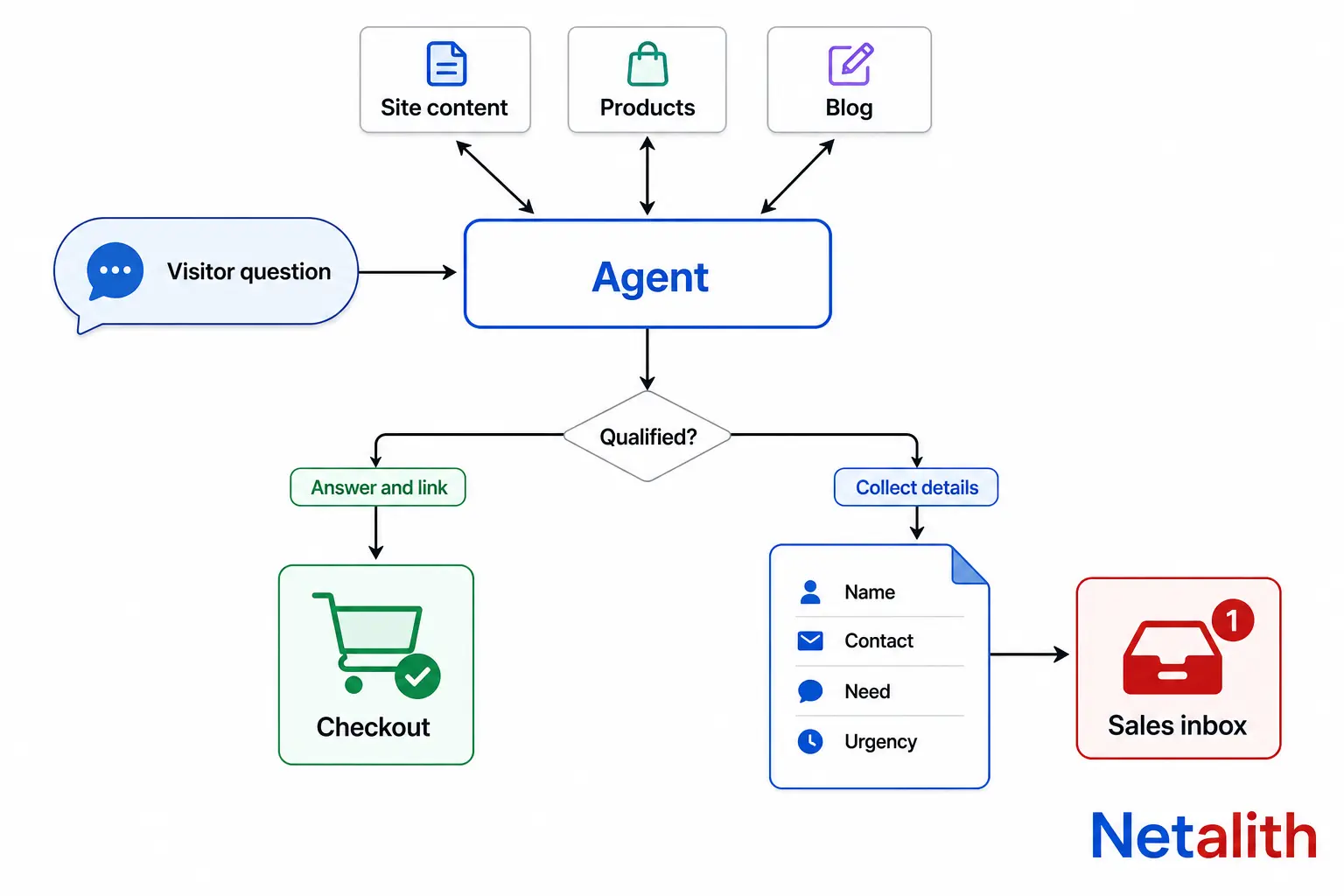
This is the part most vendors gloss over, and it is where the money is. Answering questions is table stakes; turning a conversation into something your sales or support person can act on is the deliverable.
The agent qualifies while it helps, rather than opening with a form. Nobody fills in a form before they know whether you can solve their problem. So the sequence is inverted: answer first, establish fit, then ask for contact details at the point the visitor actually wants to be contacted. What arrives on your side is a structured record:
{
  "name":         "who they are",
  "contact":      "email / phone / whichever they offered",
  "need":         "what they're trying to solve, in their words",
  "fit":          "which service or product matches",
  "urgency":      "timeline they stated",
  "transcript":   "full conversation for context"
}
Route to a brief, or hand over to a human? Choose by whether you're actually staffed
There are two ways to end a conversation the agent can't finish, and picking the wrong one is a common and expensive mistake. Both are buildable; they are not tiers of the same thing.
| Route to a brief | Live handover | |
|---|---|---|
| What the visitor sees | “I've sent this to the team — they'll reply to you by email” | The conversation transfers to a person, in the same window |
| What your team gets | A structured record plus the transcript, in the inbox or CRM | A live conversation they must pick up now |
| Requires | Nothing but somebody reading the inbox | Staffed coverage during your customers' waking hours |
| Fails when | The follow-up email is slow | Nobody is at the desk — the visitor watches a spinner, then leaves |
The deciding question is not which is more advanced. It is whether you have people online during your customers' hours. A “talk to a human” button with nobody behind it is worse than no button at all: you've made a promise in the one moment the visitor was ready to be helped, and broken it in front of them. Routing to a brief makes a smaller promise you can actually keep, and the visitor leaves knowing what happens next.
The agent on netalith.com runs in brief-and-route mode, because we sell into the US and EU from a different timezone and will not pretend otherwise — that is what you see in the demos. For clients who do run a staffed desk, we build the live handover path instead, with the agent doing the qualification first so the person picking up already has the full context rather than starting from “hi”. If you're unsure which you need, the honest answer usually falls out of one number: what share of your chat volume arrives outside the hours your team is online.
Can an AI agent recommend products and take the visitor to checkout?
Yes, and this is where an agent earns its cost rather than just deflecting tickets. The flow is: the visitor describes a need, the agent queries the catalogue in real time, explains which item fits and why, and returns the link that takes them straight to checkout in the same conversation.
One engineering rule makes this safe, and you should require it of whoever builds yours: prices and availability are returned by the lookup tool and passed through unchanged. The model may phrase the surrounding explanation however it likes; it may not compose the number. An agent that can generate a price can be talked into generating a discount, and you will be held to it — Air Canada lost exactly that argument in 2024 over a bereavement policy its bot invented.
The same rule covers stock, delivery windows and anything contractual. If a vendor's demo shows the model stating a price without a visible lookup step, ask them how the number got there.
What an AI agent for a website costs
Two separate numbers, and vendors tend to quote one and stay quiet about the other.
Build cost drivers
| Driver | What moves the number |
|---|---|
| Integration count | Site content only is cheap. Catalogue, CRM, order system and ticketing each add a tool, auth, error handling and testing |
| Data freshness | Nightly sync is cheaper than live query; live query is what makes prices trustworthy |
| Languages | Marginal for the agent, real for QA — every language needs its outputs reviewed by someone who reads it |
| Commerce depth | Recommending is straightforward; returning a working checkout link tied to live inventory is not |
| Guardrail scope | Anything legally binding — pricing, refunds, warranties, regulated claims — needs a hard constraint and a test for it |
Running cost
The surprise is that replies are cheap. The bill is driven by input: every turn re-sends the system prompt, the tool definitions, the retrieved passages and the conversation so far. A ten-turn conversation re-sends the same instructions nine times. The levers that matter:
- Prompt caching on the stable prefix. The biggest single lever and the one most often skipped.
- Retrieval, not stuffing — send the three relevant passages, not the knowledge base.
- Model routing — a small fast model handles routine turns; the large one is called for genuinely open reasoning.
- Deterministic short-circuits — order status, opening hours and tracking answered straight from the database with no model call at all.
Compare against hosted widgets, which mostly price per resolution or per conversation: their cost scales linearly with how well the bot works. An owned agent's cost responds to the levers above plus flat hosting, and you keep the transcripts — which are the best customer research asset the agent produces.
No-code widget or custom-built agent?
Off-the-shelf is the right answer more often than agencies admit. Decide honestly.
| Buy a no-code widget when | Commission a custom agent when |
|---|---|
| Your questions are mostly FAQ-shaped | Answers depend on live data in your own systems |
| You have no API or backend to call | You need real actions: catalogue queries, lead writes, checkout links, ticket creation |
| Conversation volume is low | Per-resolution pricing has started to hurt |
| One language, one market | You sell across the US, EU and beyond |
| Data residency is not a constraint | EU customers, GDPR scope, or contractual limits on where transcripts live |
| You want it live this week | The agent is part of the product, not decoration |
A hybrid is legitimate: keep a widget's chat UI and point its webhook at your own agent endpoint. You get the front end free and keep control of the reasoning, the tools and the data.
Eight questions to ask before you hire anyone to build it
These are the questions that separate a real agent build from a rebranded chatbot. Gartner's cancellation forecast exists because buyers skip them.
- Show me a tool call. Not a transcript — the actual function the agent invoked and what your system returned. If there isn't one, it's retrieval with a personality.
- Where does a price come from? The only acceptable answer is a lookup returning a string that passes through unchanged.
- What happens when it doesn't know? “I don't have that, let me get someone who does” must be a designed outcome that triggers routing, not a failure the model tries to avoid by inventing an answer.
- How is the handoff delivered, and which mode fits me? If it routes to a brief: a named recipient, a structured record and a transcript, not a notification nobody reads. If it hands over live: who is rostered to catch it, and what the visitor sees when nobody does. A vendor who offers only one mode and doesn't ask about your staffing is selling what they have, not what you need.
- Who owns the transcripts, and where do they live? Relevant for GDPR, and relevant if you ever change vendors.
- How does it resist prompt injection? The agent reads page content, reviews and uploaded files — all attacker-reachable. Instructions found in retrieved content must be treated as data, never commands.
- Does it disclose that it's AI, in the first message? Article 50 of the EU AI Act — Regulation (EU) 2024/1689 — has applied since , and the Digital Omnibus that deferred the high-risk regime to December 2027 deliberately left it in place. If people in the EU can reach your chat widget, the disclosure belongs in the greeting, not in your terms of service.
- What does a month cost at my traffic? Ask for the arithmetic — conversations per month, average turns, and what caching and routing do to the total. A vendor who can't show it hasn't measured it.
Where to start
Before commissioning anything, do one hour of work that costs nothing. Open your analytics and find what share of sessions arrive outside your working hours — for most people selling into the US and EU from elsewhere, it is the majority. Then list the five questions you answer most often by email. Those two numbers are your business case, and they also define the first version of the agent: five answers, one catalogue lookup, one lead route. Everything else is phase two.
Build the smallest version that closes the overnight gap, measure whether qualified leads arrive, then add tools. That sequencing is what keeps a project out of the 40% that get cancelled.
If you'd rather have someone map it against your actual stack and traffic first, we do that at no cost — book a free consultation with Netalith. Bring your after-hours traffic share and your five most-repeated questions; that's usually enough to scope it on the call.
FAQ
Questions fréquentes
What is the difference between an AI agent for a website and a chatbot?
A chatbot matches messages against a preset list of intents and answers from whatever was typed into a flow builder. An AI agent reads the conversation in full context and calls functions against your systems — querying live product data, retrieving from your blog, writing a lead record, routing a brief to your team. The practical test is whether it can call your systems. If it only recites a knowledge base, it is a search box with a personality, regardless of how it is marketed.
Can an AI agent replace having someone online 24/7?
For pre-sales questions, product recommendations and lead capture, yes — that is exactly the gap it closes, and it matters most if you sell into the US and EU from another timezone, where the majority of traffic arrives outside your working hours. It does not replace a staffed support desk for complex account or billing issues. The realistic model is that the agent handles the repetitive majority around the clock and routes the rest to your team with full context attached.
Can an AI agent recommend products and send customers to checkout?
Yes. The agent queries the catalogue in real time, explains which item fits the stated need, and returns the link that takes the visitor to checkout inside the same conversation. The rule that keeps this safe is that prices and availability must be returned by the lookup tool and passed through unchanged — the model may phrase the explanation but must never compose the number, because a business is held to whatever price its bot states.
How much does an AI agent for a website cost?
Build cost is driven by how many systems it integrates with, whether data is queried live or synced, how many languages need QA, and how deep the commerce flow goes. Running cost is dominated by input tokens, since every turn re-sends the system prompt, tool definitions and conversation history — prompt caching, retrieval instead of stuffing the knowledge base, routing routine turns to a smaller model, and answering order-status questions straight from the database are the main levers. Hosted widgets typically charge per resolution, so their cost rises as the bot gets better.
Can the agent hand the conversation over to a real person?
There are two designs and the right one depends on your staffing. Brief-and-route: the agent finishes the conversation, collects name, contact, need and urgency, and sends a structured record plus the transcript to your inbox or CRM. Live handover: the conversation transfers to a person in the same window, with the agent having already done the qualification so they don't start from scratch. Live handover is better if you have people online during your customers' hours and worse if you don't, because a transfer button nobody answers breaks a promise at the exact moment the visitor was ready to buy.
Does an AI agent on my website have to tell visitors it is AI?
If people in the EU can reach it, yes. Article 50 of the EU AI Act (Regulation (EU) 2024/1689) requires systems interacting directly with people to be designed so the person is informed they are dealing with an AI, unless that is already obvious. It has applied since 2 August 2026 and was not deferred by the Digital Omnibus, which only moved the high-risk deadlines. Put the disclosure in the widget's first message rather than in your terms of service.