WooCommerce eBay Integration After eBay's 2026 API Retirements
WooCommerce eBay integration in 2026: which eBay API calls were retired, what broke, how to judge a connector, and why stores still oversell.

Long Nguyen
Fullstack Developer · AI Engineer · Researcher
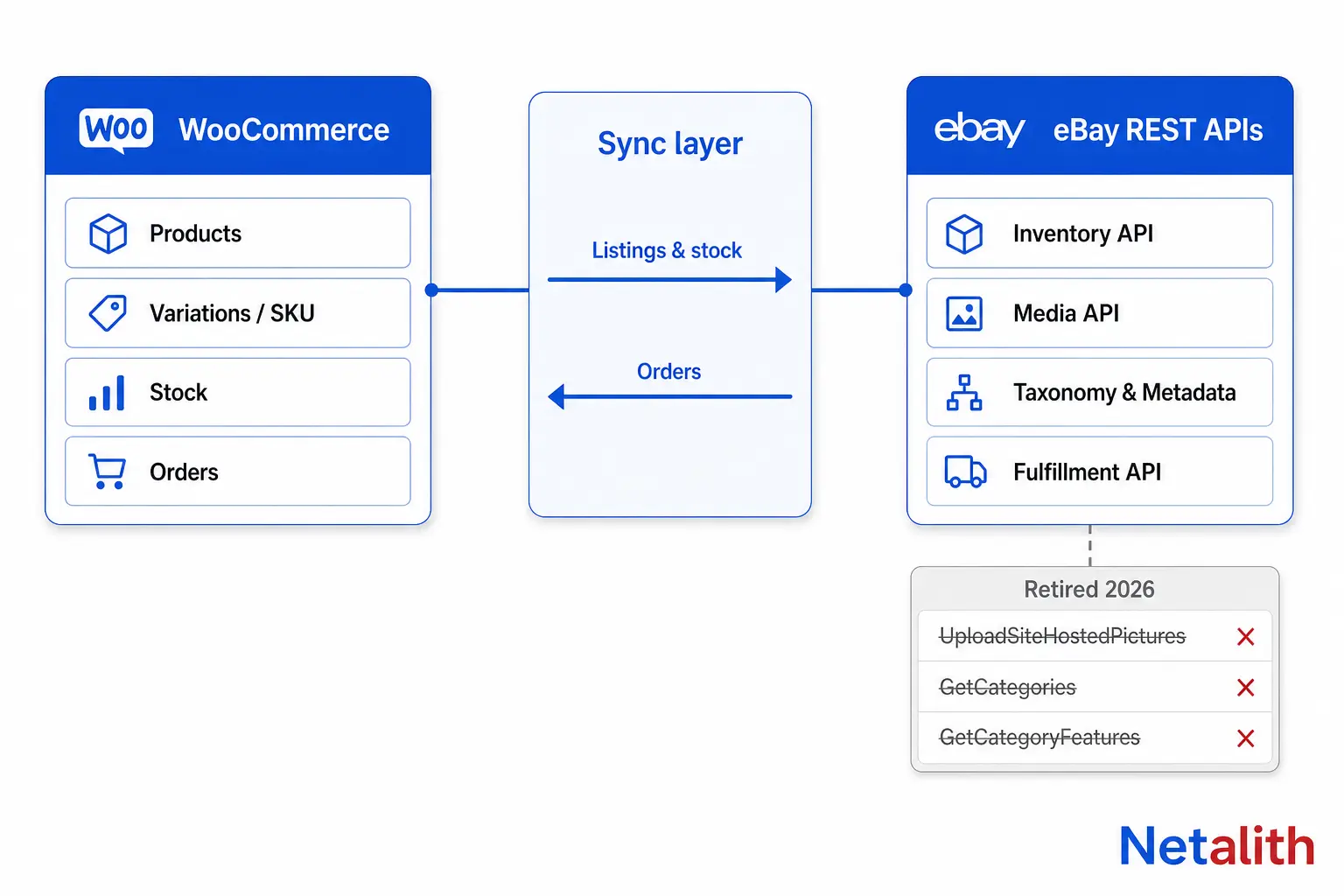
WooCommerce has no first-party eBay integration. Everything that connects the two is built by a third party — and in 2026 every one of them had to rewrite code, because eBay switched off a run of legacy API calls that WooCommerce connectors had leaned on for a decade. If you are choosing a connector now, the plugin comparison tables you will find online are mostly older than those changes.
Is there an official eBay integration for WooCommerce?
No. eBay does not publish a WooCommerce plugin, and it has been moving in the opposite direction for years — retiring its own platform connectors and pushing partners onto the public APIs instead.
That history matters when you search, because most of the top results describe products that no longer exist:
- Codisto / Codisto LINQ — the extension WooCommerce.com itself used to sell as Multichannel for WooCommerce. Its documentation now carries a notice that the product is no longer available on WooCommerce.com, the free WordPress.org listing is closed, and its last release dates from April 2022. Codisto the company was absorbed into Shopify’s ecosystem and survives there as Shopify Marketplace Connect.
- CedCommerce Multichannel for WooCommerce — the extension currently listed on the WooCommerce marketplace, covering Amazon, eBay, Walmart and Etsy. This is what people now find when they search for a woocommerce amazon and ebay integration.
- WP-Lister for eBay — a self-hosted plugin where the listings, profiles and sync queue live in your own WordPress database.
- Newer brokered connectors — plugins that handle eBay OAuth on the vendor’s own servers so you never touch an App ID or Cert ID. Convenient, and the newest of them have a short track record.
The practical consequence is blunt: your eBay channel’s lifespan is the vendor’s lifespan. Codisto’s WooCommerce users did not lose their listings, but they lost the thing they were paying for. Choose accordingly.
What eBay retired in 2026, and what it broke
eBay is not switching the old XML Trading API off in one event. It is hollowing it out one call at a time, each with its own decommission date. Here is the run that landed on marketplace connectors between 2025 and early 2027:
| API / call | Decommission date | Replacement |
|---|---|---|
| Finding API, Shopping API | 2025-02-04 | Browse API |
| Trading: VeRO report calls | 2026-02-02 | VeRO API |
Trading: eBayPlus / eBayPlusEligible fields |
2026-02-16 | Removed (no field needed) |
| Compliance API | 2026-03-30 | Metadata API compatibilities |
Trading: GetCategories |
2026-04-15 | Taxonomy API |
Trading: GetCategoryFeatures |
2026-06-04 | Metadata API |
| Product API | 2026-08-15 | Catalog API + Metadata API |
Trading: GetAdFormatLeads |
2026-09-21 | Leads API (limited release) |
Trading: UploadSiteHostedPictures |
2026-09-30 | Media API |
| Trading: shipping discount profile calls | 2027-01-19 (scheduled) | Account API v2 |
Trading: GeteBayDetails |
2027-03-15 (scheduled) | Metadata API |
The one that actually hurt was UploadSiteHostedPictures on . That single call put photos into eBay Picture Services, so essentially every listing a WooCommerce store ever created passed through it. A connector that had not migrated to the Media API could not upload an image the next morning: new listings fail validation, and any revision that touches images fails with them. WP-Lister shipped the fix in version 3.8.14 on — one day of margin.
So when you evaluate a connector, “does it use the REST API?” is the wrong question. Every one of them is a mix. The useful questions are: which legacy calls does it still depend on, and what is the next date on that list. eBay publishes both, in a table it keeps current, on its API deprecation status page. Two more dates are already on it for 2027.
How a WooCommerce eBay integration actually works
Every option is the same three moving parts — an eBay API application, an OAuth grant against your seller account, and something that runs the sync loop. What changes is who owns each part.
| Vendor-hosted connector | Self-hosted plugin | Custom integration | |
|---|---|---|---|
| eBay app & API keys | Vendor’s | Usually yours | Yours |
| Where sync runs | Vendor’s servers | Your WordPress cron / queue | Wherever you put it |
| Who handles deprecations | Vendor, on their schedule | Vendor, you apply the update | You |
| Load on your host | Near zero | Real — queues, images, polling | Controlled |
| If it stops | Listings stay live, sync dies | Same, but you keep the data | You fix it |
| Best fit | Small catalog, fast start | eBay is a core channel | ERP, 3+ channels, custom rules |
One detail worth internalising from the Codisto era: cancelling a subscription never ended anyone’s eBay listings. They simply stopped being kept in sync, and orders stopped flowing back into WooCommerce. That is the normal exit profile across this category — which means a failed connector does not announce itself with an outage. It announces itself with stale prices and stock that is wrong in exactly one direction.
Choosing a WooCommerce eBay integration plugin
Feature lists in this niche all look the same, and all of them say “real-time sync”. Judge on these instead:
- Changelog evidence of API migration. Open the vendor’s changelog and search 2026 for the words Taxonomy, Metadata and Media. A connector that quietly moved category downloads off
GetCategoriesand image uploads onto the Media API is a maintained connector. A changelog that is all “minor fixes” through 2026 is a warning. - Whose developer keys. Your own keys mean your own call allowance and a direct relationship with eBay. The vendor’s keys mean convenience now and no leverage later.
- Security posture. These plugins add admin screens and REST routes to your store. Published CVEs with a dated patch are a good sign; years of silence on a plugin with that surface area is not.
- Licensing for client work. If you are an agency, check whether the licence is per-site, who holds it, and what happens at renewal — a lapsed licence on a client store means no updates on the day the next eBay date lands.
- Variation and aspect support. Multi-variation listings and category-specific item aspects are where cheap connectors stop. Ask before you migrate a catalogue, not after.
If I had to reduce it to a rule: a maintained vendor connector for a store under a couple of thousand SKUs that needs eBay live this week; self-hosted with your own keys once eBay is a channel you would miss if it broke; custom only when the catalogue already lives somewhere other than WooCommerce.
Is there a free WooCommerce eBay integration?
Not in the sense people mean. “Free” in this category is one of three things: a free tier of a paid service capped by SKU count or listing volume, a free front-end plugin that is useless without the vendor’s paid backend, or an abandoned plugin — which is how the free Codisto listing ended up closed on WordPress.org.
There is a genuinely free setup, and it is worth naming honestly: list on eBay by hand, and push stock one way only. Under roughly 50 SKUs with slow turnover, the manual route costs less than a subscription and carries less risk than a half-maintained plugin. Above that, the cost of being free is measured in cancelled eBay orders, and eBay charges that cost to your seller metrics, not to your plugin budget.
Inventory sync: how WooCommerce stores oversell on eBay
This is where integrations actually fail, long after the listing part works. Four causes, in the order I find them:
- Two writers, one quantity. If an ERP and the plugin both set eBay quantity, they will overwrite each other and the last writer wins at random. Pick one source of truth — usually WooCommerce stock — and make every other system read-only on that field.
- WP-Cron. WordPress fires scheduled tasks on page loads. On a store with little traffic, the sync queue simply does not run, and the lag is invisible until an eBay buyer pays for something you sold yesterday. Disable WP-Cron and run it from a real system cron on a fixed schedule.
- Writes that bypass WooCommerce. Bulk importers and SQL updates that write post meta directly never fire the hooks a connector listens on. The store shows the new stock; eBay never hears about it. Any CSV import tool is a desync source until you prove otherwise.
- The sale-to-push window. Between an eBay sale and your connector pushing the decremented quantity back, you are exposed on every other channel. You cannot close that window, only shrink it — shorter poll intervals, order notifications instead of polling, and a stock buffer on your fastest-moving SKUs.
One more constraint people hit when they write their own sync: eBay rate-limits Media API POST methods to 50 requests per 5 seconds. A naive loop that uploads every image of every variation during a bulk relist will hit that wall and fail halfway, leaving listings in a partially revised state.
Variable products, variations and eBay item aspects
A WooCommerce variable product does not map cleanly onto an eBay multi-variation listing, and this is the second place integrations stall.
- Every variation needs its own unique SKU. Modern eBay listing flows are SKU-keyed: the SKU is the join between WooCommerce and the eBay offer. Empty or duplicate variation SKUs are the single most common blocker on a first migration — fix them in WooCommerce before you connect anything.
- The variation axis must be an aspect eBay supports in that category. Your attribute names are yours; eBay’s aspects are eBay’s, and they differ by category. Map them explicitly rather than trusting auto-matching.
- Required aspects change, and they now come from the Taxonomy and Metadata APIs. That is precisely why
GetCategoriesandGetCategoryFeatureswere retired in 2026 — the category rules moved to services that can be refreshed per marketplace.
The direction of travel is clear in eBay’s own category work: in collectible coins, free-text condition descriptions were replaced with structured descriptors — grading company, numeric grade, letter grade — phased in across the US from May 2026 to full enforcement in July 2026, with the metadata exposed through the Metadata API. Expect the same pattern to reach more categories. A connector that maps only title, description, price and quantity will keep passing validation right up until the category it sells in gets structured.
When to build a custom WooCommerce eBay integration
Custom is the right answer less often than developers think, and more often than plugin vendors admit. The honest signals: your catalogue of record is an ERP rather than WooCommerce, you need per-marketplace pricing or kitting rules, you hold stock in several warehouses, or you are on three or more marketplaces and want one normalisation layer instead of four plugins fighting over the same stock field.
If you do build in 2026, build on the current surface, not the one the tutorials use:
- Inventory API for the listing model — inventory item, offer, publish — rather than the item-centric Trading
AddItemfamily. - Media API for images, with
createImageFromFileorcreateImageFromUrl. - Taxonomy and Metadata APIs for categories, required aspects and compatibility data.
- Fulfillment API for orders and tracking; Account API v2 for business policies, before the January 2027 date.
Two things worth knowing before you pick an approach. First, a gotcha: createImageFromUrl means eBay fetches the image from your WooCommerce URL — if your CDN or WAF blocks non-browser user agents, or you have hotlink protection on, EPS creation fails for reasons that look nothing like an image problem. Uploading the bytes with createImageFromFile sidesteps it entirely. Second, the platform is still moving: at eBay Connect 2026 the company set out its selling-API modernisation plan, with GraphQL-based listing APIs in restricted beta and the Inventory Mapping API already live for turning external catalogue data into listing previews. Anything you build this year should assume another migration inside three.
That is also the realistic threshold for bringing in help: if the mapping layer between your catalogue and several marketplaces is becoming its own product, it should be built like one. We do this work as marketplace integration projects — eBay, Amazon SP-API, Walmart and the rest — against whatever system actually holds your inventory.
A 2026 checklist before you connect WooCommerce to eBay
- Audit variation SKUs in WooCommerce: unique, non-empty, stable. Do this first; everything else keys off it.
- Ask your connector vendor which Trading API calls they still use, and compare that answer to eBay’s deprecation table.
- Confirm images go through the Media API, not the retired EPS upload call.
- Confirm categories and item aspects are pulled from the Taxonomy and Metadata APIs, refreshed per marketplace.
- Disable WP-Cron and drive the sync queue from a system cron.
- Declare one source of truth for stock and make every other system read-only on it.
- Test an oversell: sell the last unit on eBay and time how long WooCommerce takes to reflect it.
- Diary and — shipping discount profiles and
GeteBayDetailsrespectively.
If that list reads like a project rather than a plugin install, it usually is — particularly on stores that already sell on more than one channel. Tell us what your setup looks like and we will tell you whether a connector covers it or not.
FAQ
Frequently asked questions
Is there an official eBay plugin for WooCommerce?
No. eBay does not publish or maintain a WooCommerce plugin. Every WooCommerce eBay integration is built by a third party on eBay's public APIs, which is why connectors differ so much in how quickly they adapt when eBay retires an API call.
What happened to the Codisto WooCommerce eBay integration?
Codisto's extension, sold as Multichannel for WooCommerce, is no longer available on WooCommerce.com, and its free WordPress.org listing is closed with a last release from April 2022. Codisto itself continues inside Shopify's ecosystem as Shopify Marketplace Connect. WooCommerce stores now use other connectors, most visibly CedCommerce's Multichannel extension and self-hosted options such as WP-Lister.
Can one plugin sync WooCommerce with both Amazon and eBay?
Yes, multichannel connectors cover Amazon, eBay, Walmart and Etsy from one WooCommerce dashboard. The trade-off is that one vendor's migration schedule now governs every channel you sell on, so an outage or a missed API deadline affects all of them at once rather than just one.
Do I need my own eBay developer account to integrate WooCommerce?
It depends on the connector. Vendor-hosted services handle eBay OAuth with their own application, so you never see an App ID or Cert ID. Self-hosted plugins and custom builds normally use your own eBay developer keys, which gives you your own call allowance and a direct relationship with eBay when something breaks.
Will my eBay listings disappear if I cancel the integration?
Normally no. Across this category, cancelling a connector subscription leaves existing eBay listings live, it just stops syncing them and stops sending orders back to WooCommerce. That is why a dead integration shows up as stale prices and wrong stock rather than as an obvious outage.
Does WooCommerce eBay integration support variable products?
Maintained connectors map WooCommerce variable products onto eBay multi-variation listings, but only if every variation has a unique, non-empty SKU and the variation attribute matches an aspect eBay supports in that category. Clean the SKUs in WooCommerce before connecting anything, since the SKU is what joins a WooCommerce variation to its eBay offer.
What eBay API change broke integrations in 2026?
The retirement of the Trading API call UploadSiteHostedPictures on 30 September 2026. It was the route every listing image took into eBay Picture Services, so connectors that had not migrated to the Media API could no longer upload images, which fails both new listings and any revision touching photos.