Mastering the Database per Service Pattern: A Guide to Data Sovereignty
Learn how to implement the database per service pattern to ensure data sovereignty, handle consistency challenges, and leverage polyglot persistence in microservices.
Drake Nguyen
Founder · System Architect
Introduction to the Database per Service Pattern
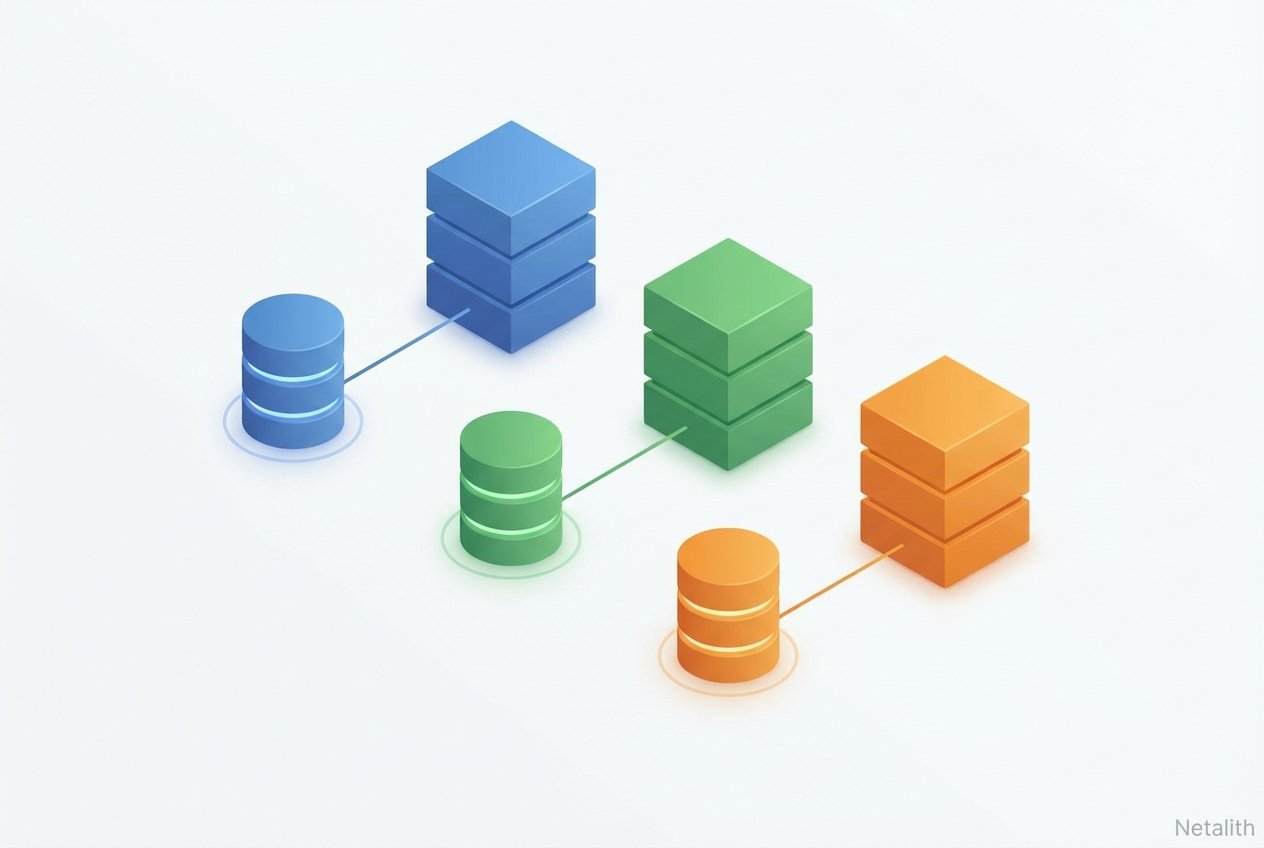
In modern software engineering, achieving true agility requires more than just breaking down code into smaller artifacts; it demands decoupling the underlying data stores as well. The database per service pattern has emerged as an architectural cornerstone for engineering teams aiming to achieve autonomous, scalable, and resilient systems. By ensuring each service strictly owns its own data, this approach mitigates the tight coupling that plagues traditional monolithic applications.
As organizations evaluate various microservices database patterns, the choice between shared and isolated storage environments dictates the long-term maintainability of the platform. Implementing a strict database per service framework revolutionizes your microservices data architecture. It eliminates shared databases that serve as hidden points of coupling, ensuring that updates to one service do not inadvertently break another. Consequently, development teams must adopt new schema management patterns, treating the database as private implementation details completely hidden behind an API boundary.
Why Data Sovereignty Matters in Microservices
At the core of the per-service database architecture is the concept of data sovereignty. In a shared database model, multiple services read and write to the same tables, violating the encapsulation required for independent evolution. Embracing data isolation microservices ensures that a service’s internal data structure remains an encapsulated domain, strictly accessible only via its designated API.
This strict data isolation is the foundation of decentralized data management. By locking down direct database access, teams enforce bounded context persistence, a Domain-Driven Design principle where a specific model is only valid within a defined context. In large-scale data sovereignty distributed systems, ensuring that each bounded context maintains exclusive rights to its schema allows engineering teams to deploy changes safely without orchestrating release schedules across multiple departments.
Pros and Cons of Database per Service vs Shared Database
Before committing to an architectural shift, technical leaders must evaluate the pros and cons of database per service vs shared database architectures. The benefits of an isolated persistence pattern are substantial. Primarily, it allows independent scaling. If an order management service requires high-throughput write capabilities while a catalog service handles high-volume reads, each can provision database resources independently. Furthermore, a per-service database architecture minimizes the blast radius of database failures, naturally complementing robust resilience patterns in microservices.
However, the per-service database architecture introduces distinct challenges. The primary disadvantage is operational complexity. Instead of maintaining a single monolithic database, platform engineering teams must deploy, monitor, and back up dozens of data stores. Furthermore, because data is distributed, ensuring business invariants across services becomes a complex undertaking that requires abandoning traditional ACID guarantees in favor of distributed consensus mechanisms.
Key Challenges: Solving Data Consistency and Distributed Joins
The transition to decentralized data is rarely without friction. Successfully implementing the per-service database architecture requires a fundamental shift in how developers think about transactions. Traditional two-phase commits (2PC) are notorious for causing availability bottlenecks in microservices. Instead, architects rely on advanced distributed data management patterns to maintain system integrity.
Because direct SQL joins across different services are physically impossible under the per-service database architecture, engineers must devise robust distributed join strategies to fetch and aggregate data required by client applications without degrading performance.
Eventual Consistency Workflows and Saga Pattern
To overcome distributed transaction constraints, teams must embrace eventual consistency workflows. Instead of locking multiple databases simultaneously, changes are propagated asynchronously. A common approach to orchestrating these workflows is evaluating the saga pattern vs event sourcing.
A Saga is a sequence of local transactions where each local transaction updates the database and publishes an event to trigger the next step. If a step fails, the saga executes compensating transactions to undo the preceding operations. Whether implemented via choreography (events) or orchestration (centralized controller), sagas are indispensable in modern distributed systems design.
API Composition and CQRS Implementation
Querying decentralized data necessitates robust distributed join strategies. The simplest method is API Composition, where an API Gateway or aggregator service queries multiple downstream services and joins the data in-memory. However, for complex queries spanning massive datasets, this approach is inefficient.
A mature CQRS implementation guide (Command Query Responsibility Segregation) is vital here. CQRS separates the read model from the write model. Services subscribe to domain events published by the owning services and maintain a denormalized, read-optimized materialized view. This remains one of the most critical microservices patterns for ensuring blazing-fast reads while honoring the per-service database architecture.
Polyglot Persistence in Microservices
A hidden superpower of the per-service database architecture is the empowerment it gives to developers to choose the right tool for the job. A comprehensive polyglot persistence in microservices guide highlights how breaking the monolithic database unlocks specialized storage solutions.
For example, a social graph service might utilize a graph database (like Neo4j) to query complex relationships efficiently. Concurrently, a product catalog might rely on a NoSQL document store (like MongoDB) for schema flexibility, while financial transactions are guarded by a traditional relational database (like PostgreSQL). This specialized approach natively supports advanced database sharding strategies, ensuring optimal performance and cost-efficiency within your overall microservices data architecture.
Frequently Asked Questions
What is the database per service pattern?
The per-service database architecture is a microservices architecture principle where each service manages and persists its own domain data exclusively. Other services can only access this data through exposed APIs, preventing direct database coupling.
How does the database per service pattern solve data sovereignty issues?
By enforcing strict boundary rules, the per-service database architecture ensures no external service can read or manipulate a service\'s underlying schema. This grants the owning service complete autonomy over how its data is stored, scaled, and evolved.
What are the pros and cons of database per service vs shared database?
The pros of the per-service database architecture include independent scaling, isolated fault domains, and schema flexibility (polyglot persistence). The cons include increased operational complexity, the necessity of eventual consistency, and the challenge of implementing distributed joins.
How do you handle distributed transactions in this pattern?
Distributed transactions are typically handled using the Saga pattern, which manages a sequence of local transactions and compensating actions to ensure eventual consistency across multiple services.
Conclusion: Decentralized Data Management with Netalith
The journey toward a fully decoupled architecture begins with mastering the per-service database architecture. While the transition introduces complexities in data consistency and cross-service querying, the gains in scalability and team autonomy are unparalleled. By leveraging cloud-native architecture patterns and robust distributed systems design, organizations can build platforms that are truly resilient to change.
At Netalith, we empower organizations to navigate these architectural shifts with precision. By focusing on data sovereignty and decentralized management, we ensure your microservices ecosystem remains agile and future-proof. Embracing these patterns is not just a technical choice—it is a strategic move toward operational excellence. In summary, a strong database per service pattern strategy should stay useful long after publication.