API Gateway vs. Service Mesh: Choosing the Right Connectivity Layer for Microservices
A comprehensive guide comparing API gateway vs service mesh architectures, focusing on north-south and east-west traffic management for microservices.

Long Nguyen
Fullstack Developer · AI Engineer · Researcher
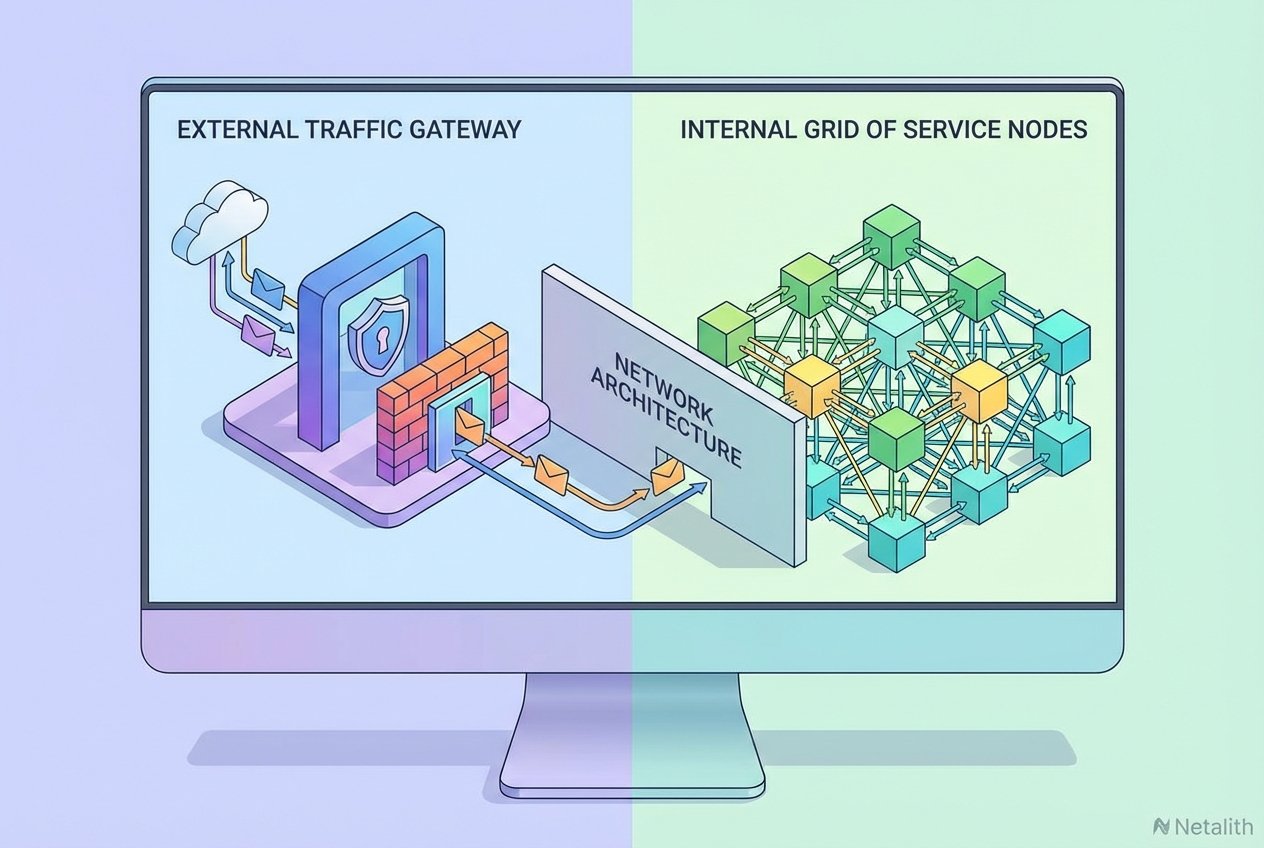
As distributed systems continue to dominate enterprise software, the complexity of managing network traffic has grown exponentially. For software architects, backend developers, and cloud engineers, understanding the precise differences in the api gateway vs service mesh landscape is no longer optional—it is a foundational requirement for building resilient, scalable infrastructure.
Historically, organizations struggled with monolithic bottlenecks, eventually breaking them down into decoupled microservices. However, this shift introduced a new challenge: how do these services securely and efficiently communicate with both external clients and each other? By evaluating api gateway vs mesh architecture paradigms, engineering teams can implement the right abstractions to secure perimeters, observe internal traffic, and ensure high availability across complex environments.
Understanding the Connectivity Layer: API Gateway vs Service Mesh
Modern microservices connectivity relies heavily on dedicated abstraction layers to handle routing, security, and observability. Without these layers, developers are forced to hardcode network logic directly into their application code, leading to fragile deployments and security vulnerabilities. This is where the core debate of api gateway vs mesh architecture begins.
At a high level, both technologies are crucial service communication layers designed to mediate traffic. However, their scopes differ significantly. While one focuses on edge gateway patterns and acting as the front door for your applications, the other provides a dedicated infrastructure layer for internal service routing. Navigating this landscape requires a deep understanding of your system's specific traffic flows and security requirements.
What is an API Gateway? Managing North-South Traffic
An api gateway is a management tool that sits between a client and a collection of backend services. Its primary responsibility is managing north-south vs east-west traffic—specifically, the "north-south" traffic that originates from outside your datacenter or cloud environment and flows inward to your APIs.
Because it acts as the single entry point for external consumers, the API gateway is heavily focused on security at the edge. It abstracts the underlying architecture, presenting a unified REST, GraphQL, or gRPC interface to mobile apps, web clients, and third-party partners. Key responsibilities include:
- Rate limiting and throttling: Protecting backend services from DDoS attacks or accidental traffic spikes by enforcing strict quota policies.
- Authentication and Authorization: Validating JWTs, API keys, and OAuth tokens before requests ever reach your internal microservices.
- API management features: Offering developer portals, API monetization, lifecycle management, and request/response transformation.
By offloading these responsibilities, developers can focus strictly on business logic rather than recreating edge security protocols across dozens of distinct services.
What is a Service Mesh? Securing East-West Traffic
If an API gateway is the front door, a service mesh is the internal hallway. A service mesh is a dedicated infrastructure layer that controls and monitors service-to-service communication within a cluster. This internal, lateral movement of data is known as east-west traffic.
A typical service mesh architecture relies on a sidecar pattern, deploying a lightweight proxy alongside every microservice instance. In any distributed proxy comparison, the service mesh stands out because it decouples infrastructure logic from the application entirely. Key features include:
- mTLS and service discovery: Automatically encrypting all internal traffic using mutual TLS (mTLS) and dynamically discovering service endpoints.
- Advanced Observability: Generating distributed traces, metrics, and logs for every hop a request makes between services.
- Traffic Control: Implementing intelligent routing, retries, timeouts, and circuit breaking to prevent cascading failures.
When evaluating a centralized vs decentralized proxy model, the service mesh falls firmly into the decentralized category. Unlike an API gateway that routes all external traffic through a centralized cluster of nodes, a service mesh distributes its proxies alongside the workloads themselves.
API Gateway vs Mesh Architecture: Core Differences
To properly contrast api gateway vs mesh architecture, you must look at their primary beneficiaries. An API gateway primarily serves external clients and business stakeholders, providing robust api management features like billing and client onboarding. A service mesh serves internal platform engineering and security teams, focusing entirely on operational resilience and zero-trust internal security.
The distinction often comes down to north-south vs east-west traffic. While a gateway centralizes security policies for incoming external requests, a service mesh provides a decentralized web of sidecar proxies to secure and route internal data. In short, the gateway hides your microservices from the outside world, while the mesh hides the network from your microservices.
Ingress Controller vs API Gateway for Modern Architecture
Within Kubernetes and modern cloud-native architecture patterns, the lines often blur between different ingress tools. When comparing an ingress controller vs api gateway, modern standards emphasize that an ingress controller primarily handles basic L4/L7 routing to get external traffic into the cluster. In contrast, edge gateway patterns dictate that an API gateway provides much richer, business-level capabilities like request transformation and complex authentication—features typically beyond the scope of a standard ingress controller.
Do I Need an API Gateway if I Have a Service Mesh?
One of the most common questions platform engineers ask is: do i need an api gateway if i have a service mesh? In almost all enterprise scenarios, the answer is yes. They are complementary technologies rather than mutually exclusive choices.
Using traffic management in distributed systems patterns, we see that a service mesh is excellent at handling resilience patterns in microservices (like retries and circuit breaking) between internal nodes. However, a service mesh is generally not equipped to handle complex API monetization, third-party developer onboarding, or edge rate limiting.
In a mature deployment, the API gateway accepts the external request, authenticates the third-party client, and passes the request into the cluster. From there, the service mesh takes over, wrapping the request in mTLS and routing it efficiently between internal microservices.
Frequently Asked Questions
Do I need an API gateway if I have a service mesh?
Yes. While a service mesh manages internal service-to-service communication, you still need an API gateway to act as the secure front door for external clients, handle API management, and manage external rate limiting.
What is the difference between north-south and east-west traffic?
North-south traffic refers to data flowing into and out of your data center (client-to-server). East-west traffic refers to the communication between services within your internal network (server-to-server).
Can a service mesh replace an ingress controller?
Some service meshes include ingress gateways that handle basic entry points, but they often lack the advanced api management features found in dedicated API gateways.
Conclusion: Navigating the API Gateway vs Service Mesh Choice
The decision regarding api gateway vs mesh architecture is rarely about choosing one over the other. Instead, it is about understanding how they work together to form a comprehensive distributed systems design. By utilizing an API gateway for external perimeter security and a service mesh for internal service communication layers, organizations can achieve a robust, zero-trust architecture.
As you refine your microservices patterns, focus on the specific needs of your traffic flows. If your goal is to manage external consumers, prioritize the API gateway. If your goal is to secure and observe a complex web of internal services, the service mesh is your primary tool. Using both ensures your infrastructure remains performant, secure, and ready for future scale. In summary, a strong api gateway vs service mesh strategy should stay useful long after publication.