Best AI Product Research Tools for Amazon in 2026 — Top Picks
Find the best AI product research tools for Amazon in 2026—real-time API data, sentiment analysis, and predictive forecasts to uncover profitable niches fast.

Long Nguyen
Fullstack Developer · AI Engineer · Researcher

Quick comparison: Top AI product research tools for Amazon
This roundup focuses on the best AI product research tools for Amazon in 2026 — tools that combine near-real-time API data, NLP-powered sentiment analysis, and demand forecasting to uncover profitable niches quickly. Below are our top recommendations and a short table to help you pick fast.
- Helium 10 — Integrated AI + Seller Central workflow; best for SMB sellers wanting end-to-end research-to-launch support.
- Jungle Scout — Seasonality-aware forecasting and opportunity scoring; best for new-to-intermediate FBA sellers.
- AMZScout — Supplier and sourcing signals with profit forecasts; best for sellers who need quick supplier checks.
- SellerApp — Competitive-gap scoring and advanced keyword clustering; best for listing optimization and keyword-led validation.
- Viral Launch — Launch-focused forecasting and promo-impact models; best for sellers planning aggressive launches.
- DataHawk — Enterprise analytics, portfolio forecasting, and BI integrations; best for brands and agencies with multi-market needs.
How we chose these: selection prioritized data freshness (SP-API vs scraped), forecasting accuracy and backtests, depth of sentiment/NLP features, API/export capabilities, and integrations with repricers/PPC and BI tools.
Jump to the detailed breakdown below or skip to the side-by-side comparison table for a quick feature/price scan.
| Tool | Standout AI capability | Best for |
|---|---|---|
| Helium 10 | Generative listings + demand forecasts | End-to-end SMB sellers |
| Jungle Scout | Seasonality-adjusted forecasts | New/intermediate FBA sellers |
| AMZScout | Supplier signals + profit calculator | Sourcing-focused sellers |
| SellerApp | Competitive gap scoring & keyword clustering | Listing optimizers & agencies |
| Viral Launch | Launch-forecast & promo lift models | Launch-first sellers |
| DataHawk | Portfolio-level forecasting, BI exports | Brands & enterprises |
How AI product research tools work (data, models, and outputs)
Understanding the technical foundations helps you read outputs critically. AI product research tools combine multiple data streams with statistical and machine learning models to produce actionable signals — but each step adds assumptions and uncertainty.
- Data inputs: ASIN-level sales estimates, historical Best Sellers Rank (BSR) time series, raw review text and ratings, image counts, buy-box change logs, price history, and inventory signals (where available).
- Data sources: Amazon Selling Partner API (SP-API) when authorized (preferred), vendor APIs, public listing pages, third-party panel data, and some tools still use web scraping — which has legal and reliability caveats.
- Core AI techniques: time-series forecasting (ARIMA, Prophet variants, and deep learning models) for demand; NLP and sentiment analysis for review insights and complaint-phrase extraction; classification models for category fit; clustering for niche discovery and opportunity grouping.
- Common outputs: demand forecasts with confidence intervals, opportunity or opportunity-score rankings, sentiment-based defect lists, automated keyword & listing suggestions, and supplier-sourcing indicators.
- What “real-time” means: update frequency ranges from near-real-time (minutes to hourly for inventory or repricer hooks) to daily refresh for crawled listings. Pay attention to stated latency and model confidence — shorter refresh intervals reduce staleness but can increase noise.

How to choose the best AI product research tool for your Amazon business
Match the tool to your workflows and budget with this checklist. Prioritize the criteria that materially affect your decision-making speed and risk.
- Data freshness & source: SP-API access beats scraping for reliability. Confirm which marketplaces the tool supports and whether you can link Seller Central for authorized metrics.
- Forecasting accuracy & timeframe: check whether forecasts are short-term (3–6 months) or long-term (12+ months) and ask vendors for backtest summaries.
- Review/sentiment depth: phrase-level extraction and root-cause labeling are more actionable than simple positive/negative counts.
- Filtering granularity: ability to filter by price, weight, dimensions, category, review count, and minimum margin matters when narrowing candidates.
- Usability & workflows: browser extensions, bulk export, API access, team seats, role controls, and integrations with PPC or repricers reduce manual work.
- Pricing model fit: freemium/trials, per-ASIN pricing, seats, and enterprise tiers can dramatically change cost for growing catalogs.
- Validation features: sample forecasts, historical backtests, and case studies help you test vendor claims before committing.
- Security & compliance: SP-API permission model, data retention policies, SSO, and agency-friendly features if you work with outside partners.
Top picks for 2026 — tool-by-tool breakdown
Below you'll find focused entries for each top pick. Each entry includes a quick summary, standout AI features, the best-fit user, pros & cons, pricing range notes, key integrations, and a recommended workflow. All info reflects 2026 checks; verify live pricing and exact plugin features on vendor pages before purchasing.
Quick navigation: each tool section has an ID for deep links to the tool review.
Helium 10 — AI-assisted product research & listing optimization
Helium 10 remains a mature end-to-end platform that extended its AI module through 2026. It couples product research, keyword discovery, and a generative listing assistant into a workflow designed for sellers who want a single vendor for research, launch, and PPC management.
- Standout AI features: real-time keyword suggestions that adapt to search trends, review-sentiment rollups, and demand forecasts with optional historical backtests for sample ASINs.
- Best for: SMB sellers seeking integrated tooling from niche discovery through listing generation and initial PPC campaigns.
- Pros: deep Seller Central workflows, browser extension for quick ASIN checks, solid documentation, and integrated launch tools.
- Cons: higher tiers required for extensive API access or large-scale exports; some advanced forecasting features gated to enterprise plans. Marketplace coverage is broad but check regional support if you sell outside US/EU.
- Suggested mini workflow: run Opportunity Finder → validate top 10 ASINs with 3-month forecasts → extract top complaint phrases → generate listing with AI copy generator → sync keywords into PPC templates.
- Pricing & verification: tiered monthly plans with add-ons for higher API limits and seats. Confirm current plan names and limits on Helium 10’s pricing page.
Jungle Scout — AI product finder and demand forecasting
Jungle Scout focuses on simplicity and reliable demand signals, with improved AI models in 2026 that emphasize seasonality-adjusted forecasts and opportunity scoring designed for fast decisions.
- AI highlights: opportunity scores that incorporate seasonality, inventory signals where authorized, and review-phrase extraction to identify feature gaps.
- Best for: new-to-intermediate FBA sellers and agencies aiming for fast product-validation cycles.
- Pros: intuitive UI, good trial options, and clear educational resources for beginners.
- Cons: enterprise-grade BI exports and deep API access often require higher tiers or custom contracts.
- Recommended trial checks: backtest a past launch, compare its forecast to actual sales, and test the opportunity-scoring thresholds on a sample set of niches.
AMZScout — AI product research and supplier signals
AMZScout blends product research with sourcing signals — supplier lead times, MOQ hints, and profit-calculator forecasts — making it a practical choice when supplier-side context matters.
- AI capabilities: opportunity scoring, profit-calculator forecasts that incorporate landed-cost estimates, and NLP-based review issue detection.
- Best for: sellers who need quick, integrated sourcing signals alongside product research.
- Pros: strong supplier-context features, CSV export, and lightweight Chrome extension for fast checks.
- Cons: forecasting models may be simpler than enterprise offerings; recommend cross-checking forecasts with a second tool for critical decisions.
- Suggested validation: use AMZScout for initial supplier and margin checks, then run ASIN-level forecasts in a forecasting-focused tool for confirmation.
SellerApp — AI-driven competitive gap analysis and keyword intelligence
SellerApp emphasizes competitive insights and keyword intelligence. Its AI is tuned to find listing gaps and cluster keywords by intent, helping sellers design listings that capture overlooked search demand.
- AI features: automated competitive-gap scoring, keyword clustering with intent detection, and sentiment dashboards that surface recurring complaints.
- Best for: sellers focused on listing optimization and keyword-led product validation.
- Pros: strong keyword tooling and actionable gap reports; useful for agencies and consultants.
- Cons: API access and large-bulk exports may require mid-to-high tiers; some users report steeper learning curve for advanced features.
- Practical tip: pair SellerApp’s gap analysis with shipment/inventory checks to ensure the category can support your planned launch volume.
Viral Launch — AI for product discovery and launch forecasting
Viral Launch focuses on launch planning and forecasting. Its models estimate promotional lift and give sellers a sense of how a planned promo might influence early velocity.
- AI highlights: launch-forecast modeling, estimated promo lift, and keyword-driven opportunity scoring tailored to launch windows.
- Best for: sellers planning product launches and needing prediction of promotional impact and early sales cadence.
- Pros: useful launch templates and scenario modeling; can help set realistic promo budgets.
- Cons: forecasting accuracy depends heavily on input assumptions (promo size, review velocity); consider hybrid testing with other tools.
- Suggested hybrid workflow: use Viral Launch for promo modeling and a sourcing-focused tool for margin and supplier checks.
DataHawk — enterprise analytics, catalog intelligence & AI forecasting
DataHawk targets brands and larger sellers with portfolio-level analytics, cohort forecasting, and integrations for BI ingestion. It’s built to scale beyond single-ASIN research into catalog optimization and monitoring.
- AI capabilities: portfolio-level forecasting, cohort analysis, anomaly detection, and automated alerts for listing changes or sentiment shifts.
- Best for: brands and agencies that need multi-market, multi-ASIN reporting and API exports to data warehouses.
- Pros: robust BI integrations, team controls, and data exports for downstream analysis.
- Cons: higher cost for smaller sellers; for single-ASIN deep-dives you may still want a tactical research tool in addition to DataHawk.
- Recommended usage: combine DataHawk for portfolio forecasts and alerts with a tactical single-ASIN research tool for detailed listing and supplier checks.
Side-by-side feature and pricing comparison
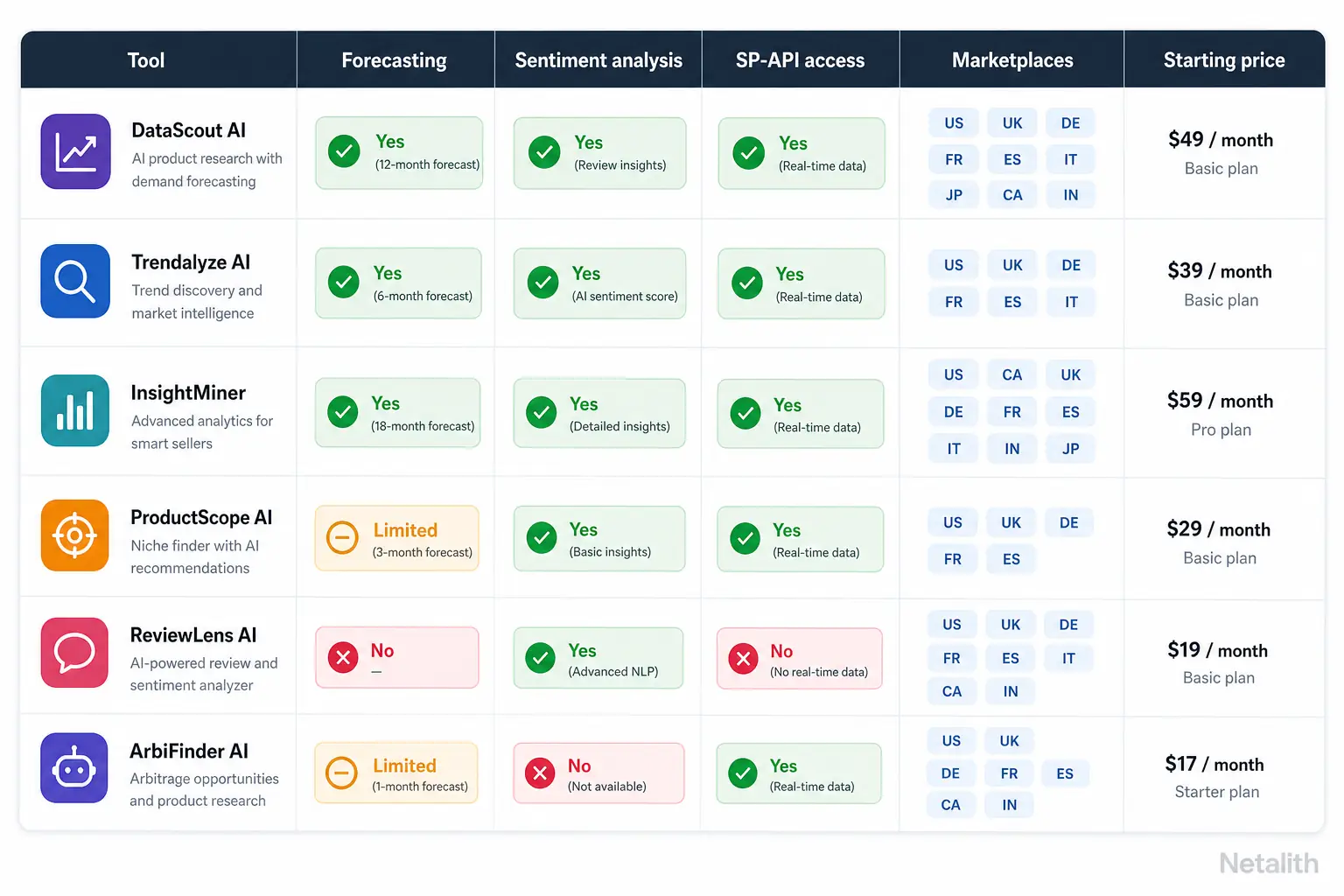
The table below summarizes core features, SP-API access, refresh frequency, marketplace coverage, and starting price indicators. Use it to narrow choices quickly — verify current pricing and enterprise limits on vendor pages before purchasing.
| Tool | AI feature (brief) | SP-API | Refresh frequency | Marketplaces covered | Best-for | Starting price / plan | Trial |
|---|---|---|---|---|---|---|---|
| Helium 10 | Forecasting + generative copy | Yes (in higher tiers) | Daily to near-real-time | US, EU, CA, AU (check regions) | SMB end-to-end | Tiered monthly plans (verify) | Yes |
| Jungle Scout | Seasonality-adjusted forecasts | Partial / vendor API | Daily | US, EU, JP (varies) | Beginners / FBA | Monthly plans (verify) | Yes |
| AMZScout | Supplier signals + profit calc | No / limited | Daily | Major marketplaces | Sourcing-focused sellers | Lower-cost tiers (verify) | Yes |
| SellerApp | Competitive-gap & keyword clustering | Yes (tiered) | Daily | US, EU, others | Listing optimizers & agencies | Tiered (verify) | Yes |
| Viral Launch | Launch & promo forecasting | Partial | Daily | US, select regions | Launch-first sellers | Tiered (verify) | Yes |
| DataHawk | Portfolio forecasting & BI export | Yes (enterprise) | Hourly to daily | Multi-market | Brands & enterprises | Custom / enterprise pricing | Yes (demo) |
Recommendation rows: Best for beginners — Jungle Scout; Best value for SMBs (end-to-end) — Helium 10; Best for enterprise reporting — DataHawk; Best for sourcing signals — AMZScout.
Step-by-step workflow: find a profitable product using AI tools
Follow this repeatable workflow using any of the recommended tools. Each step includes what to run in the tool and the outputs to record for comparison.
Step 1 — Rapid niche discovery
Use clustering and opportunity scores to generate 20–50 candidate niches quickly.
- Run an automated niche or category cluster report and sort by opportunity score.
- Export 20–50 candidate ASINs/niches for further filtering.
Step 2 — Apply hard filters
Filter the candidate list by objective constraints to reduce noise.
- Price range: e.g., $15–$60 depending on target margin.
- Weight & dimensions: favor lightweight, low-FBA-fee items.
- Review counts & competition: exclude niches with many listings >1,000 reviews if you’re launching a new brand.
- MOQ & supplier lead time constraints.
Step 3 — Validate demand with forecasting
Run 3–6 month forecasts and examine confidence bands and seasonality.
- Compare point estimates and upper/lower confidence bounds across at least two tools if possible.
- Watch for heavy seasonality; adjust inventory plans for peak months.
Step 4 — Review sentiment-driven feature gaps
Extract the top complaint phrases and see if simple product changes can address them.
- Capture the top 10 complaint or feature-request phrases and tag by severity (quality, packaging, durability).
- Decide whether an improved spec or bundle can close the gap.
Step 5 — Supplier & margin check
Calculate landed cost, break-even, and realistic margin using built-in calculators.
- Include FOB, freight, duties, FBA fees, and promotional budget in the landed cost.
- Set a minimum margin threshold (e.g., 25–30% after PPC) before committing.
Step 6 — Small-scale validation
Order a test batch or run an initial PPC + promo test and compare results to the forecast.
- Run a 30–60 day validation: track sales vs forecast, PPC spend, conversion rate, and review velocity.
- Log KPIs: ACOS, conversion, sessions, unit session percentage, and review sentiment changes.

Real example: from idea to validation (mini case study)
Example product: insulated lunch bag (generic). This mini case shows how data and AI signals drive decisions.
- Initial signals: opportunity score 78/100, avg monthly demand range 1,200–1,800 units, median price $29.99, avg reviews for top 10 sellers = 420.
- After filters: initial candidate pool 720 ASINs → after price/weight/review filters = 42 candidates.
- Forecast excerpt (months 1–6): month 1: 120 (CI 80–170), month 2: 160 (CI 110–220), month 3: 210 (CI 150–300), month 4: 230 (seasonal uptick), month 5: 200, month 6: 190.
- Sentiment findings: top recurring complaints: poor insulation (28% of negative phrases), zipper durability (18%), interior staining (12%). Decided spec changes: upgraded insulation liner, reinforced zipper, and a removable, washable inner liner.
- Margin & supplier check: sample landed cost $6.50, target sell price $29.99, estimated net margin after FBA & PPC ~32% (assuming conservative ACOS 20%).
- Validation test (30 days): sales 145 units vs forecast 120 (within confidence interval), PPC spend $750, conversion rate 6.2% (target 5–7%), two critical negative reviews related to zipper (led to new supplier sample request).
Debrief: the AI forecast provided realistic expectations and confidence bands that matched early sales. The sentiment analysis correctly highlighted zipper issues; acting on that feedback (new sample & supplier check) reduced early negative reviews in later weeks. Surprise: conversion was slightly higher than predicted — possibly due to creative listing copy and targeted PPC. Lesson: use forecasts as directional guides, validate quickly, and iterate on product specs using sentiment signals.
Integrations, data sources, and API access: what to check before you buy
Reliable integrations and data access determine how well a tool fits into your existing stack.
- SP-API vs scraping: SP-API is authorized and more stable; request specific permissions (orders, reports, listings) and confirm vendor storage/retention policies. Scraped data can fill gaps but risks rate limits and legal challenges.
- Real-time & webhook options: check if the tool supports webhooks for inventory or listing-change alerts and whether near-real-time feeds exist for repricers or inventory systems.
- Export & API features: CSV and bulk ASIN export are table stakes; an official API or data connector for BI tools is critical for larger catalogs and automated reporting.
- Integrations to consider: repricers, inventory management, PPC platforms, 3PL/supplier portals, and data warehouses/BI tools.
- Security & compliance: SSO, role-based access, and clear data retention and deletion policies are essential for agencies and brands with compliance requirements.
Limitations, common pitfalls, and how to reduce risk
AI tools reduce decision friction but have limits. Being aware of common pitfalls prevents costly mistakes.
- Model limitations: forecasts can overfit historical promotions and cannot fully foresee competitor changes or supply shocks. Models struggle with very low-volume niches.
- Data issues: stale coverage, misattributed sales, and noisy review text can mislead NLP routines.
- Business pitfalls: don’t rely solely on an AI score — always run margin checks, supplier vetting, and compliance checks.
- Risk reduction strategies: backtest forecasts on historical launches, cross-check with at least one other tool, run small pilots, and require physical samples before large orders.
- Go/no-go checklist: forecast consensus across tools, minimum margin threshold met, sample quality sign-off, supplier reliability confirmed, and a 90-day inventory burn plan aligned with expected sales velocity.