Google Shopping Feed Management Pricing: What the Bill Really Looks Like in 2026
Google Shopping feed management pricing in 2026: real tier costs, why variants inflate your SKU bill, hidden add-ons, and when free Merchant Center is enough.

Long Nguyen
Lập trình viên Fullstack · Kỹ sư AI · Nhà nghiên cứu
What Google Shopping feed management costs in 2026
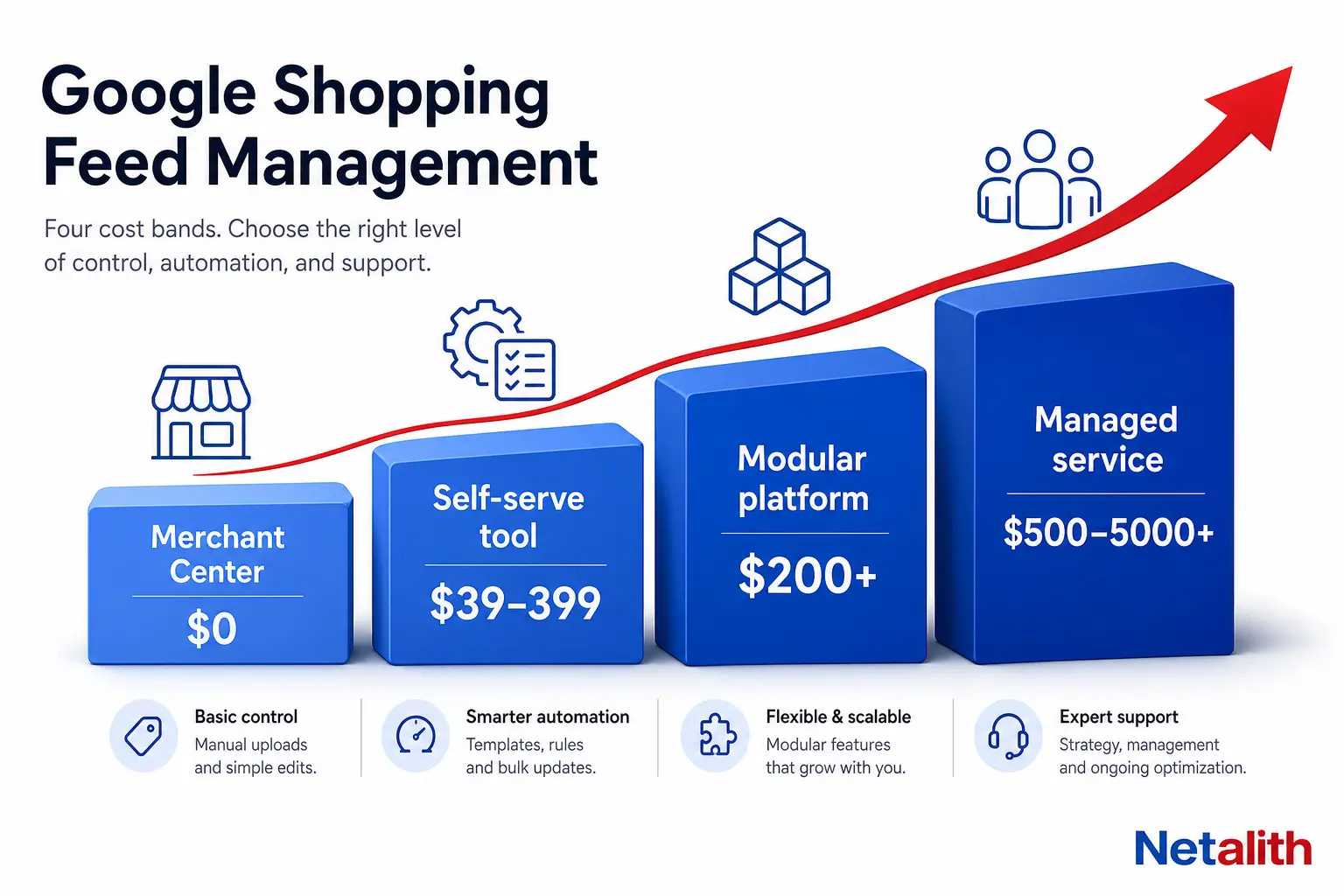
There is no single price, there are four bands — and they sit roughly two orders of magnitude apart. Knowing which band you belong in answers the budgeting question faster than any tool comparison.
| Model | Typical monthly cost | Who does the work | Where it breaks down |
|---|---|---|---|
| Merchant Center on its own | $0 | You, by hand or via your store platform | More than one country, one channel, or a catalogue that changes during the day |
| Self-serve feed tool | $39 – $399 | You, with a rule engine | You need people, not software |
| Modular platform (feeds + add-ons) | ~$64 base, often €200+ fully loaded | You, plus vendor support | Module stacking outgrows the budget you approved |
| Fully managed feed service | ~$500 – $5,000+, quote only | The vendor's team | Your catalogue is small enough to self-serve |
Almost nobody is actually choosing between the two ends of that table. The real decision is band two against band four, and it is a labour decision dressed up as a software decision. Everything below is about working out which one your catalogue puts you in.
Why your SKU count, not your product count, sets the price
This is the single biggest source of budget surprise in feed management, and it catches people on their first invoice. Feed tools bill on items imported, and an item is a variant, not a product page.
Channable states it directly in its pricing documentation: each SKU imported counts as one item, size and colour variants included, and you are told to count everything you will import even if you never advertise it. DataFeedWatch bills the same way — the number charged is the product count in your source feed, variants included.
What that does to a modest catalogue:
| Store | Product pages | Average variants | Billable items | Tier it lands in |
|---|---|---|---|---|
| Auto parts, single fitment | 800 | 1 | 800 | Entry (1,000 items) |
| Apparel, size × colour | 400 | 8 | 3,200 | Mid (5,000 items) |
| Auto parts, multi-fitment | 800 | 4 | 3,200 | Mid (5,000 items) |
| Furniture, finish × size | 1,200 | 6 | 7,200 | Upper mid (20,000 items) |
The practical consequence: filter at the source, not inside the tool. Your bill is set at the moment of import, so excluding discontinued lines, permanently out-of-stock variants and products below your margin floor has to happen in the export from your store, before the feed tool ever sees them. Filtering them out with a rule inside the platform cleans up your channel output and does nothing at all to your invoice.
Self-serve feed tool pricing compared
Published tiers as of October 2026. Prices move, so treat these as the shape of the market and confirm the current number on each vendor's own pricing page before you commit to annual billing.
| Tool | Entry | Mid | Top self-serve | Overage / notes |
|---|---|---|---|---|
| GoDataFeed | $39 — 1,000 SKUs, 1 sync/day | $99 — 5,000 SKUs, 4 syncs/day | $199 — 20,000 SKUs, 16 syncs/day; $399 — 40,000 SKUs, 24 syncs/day | Managed tier quoted separately |
| DataFeedWatch | $64 — 1,000 products, 1 shop, 3 channels | $84 — 5,000 products, 10 channels | $239 — 30,000 products, 150 channels, unlimited shops | $5 / $3 / $2 per extra 1,000 products by tier |
| Channable | From roughly €39 / $49, feeds only | Package × Core plan (Standard, Plus, Pro) | Enterprise on application | Marketplaces, repricing, PPC and image modules priced on top |
| Feedonomics | Quote only, managed; third-party reports commonly put it between roughly $500 and $5,000+ per month | No percentage of revenue taken | ||
What the higher tiers are actually selling you
Read those ladders again and the pattern is obvious once you see it: the rule engine is on every tier. What you buy as you climb is capacity and refresh rate. GoDataFeed's ladder runs 1 → 4 → 16 → 24 syncs per day. Channable's Core plans run one data sync per day, up to three, then up to twenty-four.
So the plan question is not really "how big is my catalogue". It is how fast does my truth go stale. A furniture store whose stock moves weekly is wasting money on hourly syncs. A parts seller with single-unit stock levels and frequent price changes is losing more to stale availability data — disapprovals, wasted clicks on items already sold — than the tier upgrade costs. Price your refresh rate off stock velocity, then check the SKU ceiling second.
When free Merchant Center is genuinely enough
Merchant Center itself costs nothing. Scheduled fetch of a feed file, supplemental feeds and the native integrations most store platforms ship are all included. Paying for a feed tool when you do not need one is the most common waste in this category, so here is the honest line.
Free is enough when all of these hold:
- One country, one currency, one language
- Google is the only destination you care about
- A few hundred SKUs, and your platform already emits a compliant feed
- Prices and stock change daily at most
- You are not fighting recurring disapprovals
It stops being enough at the first of these:
- A second country or currency, which means a second channel and different shipping and tax data
- A second destination that wants different titles, categories or images from the same catalogue
- Variant-level data your platform exports badly — GTINs, colours, sizes collapsed into the parent
- Intraday stock movement, where a once-a-day fetch means advertising items you have already sold
- Disapprovals you cannot fix at source because the fix belongs in the feed, not in the product record
A $64 per month tool that recovers forty disapproved SKUs has paid for itself before the first invoice clears. The same tool bolted onto a 200-SKU single-country store buys you nothing that a clean export and a scheduled fetch do not already do.
The 2026 line item nobody budgeted for
If your feed reaches Merchant Center through code you own, your cost base changed this year. Google's Content API for Shopping reached its sunset on , and from calls from projects without an active extension start failing intermittently with HTTP 410. Everything programmatic has to be on the Merchant API.
This quietly rewrote the build-versus-buy maths. A homegrown script pushing products to the Content API used to be the cheapest option on the table: no licence, no per-SKU ceiling, total control. It now carries a migration project and a permanent maintenance line — resource paths, identifier format and batching all changed, and Google has said new features land in the Merchant API first.
The failure mode is what makes it a budget item rather than a technical one. A broken feed integration does not stop your campaigns; it stops your updates. Prices, stock and shipping data freeze while the ads keep spending against them. Two questions worth asking before you renew anything:
- Ask your feed vendor plainly whether they are on Merchant API v1 and when their migration completed. One quirk to expect: after a vendor migration, Merchant Center may still display "Content API" as the data source name, which is cosmetic.
- Audit every integration you own, not just the main one — reporting scripts, inventory pushes and old plugins touch the same endpoints. If that audit turns up code nobody has owned since it was written, product feed management and Merchant Center integration is the kind of work that is cheaper to hand over than to re-learn.
Tool, managed service or agency — where the money actually goes
| Option | Monthly | What you are buying | The question it answers |
|---|---|---|---|
| Self-serve tool | $39 – $399 | A rule engine. You supply the hours and the judgement | Can my team own this? |
| Managed feed service | ~$500 – $5,000+ | People who own the output, not software you operate | Is feed work eating a person? |
| Agency or specialist retainer | Priced to scope | Feed treated as one input to campaign performance | Is the feed the problem, or the campaigns? |
| In-house build | Developer time | Total control, plus the Merchant API maintenance above | Is our catalogue genuinely unusual? |
Convert the licence into hours and the decision gets easier. A $99 per month tool against six hours a month of someone fixing disapprovals means you are already paying more in labour than in software — and the labour number is the one that grows with your catalogue. Managed starts to make sense somewhere around the point where feed work exceeds a day a month, or where a single recurring disapproval is costing more in lost impressions than the service fee.
One useful filter when comparing managed quotes: whether the vendor takes a percentage of revenue or GMV. Flat SKU-and-channel pricing is predictable as you grow; a revenue share quietly reprices your success. Ask which model is on the contract before the discount conversation starts.
Sizing the budget against your Shopping ad spend
A starting heuristic rather than a law — catalogue volatility and country count move this more than spend does — but it stops the two common mistakes, which are paying enterprise prices on a 300-SKU store and running a $40,000 month on a spreadsheet.
| Monthly Shopping spend | Sensible feed budget | What that buys |
|---|---|---|
| Under $2,000 | $0 – $50 | Merchant Center plus a platform app or an entry tool |
| $2,000 – $10,000 | $50 – $250 | Mid self-serve tier, more syncs, multiple channels |
| $10,000 – $50,000 | $250 – $1,000 | Top self-serve tier plus specialist hours on the data |
| Over $50,000 | $1,000+ | Managed service, or a tool plus a named owner |
Roughly one to three percent of Shopping spend on feed infrastructure is a defensible range. Below about $2,000 a month in spend, tooling is almost never the bottleneck — the data quality in your product records is, and no licence fixes that for you.
If you are not sure which band you are in, the honest answer usually comes from two numbers you can pull this afternoon: your billable item count including variants, and the hours someone spent on feed errors last month. If you would rather have those sized by someone who has done the migration work, ask for a scoped quote and bring both numbers with you.
CÂU HỎI THƯỜNG GẶP
Câu hỏi thường gặp
How much does Google Shopping feed management cost per month?
It falls into four bands. Merchant Center on its own is free. Self-serve feed tools run roughly $39 to $399 a month depending on SKU count and sync frequency. Modular platforms start near $64 for feeds only but often land above €200 once marketplace, repricing and PPC modules are added. Fully managed services are quote-only and commonly sit between about $500 and $5,000+ a month. Most stores are choosing between the self-serve band and the managed band, and that is a staffing decision more than a software one.
Do feed management tools charge per product or per variant?
Per variant, in almost every case. Channable counts each imported SKU as one item, size and colour variants included, and DataFeedWatch bills on the product count in your source feed, variants included. An apparel store with 400 product pages and eight variants each is billed for 3,200 items, not 400. Filter unwanted SKUs out of the export from your store rather than with a rule inside the tool, because the bill is set at the point of import.
Is there a free way to manage a Google Shopping feed?
Yes. Merchant Center costs nothing, and scheduled fetch of a feed file, supplemental feeds and the native integrations most store platforms ship are all included. That is genuinely enough for a single-country, single-channel store with a few hundred SKUs whose prices and stock change daily at most. It stops being enough the moment you add a second country, a second channel wanting different titles, variant-level data your platform exports badly, or intraday stock movement.
Why did my feed tool bill go up when I did not add products?
Three usual causes. New variants on existing products raise your billable item count. Selling into an extra country adds a channel, and channel count is a tier input even when the catalogue is identical. And several vendors upgrade your subscription automatically when you exceed the usage limit rather than failing the sync, so the tier moves without anyone approving it. Check your billable item count including variants before each renewal.
Does the Merchant API migration add cost to feed management?
Only if you own the integration. Google's Content API for Shopping reached its sunset on 18 August 2026, and from 1 September 2026 calls from projects without an active extension begin failing with HTTP 410, so anything programmatic must run on the Merchant API. Managed tools absorbed this for their customers. Homegrown scripts carry a migration project plus ongoing maintenance, and the failure mode is silent: campaigns keep spending while prices and stock stop updating.