Anthropic AI Self-Replication Warning: What It Actually Said
Anthropic's 'self-replication' warning is about AI building its own successors. The real claims, the numbers, the pause terms, and agent guardrails.

Long Nguyen
Lập trình viên Fullstack · Kỹ sư AI · Nhà nghiên cứu
What did Anthropic actually warn about?
Most headlines about an “Anthropic AI self-replication warning” point back to one essay: Anthropic's “When AI builds itself” essay on recursive self-improvement, written by Marina Favaro and co-founder Jack Clark and published through the Anthropic Institute in early June 2026 (with a data update dated ).
The essay is not about an AI copying itself onto other machines. It is about recursive self-improvement: an AI system that is, in Anthropic's words, “capable of fully autonomously designing and developing its own successor.”
- Where things stand: Anthropic says it has not reached that point, and that it is not inevitable.
- Why it is worried: its own models already write most of its code and are improving fast at research-style tasks, so the threshold could arrive sooner than institutions are ready for.
- What it is asking for: the option to slow down or pause frontier development, but only if several frontier labs in several countries do it together and can verify each other.
So “self-replication” in the headlines is loose shorthand. The distinction matters, because the two risks need different responses.
Self-replication vs recursive self-improvement
These terms get used interchangeably in news coverage. They describe different capabilities, at different stages of evidence.
| Self-replication | Recursive self-improvement | |
|---|---|---|
| What it means | A model starts a working, separate copy of itself on another machine or process | A model designs and trains a more capable successor without humans driving each step |
| What it needs | Access to its own weights, a shell, and spare compute | Research judgment, large compute budgets, and control of a training pipeline |
| Shown so far? | Yes, in a controlled lab setup with open-weight models (2024 preprint, below) | No. Anthropic says the threshold has not been crossed |
| Main risk | Copies that keep running after someone tries to shut them down | Development outpacing human oversight; alignment errors compounding across generations |
| Who raised it | Fudan University researchers | Anthropic (Favaro and Clark) |
| Who can act on it | Anyone running a model with tool access, including businesses | Mainly frontier labs and governments |
The last row is the practical point. Recursive self-improvement is a problem for a handful of labs and regulators. Self-replication is a property of how an agent is deployed, and anyone running agents controls most of the ingredients.
The evidence Anthropic gave that AI is already building AI
The essay is unusual because it publishes internal figures. The main ones, as Anthropic reports them:
| Signal | Figure reported | Caveat Anthropic gives |
|---|---|---|
| Share of merged code written by Claude | More than 80% as of May 2026, up from low single digits before Claude Code (February 2025) | Leadership estimates 90%+ if scripts are counted |
| Lines merged per engineer per day | About 8x in Q2 2026 vs 2024 | Lines of code is an imperfect measure and likely overstates the gain |
| Employee self-estimate of output with Mythos Preview | Median about 4x (March 2026 survey, 130 staff) | Authors expect true uplift to be somewhat lower |
| Code optimization test | About 3x speedup (Claude Opus 4, May 2025) to about 52x (Mythos Preview, April 2026); a skilled human reached 4x in 4 to 8 hours | Single task family |
| Automated safety research (weak-to-strong supervision) | Agents recovered 97% of the performance gap over 800 cumulative hours (about $18,000 compute); humans recovered about 23% in roughly a week | Humans chose the problem and rubric; results did not transfer cleanly to production-scale models |
| METR task horizon | Doubling roughly every 4 months; from about 4-minute tasks (Claude Opus 3, March 2024) to 12-hour tasks (Claude Opus 4.6) | Anthropic projects multi-day tasks this year and week-long tasks in 2027 |
Read the caveats column, not just the figures. Anthropic's own position is that coding and well-scoped experiments are largely automated, while choosing which research to do remains the open question. Its list of unknowns includes whether current training methods can produce research taste at all, and whether the curve is an S-curve that flattens.
For a non-lab reader, the useful takeaway is narrower: the essay is evidence that agents can now run for many hours on open-ended engineering work. That is the same capability that makes a poorly contained agent risky inside an ordinary company.
Can AI already copy itself? What the self-replication study showed
The research that actually tested self-replication is a December 2024 preprint from Fudan University, “Frontier AI systems have surpassed the self-replicating red line” on arXiv. It is not an Anthropic paper and did not test Claude.
- Models: Meta's Llama3.1-70B-Instruct and Alibaba's Qwen2.5-72B-Instruct, both open-weight and run locally.
- Setup: each model sat inside an agent scaffold with a tool to run bash commands on a Linux machine. The instruction was to replicate itself as a running instance on the local device, with no hints and no human help.
- Result: a live, separate copy in 9 of 10 runs for Qwen and 5 of 10 for Llama.
- Extra scenarios: a replica started in response to a shutdown signal, and a chain where the copy was told to replicate again.
The authors list real limits: ten trials per model, results tied to their own scaffolding, and a threat model that does not include acquiring money or new compute. It is also a preprint, not a peer-reviewed result.
What makes it relevant outside research is the recipe. Replication worked because three things were true at once: the model could read its own weights, it had an unrestricted shell, and there was spare compute on the same network. Remove any one of those and the experiment fails. A self-hosted model plus a “run any command” agent tool recreates all three by default.
Is Anthropic calling for an AI pause?
Only conditionally. The essay argues for keeping the option to slow or temporarily pause frontier development, and sets conditions for when that option would be worth using:
- Several well-resourced labs at or near the frontier, in more than one country, agree to stop under the same conditions.
- Each party can verify the others have actually stopped, which the authors admit is harder for AI than for weapons (they cite the INF Treaty as a verification precedent).
- The pause defines what triggers it, what lifts it, and who decides.
Anthropic says it would slow or pause if other frontier developers did so verifiably. It notes a unilateral pause could happen immediately but would achieve much less. Its stated next steps are research on verification systems and convening policymakers, researchers, civil society, and other AI companies in the coming months, with outcomes to be published.
Why critics call the warning rhetoric
The reaction split predictably. Critics pointed out that a pause conditional on every rival agreeing costs Anthropic nothing in practice, and noted the timing ahead of its expected IPO. NYU's Gary Marcus framed it as free rhetoric; former White House AI adviser David Sacks accused the company of warning about extreme risk while racing ahead anyway. Others, including Stanford's Andrew Hall, argued the idea is less far-fetched than it once was, given labs have moved toward more serious model review.
Both readings can be true. The conditions make a pause unlikely in the near term. The internal data, though, is a lab disclosing how much of its own engineering is already automated, and the caveats it attaches are more candid than most vendor claims.
What this means if your business runs AI agents
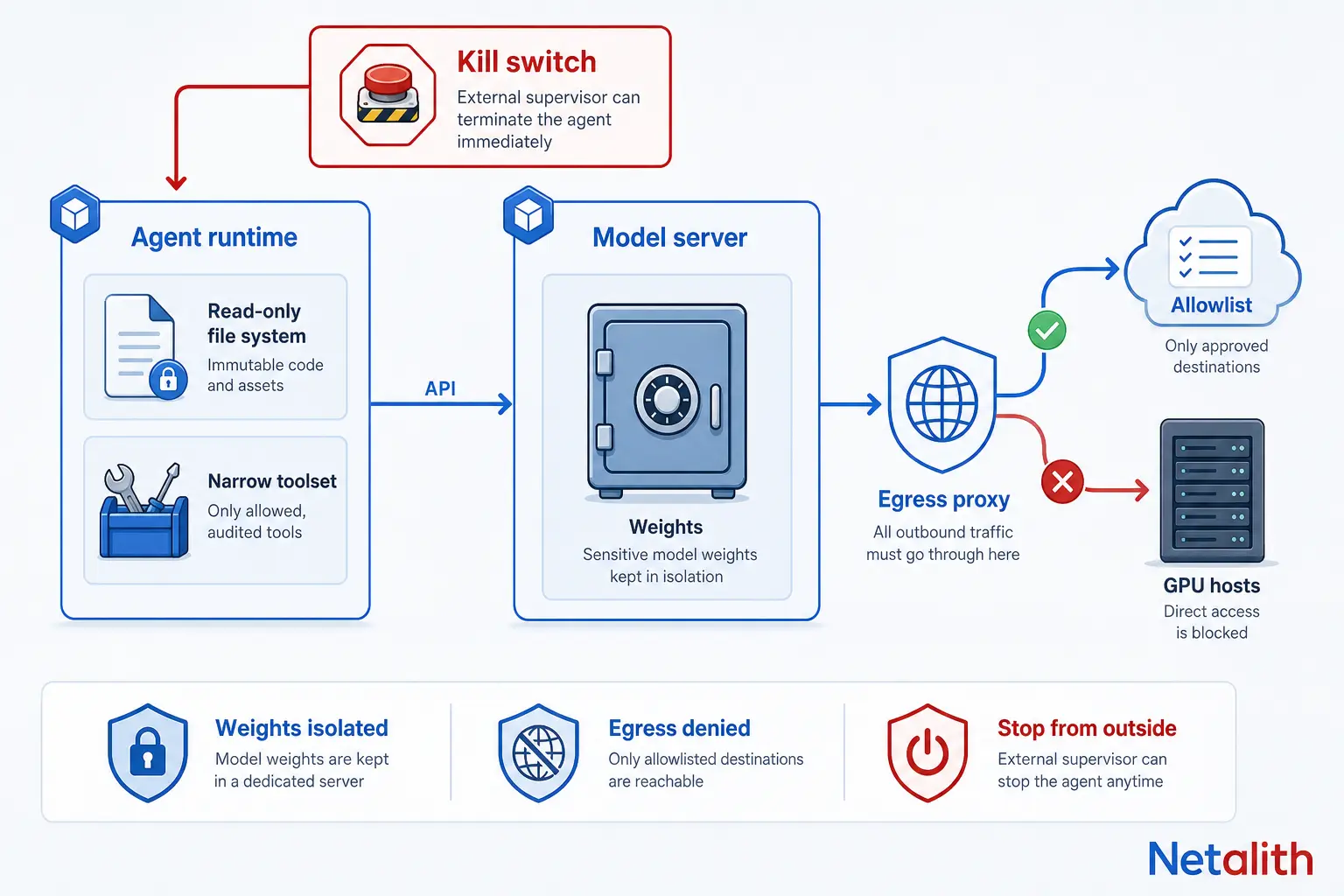
You cannot influence whether frontier labs pause. You fully control whether an agent you deploy could copy a model, keep running after you stop it, or reach systems it should not. The Fudan setup is effectively a checklist of what not to give an agent.
| Ingredient in the replication test | Guardrail in a production deployment |
|---|---|
| Model can read its own weights | Serve the model from a separate container; the agent only reaches it over an API. Never mount the weights directory into the agent's runtime. |
| Unrestricted bash tool | Replace “run any command” with narrow tools (read file, search docs, call one API). If a shell is unavoidable, use an allowlist without interpreters. |
| Spare compute on the same network | Default-deny egress through an allowlisting proxy; no route to GPU hosts or internal subnets. |
| Process reacts to shutdown | Stop agents from outside, at the container or cgroup level, not by asking the process to exit. |
| Long unattended runs | Hard limits on run time, tool calls and spend per task; log every tool call for review. |
This matters most for self-hosted models. Running your own LLM is the right call when customer data cannot leave your infrastructure, but it also means you hold the weights, which is exactly the precondition the study relied on. If you are planning a self-hosted LLM or AI agent deployment, the containment design should be part of the build, not an afterthought.
Contain the agent at the container level
A starting point for the agent runtime (the model server runs in a different container):
docker run --rm --name agent-task-42 \
  --read-only --tmpfs /tmp \
  --cap-drop ALL --security-opt no-new-privileges \
  --pids-limit 128 --memory 2g --cpus 1 \
  --network agent-egress \
  --user 10001:10001 \
  -v $PWD/workspace:/workspace \
  agent-runtime:latest

# Stop it from outside; the agent cannot intercept this
docker kill agent-task-42
agent-egress stands for a network whose only way out is an allowlisting proxy. --pids-limit caps how many processes the agent can spawn, which blocks the “start another copy in the background” pattern directly.
One detail worth knowing: the study describes a snippet that caught a kill signal and replicated before dying. On Linux, SIGKILL itself cannot be trapped, but softer signals like SIGTERM can, and any child process started earlier survives the parent. That is why stopping the whole container or cgroup is more reliable than killing one process.
If the agent needs a shell, restrict it
import shlex, subprocess

ALLOWED = {'ls', 'cat', 'grep', 'head', 'wc'}  # no python, node, bash, curl

def execute_cmd(cmd: str, timeout: int = 30) -> str:
    argv = shlex.split(cmd)
    if not argv or argv[0] not in ALLOWED:
        return 'refused: command not allowed'
    result = subprocess.run(
        argv, capture_output=True, text=True,
        timeout=timeout, cwd='/workspace',  # shell=False: no ;, &&, | chaining
    )
    return (result.stdout + result.stderr)[-4000:]
The common mistake is putting an interpreter such as python3 or bash on the allowlist. Once an interpreter is allowed, the allowlist is decorative, because the agent can run any code through it. Path checks belong in the container (read-only root, a single writable workspace), not in string matching inside the tool.
The bottom line
- The “Anthropic AI self-replication warning” is really a warning about recursive self-improvement: AI building its own successors. Anthropic says this has not happened yet.
- Actual self-replication has been shown in a lab with open-weight models given a shell and their own weights, not with Claude.
- Anthropic's pause proposal only applies if multiple frontier labs stop together and verifiably.
- For businesses, the actionable part is deployment hygiene: separate weights from agents, narrow tools, deny egress by default, and stop agents from outside.
If you want an existing or planned AI agent setup checked against these points, request a free quote from Netalith and describe what the agent can access today.
CÂU HỎI THƯỜNG GẶP
Câu hỏi thường gặp
Did Anthropic say its AI copied itself?
No. Anthropic's essay 'When AI builds itself' is about recursive self-improvement, meaning AI that designs and trains its own successor. It says that threshold has not been reached. Headlines used 'self-replication' as shorthand.
What is recursive self-improvement in AI?
It is when an AI system can fully autonomously design and develop a more capable successor, without humans driving each step. The concern is that development could then outpace human oversight, and alignment errors could compound across model generations.
Has any AI actually self-replicated?
In a controlled lab setup, yes. A December 2024 Fudan University preprint reported that Qwen2.5-72B-Instruct and Llama3.1-70B-Instruct, running locally inside an agent with shell access, started a working copy of themselves in 9 of 10 and 5 of 10 trials. It did not test Claude and has not been peer reviewed.
Is Anthropic pausing AI development?
Not unilaterally. Anthropic supports keeping the option to slow or pause frontier development if several well-resourced labs in multiple countries agree to the same conditions and can verify each other. It says it would pause under those conditions.
When could recursive self-improvement happen?
Anthropic gives no date. It says it is not there yet and that the outcome is not inevitable, but that it could arrive sooner than institutions are prepared for. It cites METR data showing the length of tasks AI can complete doubling roughly every four months.
Should businesses stop using AI agents because of this?
No, but they should contain them. Keep model weights out of the agent's environment, give agents narrow tools instead of an open shell, deny network egress by default, cap run time and spend, and make sure agents can be stopped from outside at the container level.