Fees for Amazon Sellers in 2026: What Actually Comes Out of Every Sale
Fees for Amazon sellers in 2026: referral, FBA, storage and the new 3.5% fuel surcharge, plus the math to find your real net per sale.

Long Nguyen
Développeur fullstack · Ingénieur IA · Chercheur
Every seller knows the 15% number. Almost nobody can tell you, without opening a report, what percentage of a given order actually lands in their bank account. The gap between those two figures is where thin-margin Amazon businesses quietly die.
Fees for Amazon sellers are not one charge. They are a stack of five or six independent charges, each calculated on a different base — some on your sale price, some on your package dimensions, some on how long a unit sat in a warehouse, and, since April 2026, one that is calculated on top of another fee. This guide breaks the stack apart, shows the arithmetic on a real order, and covers what changed in 2026.
How much do fees for Amazon sellers actually cost per sale?
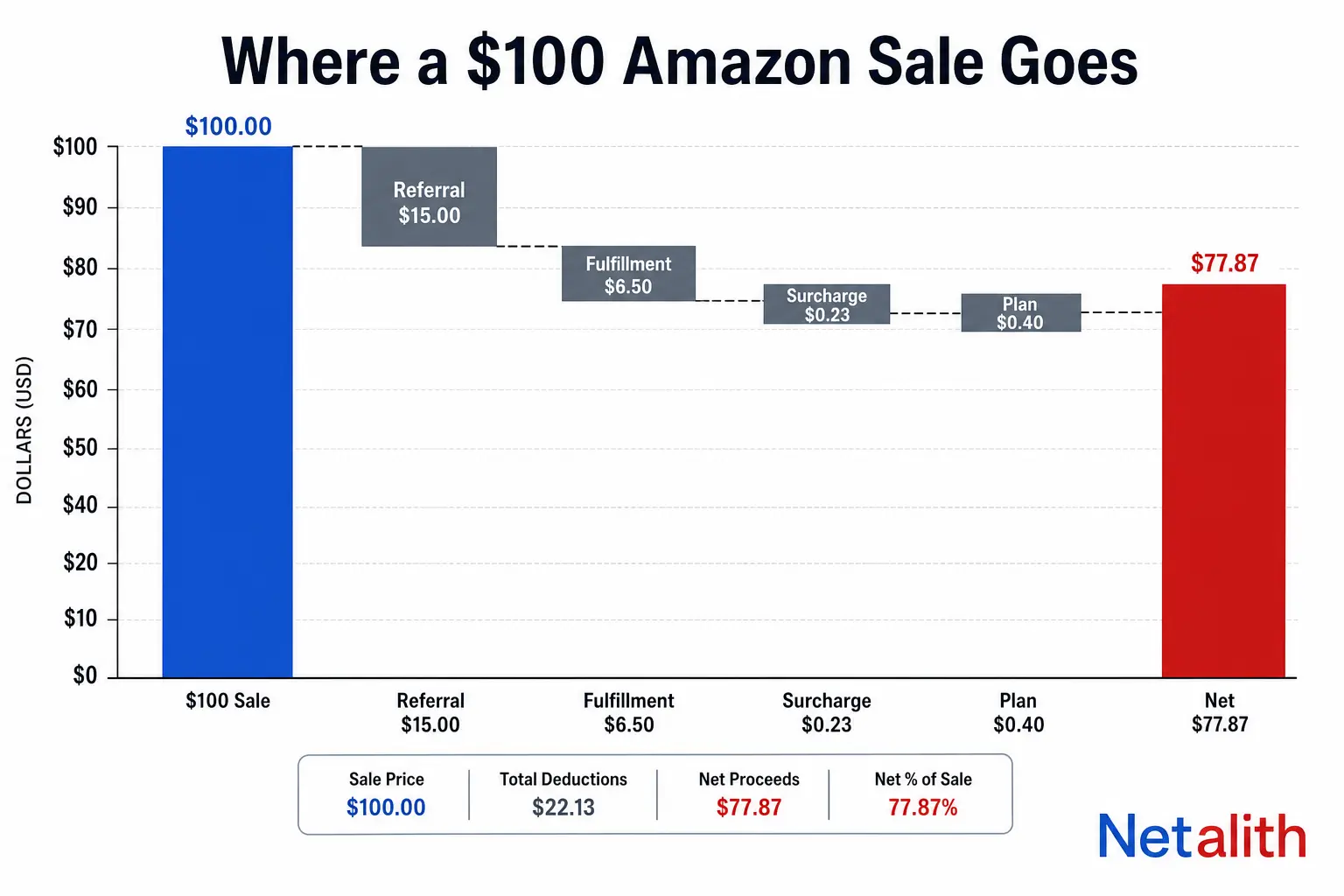
There is no single answer, because the fees are charged on different bases. The mental model that matters is this: only one of your fees is a percentage of revenue. Everything else is a flat per-unit charge, which means your effective take rate moves inversely with your average selling price.
Here is the full stack on one FBA order, using a $100.00 product in a 15% referral category, large standard size. The fulfillment figure is the one number you must pull from your own rate card — it varies by size tier and price band — so it is marked as such.
| Fee | Charged on | On a $100.00 sale |
|---|---|---|
| Professional selling plan | $39.99 per month, flat — not per unit | $0.40 at 100 units/month |
| Referral fee | Total sales price, including shipping and gift wrap you charge | $15.00 |
| Variable closing fee | Flat per unit, media categories only | $0.00 (not applicable) |
| FBA fulfillment fee | Per unit, by size tier and price band | your rate card, e.g. $6.50 |
| Fuel and logistics surcharge | 3.5% of the fulfillment fee | $0.23 |
| Monthly inventory storage | Cubic feet per month, higher in Q4 | spread across units held |
| Returns processing | Per returned unit, in higher-return categories | only on returns |
Marketplace fees on that order come to roughly $22.13, or about 22% — not 15%. And that is before cost of goods, inbound freight, advertising, or the returns you will eat.
Now run the same stack on a $12.00 item. The referral fee drops to $1.80, but the fulfillment fee barely moves, because a box does not get cheaper to pick and ship just because you priced it lower. That is the entire economics of low-ASP Amazon selling in one sentence: flat fees are regressive. A product under roughly $15 spends a far larger share of its price on fulfillment than the category percentage ever suggests.
The two fee floors that catch new sellers
- The $0.30 minimum referral fee. Most categories apply it. On a $1.50 item, that $0.30 is a 20% effective referral rate, not 15%. Sub-$2 products are almost never viable on Amazon for this reason alone.
- Referral is charged on the total sales price. If you sell FBM at $20.00 plus $5.99 shipping, the referral fee is calculated on $25.99, not $20.00. Sellers who price shipping separately to look cheaper are paying referral fees on their own freight.
Amazon referral fees by category: the percentage everyone quotes
The referral fee is Amazon's commission and the single largest line on most orders. Rates run from 5% to 45% depending on category, though the great majority of physical goods sit between 8% and 15%. Amazon publishes the authoritative table on its official selling fees page, and it did not introduce new referral fee types in the US for 2026 — rates have now held steady across two consecutive years.
What generic fee articles miss is that several categories are tiered or conditional, so the headline percentage is often not the rate you pay:
| Category | Published rate | What it actually means |
|---|---|---|
| Clothing & Accessories | 5% at $15.00 or less | Price-banded. Crossing a band boundary changes your rate, not just your revenue. |
| Electronics Accessories | 15% up to $100.00, then 8% | Split-rate. Only the portion above $100.00 gets the lower rate. |
| Amazon Device Accessories | 45% | The ceiling. Verify the category before you source, not after. |
| Most categories | Typically 8%–15% | Subject to the $0.30 minimum referral fee. |
| Fine Art | Tiered | Carries a $1.00 minimum instead of $0.30. |
Books, DVD, music, software and video also carry a variable closing fee of $1.80 per item on top of the referral fee. On a $6.99 paperback that single flat charge is more than a quarter of the sale price — which is why media sellers live or die on sourcing cost, not on pricing strategy.
One practical note worth more than any rate table: new sellers can qualify for automatic referral-fee waivers in their first year, worth up to $50,000 in total incentives. If you are modelling year-one unit economics, model them twice — once with the waivers and once without — because the second model is the business you actually have in year two.
The FBA fees that never show up in a calculator
Fulfillment fee calculators answer one question: what does it cost to pick, pack and ship this unit once. That is the fee sellers plan for. The fees that surprise them are the ones tied to inventory behaviour rather than to sales.
| Fee | Trigger | Why it bites |
|---|---|---|
| Monthly inventory storage | Cubic feet held, charged monthly | Rates rise sharply in October–December, exactly when you are holding the most stock. |
| Aged inventory surcharge | Units sitting past defined age thresholds | Compounds monthly. Slow movers can eventually cost more in storage than they will ever sell for. |
| Low-inventory-level fee | Sustained thin weeks-of-cover on an FBA SKU | Penalises the cash-conservative strategy of running lean. Under-stocking is now a billable event. |
| Inbound placement service fee | Sending inventory to fewer destinations than Amazon requests | You pay either the placement fee or the freight cost of splitting shipments. There is no free option — only a cheaper one per shipment. |
| Returns processing | Per returned unit in higher-return categories | Charged on the return, while the referral fee refund on the original sale is not always complete. |
| Removal and disposal | Per unit removed or destroyed | The exit cost of a failed product. Budget it before you place the first PO, not after. |
The pattern is consistent: Amazon has steadily shifted fees away from the moment of sale and toward the way you operate your inventory. Two sellers with identical products, identical prices and identical sales volume can now have materially different fee profiles purely because one manages weeks-of-cover well and the other does not.
What changed in 2026: the January rate card and the April surcharge
Two separate events moved fees for Amazon sellers this year, and they work very differently.
January 2026: the annual rate card
Effective , Amazon updated US FBA fees. The headline is that fulfillment fees rose by an average of $0.08 per unit sold — less than 0.5% of the average item's selling price — with adjustments spread across fulfillment, inbound placement, storage, aged inventory, low-inventory-level, removal, disposal and returns processing. Referral fees were left alone, as they were in 2025.
An $0.08 average is genuinely modest. But it is an average, and the 2026 fulfillment schedule prices small standard items in three bands — under $10, $10 to $50, and over $50. If your ASP sits close to a band boundary, your per-unit change can be several times the average in either direction. Check your own tiers; do not plan from the headline.
April 2026: the 3.5% fuel and logistics surcharge
The larger story is the surcharge Amazon announced in April. From , a 3.5% fuel and logistics-related surcharge applies to fulfillment fees across FBA in the US and Canada, and to Remote Fulfillment with FBA from the US into Canada, Mexico and Brazil. From it extends to Buy with Prime in the US and Multi-Channel Fulfillment in the US and Canada. Amazon describes it as temporary and says it will continue to evaluate it as conditions evolve, but has published no end date. The full notice is in Amazon's Seller Central announcement.
The critical detail, and the one most commentary got wrong in the first week: the surcharge is calculated on your fulfillment fees, not on your sale price. That distinction is worth real money. 3.5% of revenue on a $100 order would be $3.50; 3.5% of a $6.50 fulfillment fee is $0.23.
But because it rides on a flat fee, the surcharge inherits the same regressive shape as everything else in the FBA stack:
| Sale price | Illustrative fulfillment fee | 3.5% surcharge | Surcharge as % of revenue |
|---|---|---|---|
| $100.00 | $6.50 | $0.23 | 0.23% |
| $30.00 | $5.50 | $0.19 | 0.64% |
| $12.00 | $4.25 | $0.15 | 1.24% |
| $8.00 | $3.50 | $0.12 | 1.53% |
Substitute your own rate-card figures and the shape holds: high-ASP sellers can absorb this without repricing, while sub-$15 catalogues lose a meaningful slice of an already thin margin. If you sell across both ends of that range, do not apply a blanket price increase — the surcharge does not affect your SKUs equally, and repricing your $100 items to cover a $0.23 charge hands share to competitors for nothing.
How to calculate Amazon selling fees before you source a product
Most Amazon selling fees calculators give you referral plus fulfillment and stop. That produces an optimistic number you cannot run a business on, because it excludes every inventory-behaviour fee and every allowance for returns and advertising.
The model below is the one worth building into a spreadsheet or a sourcing script. It computes contribution per unit, which is the only number that tells you whether a product is worth buying.
def net_per_unit(
    price,              # your list price
    shipping_charged,   # 0 for FBA/Prime
    referral_rate,      # e.g. 0.15
    fulfillment_fee,    # from YOUR rate card, by size tier + price band
    cogs,
    inbound_per_unit,   # freight + prep, amortised per unit
    storage_per_unit,   # monthly storage / expected monthly velocity
    ads_per_unit,       # total ad spend / total units, not just attributed
    return_rate,        # category reality, not your optimism
    return_cost,        # returns processing + unsellable write-off
    closing_fee=0.0,    # $1.80 on media
):
    revenue_base = price + shipping_charged
    referral = max(0.30, referral_rate * revenue_base)
    fulfillment = fulfillment_fee * 1.035   # 3.5% fuel + logistics surcharge
    returns = return_rate * (return_cost + fulfillment)

    return (
        revenue_base
        - referral
        - closing_fee
        - fulfillment
        - storage_per_unit
        - ads_per_unit
        - returns
        - cogs
        - inbound_per_unit
    )
Three modelling decisions separate a useful calculator from a comforting one:
- Divide total ad spend by total units, not by attributed units. Attributed-sales accounting makes every campaign look profitable. Organic sales subsidised by advertising are still sales you paid for.
- Charge the fulfillment fee again on the return. A returned unit consumed a fulfillment event that is not refunded, plus a return trip and often a grade-down. Modelling returns at only the processing fee understates them badly in apparel and electronics.
- Apply the surcharge multiplier inside the model, not as a footnote. It is 1.035 today. Keep it as a variable, because Amazon has called it temporary and it will either lapse or move.
If the output is positive but under roughly 10% of price, treat the product as a cash-flow liability rather than a margin business — one storage season or one return spike puts it underwater.
Where to find your real Amazon Seller Central fees, not an estimate
Every calculator, including Amazon's own fee preview, is an estimate derived from the product dimensions currently on file. The authoritative number is what Amazon actually deducted. Three places hold it, in increasing order of usefulness:
- Fee Preview report (Reports → Fulfillment). Per-SKU estimated fees based on recorded dimensions and current rates. Useful for catalogue-wide scanning, not for reconciliation.
- Settlement reports (Payments → Reports Repository). The ground truth: every fee line Amazon charged in a settlement period, per order. This is what you reconcile against, and it is the only source that catches a fee you were not expecting.
- The SP-API Product Fees API.
getMyFeesEstimateForSKUreturns a structured fee breakdown for a given price, which lets you price-test a SKU programmatically instead of guessing at band boundaries one product at a time.
The reconciliation that pays for itself is comparing settlement-report fulfillment fees against the size tier you believe a SKU occupies. Amazon measures units on intake, and a re-measurement — a slightly puffier poly bag, a revised carton — can silently move a SKU into a more expensive tier. Nothing alerts you. You see it as margin erosion weeks later, and by then you have been overcharged on every unit shipped since. Where a measurement is genuinely wrong, it can be disputed and overcharged fees reimbursed, but only if you noticed.
If you sell across several marketplaces, the same reconciliation logic applies everywhere and is worth automating rather than repeating in spreadsheets. We cover the wider cost picture in our complete guide to Amazon marketplace costs, which maps the full fee taxonomy alongside the operating costs that sit outside Amazon's invoices.
How to reduce fees for Amazon selling without losing the Buy Box
Very few Amazon fees are negotiable. Nearly all of them are engineerable, because they are triggered by thresholds — and thresholds can be designed around.
- Shrink the package, not the price. Dropping a size tier is the single highest-leverage change available to most sellers. Reducing a carton by half an inch to clear a tier boundary can beat a year of price optimisation, and it compounds: a lower fulfillment fee also means a smaller 3.5% surcharge and less cubic footage in storage.
- Price with the fulfillment bands in mind. The 2026 schedule bands small standard items under $10, $10–$50 and over $50. A SKU sitting at $9.85 and a SKU at $10.15 are not in the same cost structure. Test both sides of a boundary before assuming the higher price wins.
- Check referral tier boundaries before repricing. Split-rate categories change the marginal rate above a threshold — in Electronics Accessories, the portion above $100.00 is charged at 8% rather than 15%, which makes the economics of a bundle materially different from two single units.
- Manage weeks-of-cover in both directions. Too much inventory triggers storage and aged-inventory charges; too little triggers the low-inventory-level fee. There is now a billable penalty on both sides, so replenishment planning is a fee-reduction activity, not just an ops one.
- Do the placement-fee arithmetic per shipment. Splitting a shipment across more destinations costs freight; not splitting it costs the inbound placement service fee. Which is cheaper depends on volume, weight and lane — calculate it each time rather than defaulting to one policy.
- Move the worst offenders off FBA. Large, slow-moving, low-margin SKUs are where FBA's flat fees hurt most. Seller-fulfilled or Seller Fulfilled Prime can be cheaper per unit for those specific products, even while FBA remains right for the rest of the catalogue.
- Audit reimbursements on a schedule. Lost and damaged units, dimension errors and fee miscalculations are recoverable, but only within Amazon's claim windows. An unaudited account leaves money behind by default.
None of these require permission from Amazon. They require knowing where the thresholds sit and having clean data on which SKUs are near them — which, for most catalogues above a few hundred SKUs, means pulling the numbers through the API rather than reading reports by hand. If that reconciliation work is eating your week, our eCommerce support team builds marketplace API integrations and fee-reconciliation pipelines for exactly this problem.
FAQ
Questions fréquentes
What percentage does Amazon take from sellers?
The referral fee alone runs from 5% to 45% by category, with most physical goods between 8% and 15%. But referral is only one line. Once you add the FBA fulfillment fee, the 3.5% fuel and logistics surcharge, storage and an amortised share of the $39.99 Professional plan, a typical FBA order in a 15% category costs closer to 22% of the sale price in marketplace fees — and considerably more on low-priced items, because most of the stack is flat per-unit rather than percentage-based.
Is the Individual or Professional plan cheaper for me?
The Individual plan charges $0.99 per item sold with no monthly fee; the Professional plan charges $39.99 per month with no per-item charge. The break-even is about 40 units a month. Below that, Individual is cheaper on arithmetic alone. Above it, Professional wins — and it also unlocks bulk listing tools, advertising and Buy Box eligibility, which usually matter more than the $39.99 itself.
Is the 3.5% fuel and logistics surcharge charged on my sale price?
No. Amazon calculates it on your fulfillment fees, not on the sale price of your items. On a $100 order with a $6.50 fulfillment fee the surcharge is about $0.23, not $3.50. It took effect for FBA in the US and Canada on 17 April 2026 and extended to Multi-Channel Fulfillment and Buy with Prime on 2 May 2026. Amazon has described it as temporary but has not published an end date.
Why is my actual fee higher than the Amazon fee calculator said?
Fee previews estimate from the product dimensions currently on file and cover only referral plus fulfillment. They exclude monthly storage, aged inventory surcharges, the low-inventory-level fee, inbound placement and returns processing. The most common cause of a persistent gap is a size-tier re-measurement on intake: Amazon re-measures units, a SKU moves into a costlier tier, and nothing notifies you. Reconcile against settlement reports rather than the calculator.
Where do I see the exact fees charged on each Amazon order?
Settlement reports, under Payments then Reports Repository in Seller Central, list every fee Amazon deducted per order for a settlement period. That is the authoritative record. The Fee Preview report under Reports then Fulfillment is useful for scanning the catalogue, and the SP-API Product Fees API endpoint getMyFeesEstimateForSKU returns a structured fee breakdown for a given price if you want to test pricing programmatically.
Did Amazon raise referral fees in 2026?
No. Amazon did not introduce new referral fee types in the US for 2026, and referral rates also held steady in 2025. The 2026 changes, effective 15 January, were on the FBA side: fulfillment fees rose by an average of $0.08 per unit sold, with adjustments across inbound placement, storage, aged inventory, low-inventory-level, removal, disposal and returns processing. The separate 3.5% fuel and logistics surcharge arrived in April.
How can I lower my Amazon seller fees?
Reduce package dimensions to drop a size tier — that is the highest-leverage change most sellers have, and it lowers the fulfillment fee, the 3.5% surcharge and storage cubic footage at once. Then price with the fulfillment bands in mind (under $10, $10–$50, over $50), keep weeks-of-cover between the storage penalty and the low-inventory-level fee, calculate placement fee versus split-shipment freight per shipment, and move large, slow, low-margin SKUs off FBA.