Gemini 3.7 Flash: Google's New Coding & Agent Model Explained
Gemini 3.7 Flash is Google's new coding and agent model with a 1M-token context and $0.75/1M pricing. See what's new, benchmarks, cost, and how to use it.

Long Nguyen
Fullstack Developer · AI Engineer · Researcher

Gemini 3.7 Flash is Google DeepMind's newest workhorse AI model for coding and agents, released on August 13, 2026. It is a refinement of Gemini 3.6 Flash that arrived just three weeks after its predecessor, adding algorithmic improvements to the model's core reasoning foundation rather than a full retraining. It keeps the Flash tier's high speed and low cost while pushing gains in software engineering, document-heavy knowledge work, and web development. This guide covers what Gemini 3.7 Flash is, what changed, its benchmarks and pricing, where to access it, and how it compares to alternatives.
What is Gemini 3.7 Flash?
Gemini 3.7 Flash is the primary agentic workhorse in the Gemini 3 family, sitting between the deep-reasoning Pro models and the high-throughput Flash-Lite tier. It is multimodal, accepting text, images, audio, and video, with a 1 million token context window and up to 64K output tokens. Its knowledge cutoff is March 2026.
Google positions it as its most intelligent workhorse model yet for coding and agents, optimized for multi-step orchestration, full-stack code refactoring, and general reasoning. It launched alongside a notable gap in Google's lineup: the more powerful Gemini 3.5 Pro remained delayed at the time of release, putting extra weight on the Flash tier as Google's day-to-day model.
What's new in Gemini 3.7 Flash?
The headline change is control over the reasoning effort. Gemini 3.7 Flash exposes a thinking level you can tune to trade quality against cost and latency, with supported values of LOW, MEDIUM (the default), and HIGH. Unlike some earlier models, MINIMAL is not available and will return an API validation error.
- Better coding. It generates more deployable, production-ready code on the first try and can complete app builds in fewer prompts.
- More disciplined agents. It adapts to roadblocks, clarifies intent when needed, and puts more effort into multi-step planning and tool calls, which means fewer retries and less manual oversight.
- Stronger document work. It handles complex documents and real-world business workflows markedly better than 3.6 Flash.
- Improved Workspace tool use. It powers Google's Gemini Spark agent for more efficient knowledge work across Google Workspace apps.
Gemini 3.7 Flash benchmarks
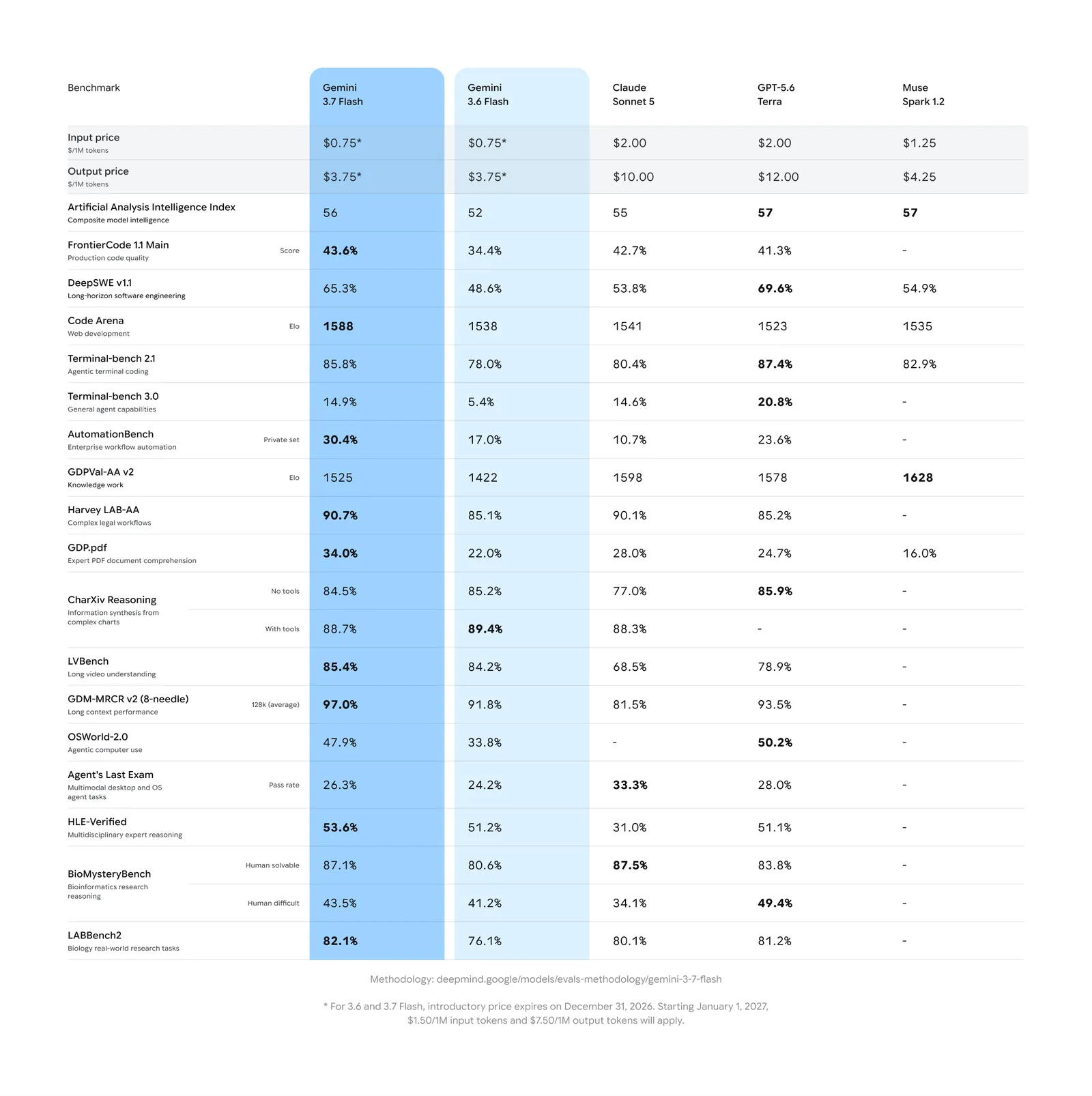
The reported gains over 3.6 Flash are concentrated in coding, agents, and document processing:
- FrontierCode: 43.6% versus 34.4%
- DeepSWE: 65.3% versus 48.6%
- WebDev Arena: 1588 Elo
- GDP.pdf (complex document processing): 34.0% versus 22.0%
- AutomationBench (real-world business workflows): 30.4% versus 17.0%
The gains are real but incremental, in line with a refinement rather than a new base model. On some evals the picture is mixed: rival GPT-5.6 Terra still leads on terminal and computer-use agents, and CharXiv shows a small regression against 3.6 Flash.
Gemini 3.7 Flash pricing
Price is the strongest part of the story. Gemini 3.7 Flash lists at $0.75 per 1M input tokens and $3.75 per 1M output tokens, roughly half the original 3.6 Flash list rate. That rate is introductory and expires on December 31, 2026; from January 1, 2027 it rises to $1.50 input and $7.50 output.
For context, in Google's own comparison Claude Sonnet 5 sits at $2.00 / $10.00 and GPT-5.6 Terra at $2.00 / $12.00 per 1M tokens. At a typical 80/20 input-output mix, that puts Gemini 3.7 Flash near a blended $1.35 per 1M tokens today, well under both rivals. For teams running agents at volume, that intelligence-per-dollar gap is the main reason to evaluate it, more than any single benchmark win.
How to access and use Gemini 3.7 Flash
The model is broadly available across Google's developer and enterprise surfaces, including the Gemini app (rolling out via Spark, which requires an AI Pro or Ultra subscription), Google Antigravity, AI Studio, Android Studio, the Gemini Enterprise Agent Platform, and the Gemini Enterprise app.
For the API, target the model string:
gemini-3.7-flashIf you are migrating from an older configuration, note a few Gemini 3.x requirements: strip temperature, top_p, and top_k from generation configs, replace thinking_budget with the thinking_level string enum, and remove candidate_count, which is unsupported in Gemini 3.x. Prefilled model turns should also be removed. Always confirm details against Google's official documentation, since API behavior can change.
Gemini 3.7 Flash vs 3.6 Flash and rivals
Against 3.6 Flash, version 3.7 is a cheaper, sharper iteration: clear coding and document gains, better agentic discipline, and roughly half the price, shipped only three weeks later. One partner reported the 3.7 Flash agent ran about 35% cheaper than 3.6 Flash with a higher prompt-cache hit rate and fewer tool errors.
Against competitors, the trade-off is clearer on price than on peak capability. Gemini 3.7 Flash undercuts Claude Sonnet 5 and GPT-5.6 Terra substantially on tokens, but GPT-5.6 Terra still holds an edge on terminal and computer-use agent tasks. The right choice depends on whether your workload is cost-sensitive at scale or leans on the specific agent capabilities where rivals lead.
Should you switch to Gemini 3.7 Flash?
Gemini 3.7 Flash is a strong default for teams building coding assistants, document-processing pipelines, and tool-using agents where cost per token matters. The tunable thinking level lets you dial latency down for real-time tasks or quality up for harder reasoning, and the low introductory price makes high-volume agent workloads far cheaper to run.
Two caveats are worth planning around. First, the introductory pricing doubles on January 1, 2027, so build your cost model on the post-introductory rate if you are committing long term. Second, it is a refinement rather than a leap, and rivals still lead on some agentic tasks, so validate it on your own workload before switching production systems. For deterministic, workflow-controlled agent pipelines, its improved instruction-following and fewer tool errors are the most practically useful gains.
FAQ
Frequently asked questions
When was Gemini 3.7 Flash released?
Google DeepMind released Gemini 3.7 Flash on August 13, 2026, just three weeks after Gemini 3.6 Flash. It continues Google's accelerated release cadence within the Gemini 3 model family.
How much does Gemini 3.7 Flash cost?
At launch it lists at $0.75 per 1M input tokens and $3.75 per 1M output tokens. That is an introductory rate that expires on December 31, 2026; from January 1, 2027 it rises to $1.50 input and $7.50 output. It is still cheaper than rivals like Claude Sonnet 5 and GPT-5.6 Terra.
What is the context window of Gemini 3.7 Flash?
Gemini 3.7 Flash supports a 1 million token context window and can return up to 64K output tokens. It is multimodal, accepting text, images, audio, and video, with a knowledge cutoff of March 2026.
How is Gemini 3.7 Flash different from 3.6 Flash?
It is a refinement of 3.6 Flash with algorithmic improvements to the reasoning foundation rather than a new pretraining run. It delivers stronger coding, document processing, and agent workflows, more disciplined tool use, and roughly half the price, shipped only three weeks later.
Where can I use Gemini 3.7 Flash?
It is available in the Gemini app via Spark (with an AI Pro or Ultra subscription), plus Google Antigravity, AI Studio, Android Studio, the Gemini Enterprise Agent Platform, and the Gemini Enterprise app. Developers can call it through the API with the model string gemini-3.7-flash.
Is Gemini 3.7 Flash good for building AI agents?
Yes. It is positioned as an agentic workhorse, with better multi-step planning, instruction-following, and fewer tool errors than 3.6 Flash, plus a tunable thinking level to balance cost and latency. Note that rival GPT-5.6 Terra still leads on terminal and computer-use agent tasks, so validate it on your workload.