Self-Hosted LLMs for Business: Why I Think Sovereign AI Is the Next Big Shift
Why businesses will move customer data onto self-hosted LLMs: CLOUD Act exposure, AI access risk, open-weight models, hardware math and a hybrid setup.

Long Nguyen
Fullstack Developer · AI Engineer · Researcher
My position in one paragraph
The most capable AI models in the world today are built by a handful of U.S. companies and served from their infrastructure. For a business outside the United States, that creates two exposures that have nothing to do with how good the models are: the data you send can be reached by U.S. legal process, and access itself can be changed or suspended by U.S. policy. My bet is that over the next few years, companies that handle sensitive customer data will move that part of their AI workload onto open-weight models they run themselves. Frontier APIs will not disappear. They will simply stop being the place where customer data goes.
This is a forecast, not a certainty. The rest of this article lays out why I hold it, where it is weaker than it sounds, and what self-hosting actually takes.
Who controls the AI your business runs on?
On , leaders from Google, OpenAI, Anthropic, Meta, xAI and Nvidia met President Trump at the White House and signed an accord to police their own AI development: internal monitoring, internal teams to check that safeguards work, and external auditors. The accord is voluntary and non-binding, and it says nothing about how customer data is handled.
Whatever you think of self-regulation, notice who was in the room. The rules that shape the models most businesses use are being negotiated between U.S. companies and the U.S. government. A clinic in Germany, a retailer in Australia or a logistics firm in Vietnam using those models has no seat at that table. Your vendor's terms of service, its government's laws and its government's priorities sit between you and your own AI stack.
That is not a conspiracy theory. It is how jurisdiction works, and it is the same reason many companies already keep their core databases on infrastructure they control.
Can the U.S. government access data you send to an AI API?
Under specific legal conditions, yes, and the server's location does not change that. The CLOUD Act, passed in 2018, clarified that U.S. providers must produce data in their possession, custody or control in response to valid U.S. legal process, even when the data is stored abroad. The U.S. Department of Justice describes the law and the data-sharing agreements built on it in its CLOUD Act resources. Separately, Section 702 of FISA allows U.S. intelligence agencies to compel U.S. service providers to help target non-U.S. persons located outside the country.
It is easy to overstate this, so here is what it does and does not mean:
| Claim | Accurate? | The precise version |
|---|---|---|
| "Choosing an EU or Asia data region protects my data from U.S. law" | No | If the provider is a U.S. company, data under its control is reachable wherever it sits |
| "The U.S. government reads everything sent to ChatGPT, Gemini or Claude" | No | Access requires legal process and targets specific data; it is not blanket reading |
| "Zero-data-retention settings remove the risk" | Partly | Data that is not stored cannot be produced later, but it still passes through the provider's systems |
| "For a regulated business this is a real compliance question" | Yes | Data protection authorities, enterprise clients and NDAs increasingly ask exactly where customer data is processed and who can compel access |
For most small and mid-sized businesses, the practical pressure will not come from a government request. It will come from a client's security questionnaire asking where their data goes when your AI touches it, and an answer of "a U.S. API" losing you the deal.
AI access can be switched off, not only read
The data question gets most of the attention, but the event that changed my thinking this year was about availability. On , Anthropic suspended access to two of its flagship models for all customers worldwide after a U.S. government directive citing national security, as explained in Anthropic's statement on the model access suspension. Access came back on , after the Department of Commerce lifted the export controls involved.
Three weeks is survivable for a chat assistant. It is not survivable if that model sits inside your order processing, your customer support or a product you sell. No contract with the vendor could have prevented it, because the vendor itself had no choice.
Open weights behave differently. Once a model's weights are on your own server, they cannot be recalled, rate-limited, repriced or switched off from outside. That property, more than raw intelligence, is what I expect businesses to start paying for.
Why self-hosted LLMs are taking off now
Self-hosting is not new. What is new is that it has become good enough and cheap enough for ordinary business work. Four things changed:
- Open-weight quality caught up for routine tasks. Extraction, classification, summarization, drafting support replies and answering questions over internal documents no longer need a frontier model. Mid-sized open models handle them well.
- There is real choice of model families. Qwen, DeepSeek and Kimi from China, Llama from Meta, Gemma from Google, gpt-oss from OpenAI and Mistral from France all publish downloadable weights under licenses that allow commercial use, with differences you must check.
- Serving software matured. Open-source inference servers such as vLLM and llama.cpp expose an OpenAI-compatible API. Code written for a hosted API can point at your own server with a configuration change.
- Buyers started asking. Data residency clauses, GDPR transfer assessments and AI questions in vendor security reviews are now routine in enterprise sales.
The uncomfortable detail about open weights
Several of the strongest open-weight families come from Chinese labs. For data sovereignty this matters less than it sounds: weights running on your own hardware send nothing back to whoever trained them. It still deserves due diligence. Read the license, test the model's behavior on your own tasks and sensitive topics, and pull weights only from the publisher's official repository. Sovereignty means you decide what runs. It does not mean trusting a model blindly because it runs locally.
Self-hosted LLM vs API: an honest comparison
| Factor | Hosted frontier API | Self-hosted open-weight model |
|---|---|---|
| Where customer data goes | Provider's infrastructure, under its jurisdiction | Your servers or your chosen local provider |
| Exposure to foreign legal process | Yes, if the provider is subject to it | Only your own jurisdiction |
| Availability control | Vendor and its government decide | You decide; weights cannot be recalled |
| Quality ceiling | Highest available | Lower on hard reasoning; enough for most routine tasks |
| Upfront cost | None | GPU hardware or reserved GPU servers, plus setup |
| Cost at high, steady volume | Grows linearly with tokens | Mostly fixed; cheaper per token once the hardware is busy |
| Cost at low volume | Cheap | Expensive; you pay for idle GPUs |
| Operations burden | Near zero | Updates, monitoring, scaling and security are yours |
| Time to first working version | Hours | Days to weeks |
Read that table honestly and the conclusion is not "self-host everything". It is: self-host the workloads where data control or availability matters more than peak intelligence.
What it actually takes to run an LLM in-house
Hardware: the memory math
The first sizing question is GPU memory. The weights alone need roughly the parameter count multiplied by the bytes per parameter: 2 bytes at 16-bit precision, 1 byte at 8-bit, about half a byte at 4-bit quantization. On top of that, the KV cache grows with context length and the number of simultaneous users, so plan 20 to 50% headroom, more for long documents or many concurrent requests.
| Model size | Weights at 16-bit | Weights at 4-bit | Typical fit |
|---|---|---|---|
| ~8B parameters | ~16 GB | ~4 GB | One 24 GB GPU; good for classification, extraction, short drafting |
| ~32B parameters | ~64 GB | ~16 GB | One 24 to 48 GB GPU quantized; solid for RAG and support agents |
| ~70B parameters | ~140 GB | ~35 GB | One 48 to 80 GB GPU quantized, or several GPUs |
| Large mixture-of-experts (hundreds of billions) | Hundreds of GB | Still very large | Multi-GPU server; only worth it at real scale |
Most business use cases I see land in the 8B to 32B range. The jump to the largest open models is rarely justified by the task. It is usually justified by a benchmark screenshot.
The software stack
- Inference server exposing an OpenAI-compatible endpoint (vLLM for multi-user production, llama.cpp for smaller or CPU-heavy setups).
- Retrieval over your own documents: a local embedding model plus a vector store such as PostgreSQL with pgvector, so the documents never leave your network either.
- Gateway for authentication, per-team quotas and logging that stays in-house.
- Evaluation set: real tasks with known-good answers, run on every model or prompt change.
The switching cost is lower than most teams expect. Serving an open-weight model and calling it with the standard OpenAI Python SDK looks like this:
# on your GPU server: serve a model downloaded from its official repository
vllm serve <model-id> --max-model-len 32768 --port 8000

# in your application: same SDK, different base_url
from openai import OpenAI

client = OpenAI(base_url="http://10.0.0.5:8000/v1", api_key="internal")

reply = client.chat.completions.create(
    model="<model-id>",
    messages=[{"role": "user", "content": "Summarize this customer ticket: ..."}],
)
print(reply.choices[0].message.content)
Changing the base URL is the easy part. The real work is behind it: checking that a smaller model calls your tools reliably, follows your output format under pressure and does not invent answers when retrieval comes back empty. The agent on netalith.com runs on a hosted API, and that is a deliberate choice: it answers from our public pages. An agent reading a client's CRM, contracts or patient records is a different calculation, and that is where I would build on a self-hosted model. If you are weighing that move for your own customer data, this is the work our AI development service for chatbots and data agents covers, from model selection and evaluation to deployment on infrastructure you control.
The realistic end state: a hybrid LLM architecture
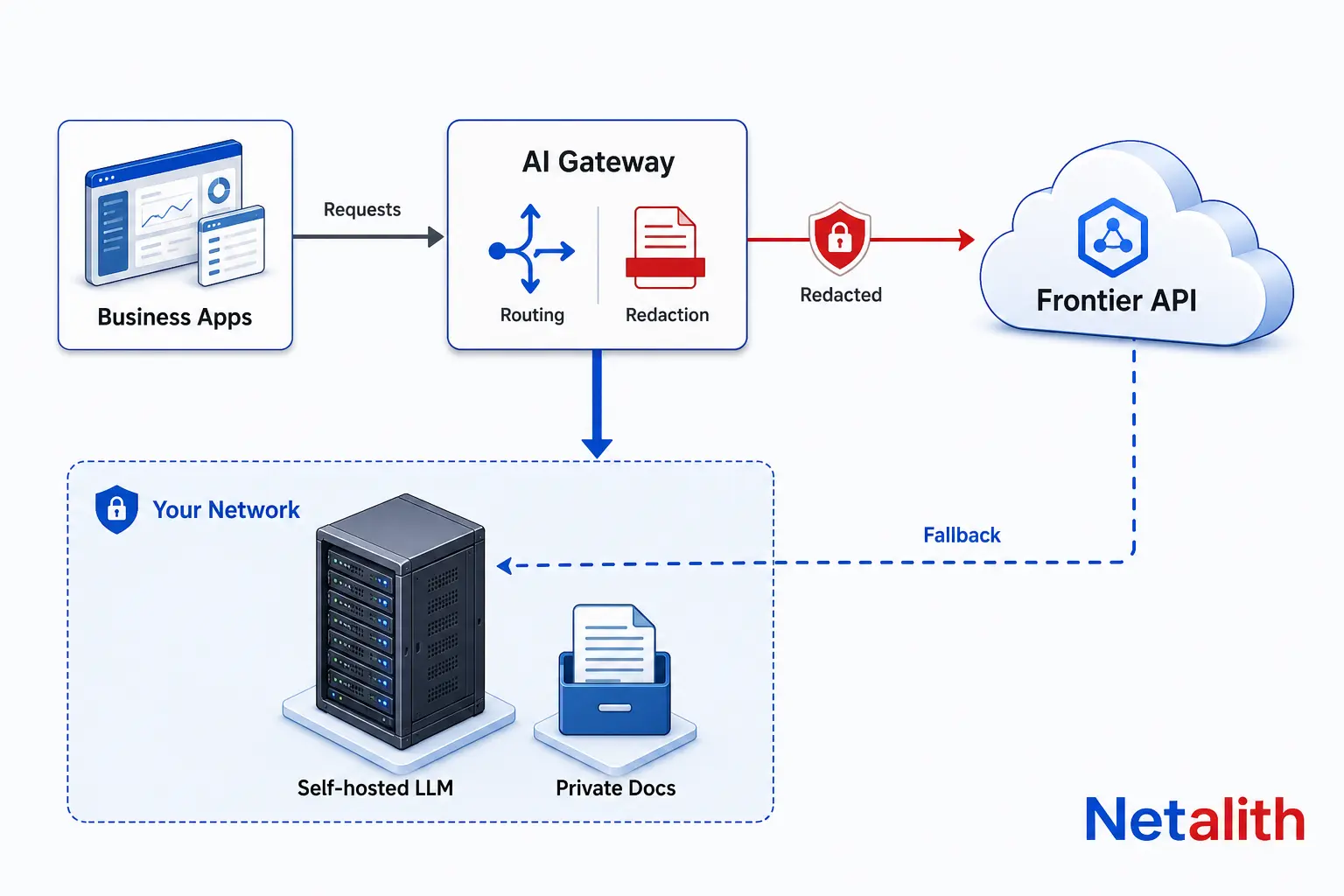
I do not expect businesses to abandon frontier APIs. I expect them to route. Sensitive data stays on a model they run. Hard reasoning over non-sensitive material goes to the strongest API available. A routing layer decides, and redacts personal data before anything leaves the network.
| Workload | Where it runs | Why |
|---|---|---|
| Support replies using customer history | Self-hosted | Personal data, high volume, routine reasoning |
| Q&A over contracts, HR files, financial records | Self-hosted with local retrieval | Confidential documents never leave the network |
| Classifying and extracting fields from orders or invoices | Self-hosted, small model | Cheap, fast, easy to evaluate |
| Marketing copy, public research, code on open-source projects | Frontier API | No sensitive data; peak quality pays off |
| Hard analysis that needs customer data | Frontier API after redaction, or self-hosted large model | Depends on how sensitive the data is and how hard the task is |
The same design solves the availability problem. If an external provider disappears for three weeks, the routing layer falls back to the local model. Quality drops for a few tasks, but the business keeps running.
When self-hosting an LLM is the wrong call
Being honest about the limits matters more than winning the argument. Do not self-host if:
- Your volume is low. A GPU that sits idle most of the day costs more than years of API calls.
- Nobody can operate it. An unpatched inference server exposed to the internet is a worse data risk than a reputable API with zero data retention.
- The task really needs frontier reasoning and the data is not sensitive. Pay for the best model and move on.
- You have no evaluation set. Without one you cannot tell whether the local model is good enough, and you will find out from customers.
Self-hosting is a trade: more control and less dependency, paid for with hardware, operations and some quality on the hardest tasks. My argument is that for customer data the trade is becoming worth it for far more businesses than it was two years ago, and that the companies that plan for it now will spend less moving later.
If you want an honest assessment of which of your AI workloads should run in-house and which can stay on an API, ask for a free quote with a short description of your data and volume. It costs nothing to ask, and the answer may well be that you do not need to self-host yet.
FAQ
Frequently asked questions
What is a self-hosted LLM?
A self-hosted LLM is an open-weight language model that runs on servers you control, either your own hardware or GPU servers you rent, instead of being called through a provider's API. Prompts, documents and outputs stay inside your infrastructure.
Can the U.S. government access data I send to ChatGPT, Gemini or Claude?
Under the CLOUD Act, U.S. providers must produce data in their possession, custody or control in response to valid U.S. legal process, even if it is stored outside the United States. That requires legal process for specific data; it does not mean the government reads everything. Zero-data-retention settings reduce what exists to be produced, but data still passes through the provider.
Is a self-hosted LLM as good as GPT, Gemini or Claude?
Not on the hardest reasoning tasks. For routine business work such as extraction, classification, summarization, support drafting and answering questions over internal documents, mid-sized open-weight models are usually good enough. Test on your own tasks before deciding.
What hardware do I need to run an LLM for my business?
It depends on model size. Weights need roughly parameters times bytes per parameter: an 8B model is about 4 GB at 4-bit, a 32B model about 16 GB, a 70B model about 35 GB, plus 20 to 50% headroom for the KV cache. Many business use cases fit on a single 24 to 48 GB GPU.
Which open-weight models can businesses use commercially?
Major open-weight families include Qwen, DeepSeek, Kimi, Llama, Gemma, gpt-oss and Mistral. Licenses differ, and some carry usage conditions, so read the license of the exact model version before deploying it.
Should I replace my AI API with a self-hosted model?
Usually not entirely. A hybrid setup works best for most businesses: self-hosted models for anything touching customer or confidential data, frontier APIs for non-sensitive tasks that need peak quality, and a gateway that routes, redacts and falls back to the local model if an external provider becomes unavailable.