Shopify vs Amazon: Fees, Fulfillment, and Control Compared (2026)
Shopify vs Amazon compared: real subscription and referral fees, who ships your orders, who owns your customer data, and which fits your business in 2026.

Long Nguyen
Fullstack Developer · AI Engineer · Researcher
Shopify vs Amazon at a Glance
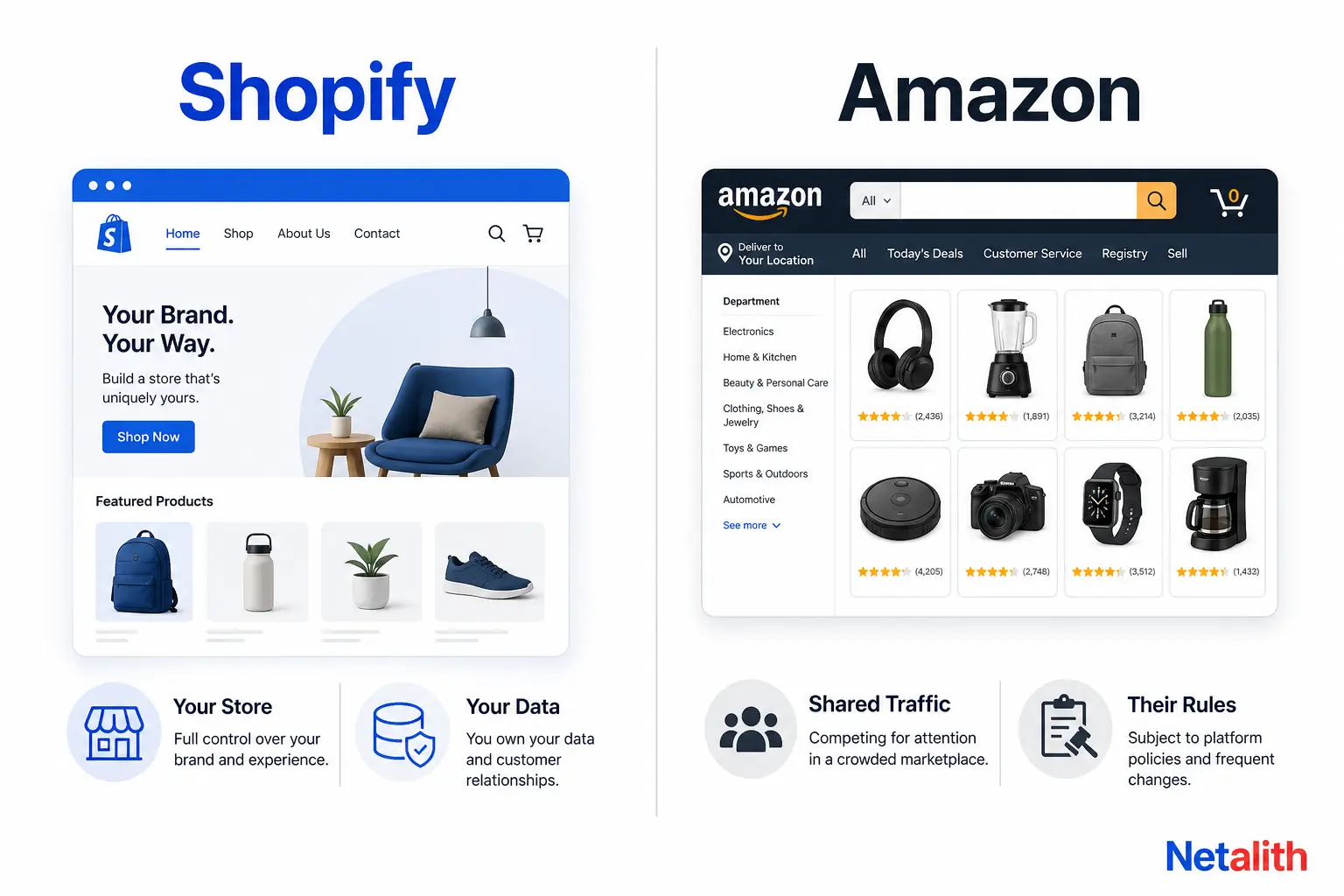
The comparison people actually want isn't "which is better" — it's "which model fits what I'm selling." Shopify and Amazon aren't competing for the same job. Shopify rents you the storefront and the checkout; you bring your own traffic and you own everything about the relationship. Amazon rents you the traffic; you play by its rules for everything else, including price display, packaging, and how customers reach you after the sale.
| Question | Shopify | Amazon |
|---|---|---|
| What it actually is | Software to build and run your own store | A marketplace where you list on someone else's storefront |
| Where traffic comes from | You: SEO, ads, social, email | Amazon's existing shopper base and search |
| Brand and page control | Full — your design, your URL, your checkout | Limited — standardized listing template, no custom checkout |
| Customer data | Yours — emails, order history, segments | Amazon's — you get order details, not a marketing relationship |
| Time to first sale | Slower — you build the audience | Faster — existing demand, if you can win the listing |
Neither model is a straight upgrade on the other. A lot of the "amazon store vs shopify" confusion comes from the fact that Amazon doesn't really have a "store" in the Shopify sense — Amazon Stores is a free page layer for brands enrolled in Brand Registry, not a standalone storefront outside the marketplace. It's marketing real estate inside Amazon, not an alternative to Amazon.
Shopify vs Amazon Fees: What You Actually Pay Per Sale
This is where most comparisons get vague. Here are the actual numbers as of late 2026.
Shopify
| Plan | Monthly (annual billing) | Online card rate | 3rd-party gateway surcharge |
|---|---|---|---|
| Basic | $39 ($29) | 2.9% + 30¢ | 2% |
| Grow | $105 ($79) | 2.7% + 30¢ | 1% |
| Advanced | $399 ($299) | 2.5% + 30¢ | 0.6% |
If you use Shopify Payments, that card rate is the entire transaction cost — there's no separate Shopify commission on the sale itself, per Shopify's own pricing page. Switch to a third-party gateway (PayPal-only checkouts, a regional processor) and the surcharge stacks on top of whatever that gateway already charges you, which is why almost every serious Shopify merchant ends up on Shopify Payments.
Amazon
| Plan | Monthly | Per-item fee | Referral fee |
|---|---|---|---|
| Individual | $0 | $0.99 per unit sold | 8–15% typical, up to 45% in a few categories |
| Professional | $39.99 | None | Same referral fee, regardless of plan |
The referral fee is the number that actually decides your margin, and Amazon's own selling FAQ confirms the referral fee applies on top of the flat plan fee no matter which plan you pick — the plan choice only changes whether you pay per item or a flat monthly rate. The individual-vs-professional break-even is simple: above roughly 40 units a month, $39.99 flat beats 40 × $0.99 in per-item fees.
The math that actually matters
Take a $30 item, 100 units sold in a month, standard 15% referral category, Shopify Payments on the Basic plan:
- Shopify: $39 plan + (100 × ($30 × 2.9% + $0.30)) ≈ $39 + $117 = $156 total platform cost. You still have to pay to get those 100 buyers to your store.
- Amazon (Professional, FBM): $39.99 plan + (100 × $30 × 15%) = $39.99 + $450 = $489.99 in Amazon fees alone, before you've paid to ship a single unit.
On paper Amazon looks far more expensive per sale — and it is, on a like-for-like transaction. But that $450 replaces a customer-acquisition cost you'd otherwise be paying separately on Shopify through ads or SEO. The fair comparison isn't "which platform charges less," it's "which is cheaper for me to acquire this specific customer": an established brand with organic traffic and an email list wins on Shopify's math; a new product with no existing audience often nets more on Amazon despite the higher take rate, because the referral fee buys you the buyer.
Amazon FBA vs Shopify Fulfillment: Who Actually Ships the Order
This is the most misunderstood part of the comparison, because Shopify spent four years trying to build an Amazon-style fulfillment network and then walked away from it. In 2023 Shopify sold off the two companies behind its owned logistics operation and shut down that strategy. What's called "Shopify Fulfillment Network" today is a different thing entirely: a free app that connects your store to third-party 3PLs — Flexport, ShipBob, Shipfusion, ShipMonk — so you compare and pick a provider, not a Shopify-run warehouse network.
| Amazon FBA | Shopify + a 3PL | |
|---|---|---|
| Who owns the warehouses | Amazon | The third-party logistics company you choose |
| Prime badge / 2-day eligibility | Yes, automatically for FBA listings | No — you negotiate delivery speed with your 3PL and carrier |
| Setup | One integrated system, one bill | Pick a 3PL, integrate it, negotiate your own rates |
| Packaging and unboxing | Standardized Amazon packaging in most cases | Fully custom — your branding, your inserts |
The practical upshot: if you need integrated, no-negotiation fulfillment with Prime eligibility baked in, Amazon FBA is a single system that just works. If branded unboxing and delivery-speed control matter more than Prime eligibility, Shopify's 3PL marketplace gets you there, but you're assembling the stack yourself rather than buying it pre-built.
Selling on Amazon vs Shopify: Who Owns the Customer
Search interest around "selling on amazon vs shopify" usually isn't about fees at all — it's about control. On Amazon, the customer belongs to Amazon. You get the shipping address to fulfill the order and a masked contact channel for support; you don't get an email list, you can't run your own retargeting pixel on the product page, and Amazon's own suggested-products module can put a competitor's listing next to yours on your own product page. On Shopify, every visitor is yours to capture — email, SMS opt-in, pixel data, repeat-purchase history — but none of that traffic exists until you build it.
This is why most brands that scale past their first six figures end up running both rather than picking one: Amazon for discovery and volume, Shopify for margin and the owned relationship. The failure mode is treating them as a choice instead of a sequence.
Regulated and Niche Products: Where Amazon's Policies Bite Harder
The "ebike sellers shopify vs amazon" question comes up because battery-powered products sit in Amazon's most policy-heavy zone. Anything with a lithium battery — e-bikes, scooters, power tools, most electronics — falls under Amazon's dangerous goods (hazmat) program: you need UN38.3 test documentation before you can list, FBA hazmat storage and prep carry their own separate fees, and some sub-categories require upfront approval before Amazon lets you sell at all. Miss a document and your listing gets suppressed, not gently flagged.
Shopify doesn't gate categories the same way — there's no approval queue standing between you and listing an e-bike on your own store. But that's a shift of responsibility, not a removal of it: you're the one who has to get battery shipping documentation right with your carrier, handle liability and warranty directly, and self-police any regional import/export rules, without Amazon's compliance checks catching a mistake before a customer gets hurt. For genuinely regulated hardware, Shopify trades Amazon's friction for your own liability exposure.
Running Both: Syncing Inventory Between Shopify and Amazon
If you're past the either/or question, the real project is keeping one inventory number true across both. Two mechanisms make this workable without a full custom integration:
- Shopify's native marketplace order sync imports orders from connected marketplaces, including Amazon, into Shopify's order and inventory system for free up to 50 synced orders a month; beyond that it's 1% of order value, capped at $99/month.
- Amazon's Multichannel Fulfillment (MCF) runs the other direction: your FBA inventory can fulfill orders placed on your Shopify store, so a single stock pool serves both channels instead of splitting inventory between two warehouses.
Where this breaks in practice isn't the sync itself — it's SKU mapping when the same product has different identifiers on each platform, and inventory buffer timing when a sale on one channel needs to reserve stock on the other before the count goes negative. This is the exact class of problem we handle when we build marketplace integrations for sellers running Shopify alongside Amazon, eBay, and other channels — the sync tools get you 80% of the way; the last 20% is where oversold listings and mismatched inventory actually come from.
Shopify AI Tools vs Amazon vs Others
Both platforms have pushed AI into the selling and buying experience, but from opposite directions. Shopify ships Sidekick, an AI assistant built into every plan for store setup, content, and data questions, and now offers a $0/month Agentic plan that lists your catalog for sale inside AI shopping assistants (ChatGPT, Gemini, Copilot, Perplexity) — you only pay a card-processing rate when an AI-driven sale completes. It's opt-in and merchant-controlled: you choose which AI channels carry your catalog.
Amazon runs its AI the other way: its own in-store shopping assistant answers customer questions and recommends products from across Amazon's whole catalog, including competitors, directly on and around your listings. You don't opt into it and you can't tune what it recommends next to your product — it's Amazon's layer, not yours. The practical difference for a seller: Shopify's AI tools work for your store specifically; Amazon's work for Amazon's marketplace, and your listing is one input among millions.
Which Should You Choose? A Decision Framework
Skip the "better platform" framing and answer these instead:
- No existing audience, need sales now: Amazon. The marketplace brings demand you haven't earned yet, and the referral fee is the price of that shortcut.
- Established brand or content/social following: Shopify. You already have the traffic; don't hand 8–15% of it to a marketplace that also owns the customer relationship.
- Regulated or hazmat product (batteries, supplements, anything hazmat-classified): Weigh Amazon's approval friction against Shopify's compliance burden — there's no free option here, only a choice of which risk you manage yourself.
- Scaling past initial traction: Both, run in parallel with synced inventory — not sequentially, and not as a single "pick one" decision.
If you're already running both and the manual reconciliation is eating a day a week, that's usually the signal to move from app-level syncing to a proper integration. If you're still deciding, Amazon's referral-fee math above is the number to run against your own margins before you commit either way — and if it's still unclear which setup fits, a free AI-visibility and platform consultation is a no-cost way to get a second opinion before you build.
FAQ
Frequently asked questions
Is Shopify or Amazon cheaper to start selling on?
Shopify's lowest all-in tier runs about $29-39/month plus card processing, with no per-sale commission beyond that. Amazon's Individual plan has no monthly fee but charges $0.99 per item plus a category referral fee (typically 8-15%), which usually makes it more expensive per sale once you're selling in volume, even though it's cheaper to start with zero commitment.
Can Amazon FBA fulfill orders placed on my Shopify store?
Yes. Amazon's Multichannel Fulfillment (MCF) lets you use your existing FBA inventory to fulfill orders from other sales channels, including a Shopify store, so you don't need to hold separate stock for each platform.
Do I need a Shopify store if I already sell on Amazon?
Not to sell, but most brands eventually want one for the things Amazon doesn't give you: an email list, customer data you actually own, and a page you control instead of a standardized listing template competitors can appear next to.
What happened to Shopify's own fulfillment network?
Shopify built an owned fulfillment network from 2019 to 2023, then sold the underlying logistics companies (Deliverr to Flexport, 6 River Systems to Ocado) and shut the in-house strategy down. Today's Shopify Fulfillment Network is a free app that connects merchants to third-party 3PLs like Flexport, ShipBob, and ShipMonk rather than Shopify running its own warehouses.
Should I choose the Amazon Individual or Professional selling plan?
The break-even is around 40 items sold per month. Below that, Individual's $0.99-per-item fee usually costs less than the Professional plan's flat $39.99/month. Above it, Professional is cheaper and also unlocks advertising, bulk listing tools, and Buy Box eligibility that Individual sellers don't get.
Is it harder to sell regulated products like e-bikes on Amazon than Shopify?
Amazon requires hazmat documentation (like UN38.3 battery testing) and category approval before you can list battery-powered products, which adds friction but also a compliance check. Shopify has no such gate, so you can list immediately, but you carry the full compliance and liability burden yourself with your carrier and insurer.