Relational vs NoSQL Databases: Strategic Selection Guide for
Compare relational vs NoSQL databases (SQL vs NoSQL) for 2026. Learn about architecture, ACID vs BASE, and performance to choose the right database for your application.

Long Nguyen
Fullstack Developer · AI Engineer · Researcher
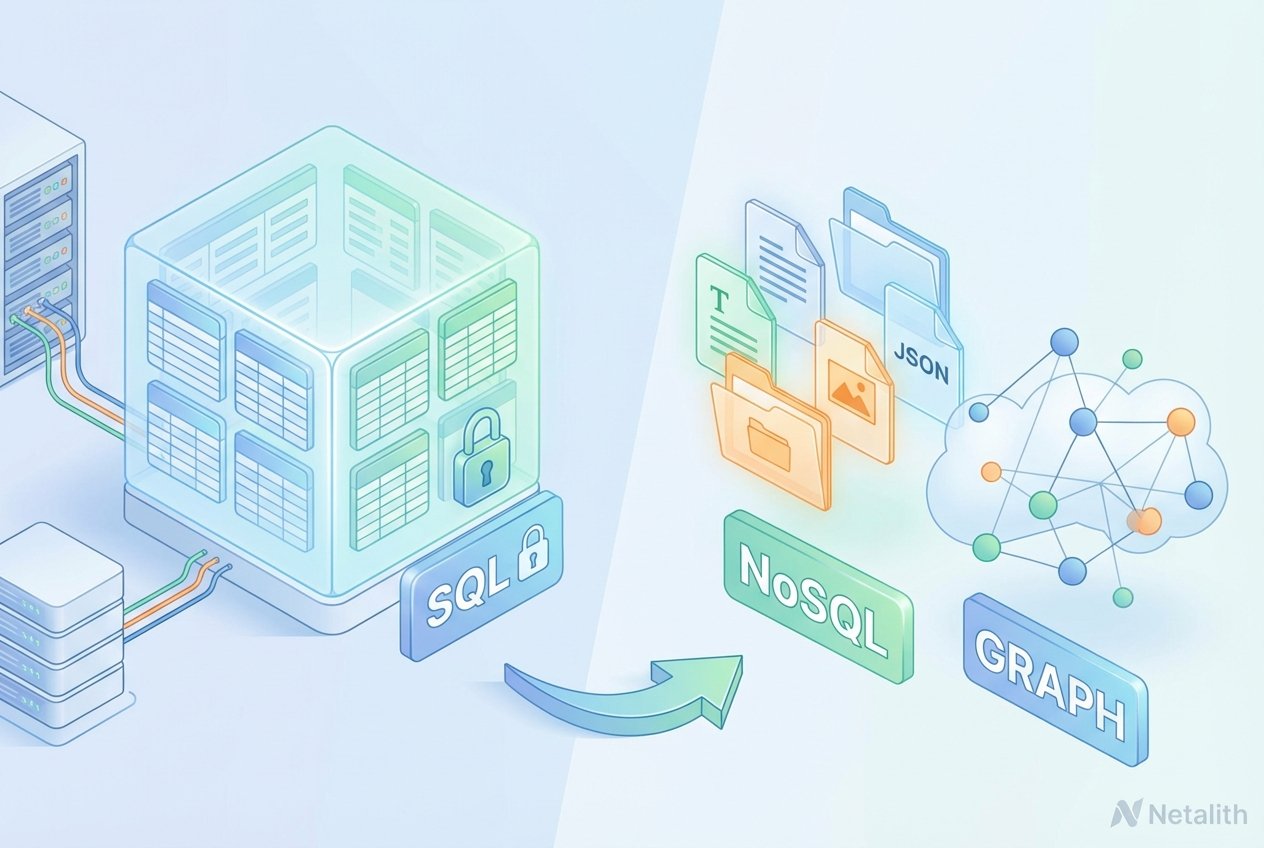
Building highly scalable applications requires a robust data layer. For developers and cloud infrastructure engineers, choosing between relational vs NoSQL databases represents one of the most critical foundational decisions in software engineering. As data velocity and volume grow exponentially, navigating the complexities of modern backend systems goes far beyond a simple DBMS tutorial for beginners.
You must fully understand the structural trade-offs of different data models. This comprehensive guide provides an in-depth look at RDBMS vs NoSQL to help you optimize your infrastructure, scale efficiently, and align your backend with the evolving needs of your applications.
Understanding Database Architecture in
In modern backend ecosystems, database architecture 2026 relies heavily on distributed flexibility and high availability. The ongoing evolution of cloud-native database management forces engineering teams to analyze various database types continuously to meet user demands. The fundamental choice between RDBMS vs NoSQL largely dictates how an application stores, retrieves, and secures structured vs unstructured data.
To make an informed architectural decision, infrastructure engineers must explore how different systems respond to heavy load, varying query complexity, and continuous schema evolution.
What Are Relational Databases (SQL)?
Relational Database Management Systems (RDBMS) organize data into strictly defined, tabular structures consisting of interconnected rows and columns. When exploring SQL vs NoSQL, understanding the rigid and highly predictable nature of relational systems is essential.
Any comprehensive SQL basics guide highlights the supreme importance of ACID properties in databases—Atomicity, Consistency, Isolation, and Durability. By strictly adhering to these principles and utilizing rigorous database normalization techniques to eliminate data redundancy, RDBMS engines ensure highly reliable transactions. When engineering teams debate relational vs non-relational solutions, the core advantage of an RDBMS remains its capacity for complex querying and absolute data integrity.
What Are NoSQL Databases (Non-Relational)?
The term NoSQL traditionally stands for "Not Only SQL." Breaking away from tabular constraints, these non-relational engines store data in diverse formats such as JSON document stores, key-value pairs, wide-column stores, or graph models. When evaluating a comprehensive SQL or NoSQL comparison, it is critical to note that NoSQL solutions are inherently built as distributed database systems designed to process massive data payloads swiftly.
Rather than prioritizing strict transaction safety, NoSQL engines rely heavily on BASE properties (Basically Available, Soft state, Eventual consistency). In the grand scheme of the relational vs non-relational debate, NoSQL provides the structural agility necessary for rapid iterations and continuous deployment pipelines.
Core Differences: Relational vs NoSQL Databases
The central divergence when comparing RDBMS vs NoSQL comes down to schema rigidity, infrastructure scaling philosophy, and data consistency models. In any technical SQL vs NoSQL analysis, system architects must decide how they plan to handle the spectrum of structured vs unstructured data.
Note on Distributed Systems: Always keep the CAP theorem (Consistency, Availability, Partition tolerance) in mind, which posits that distributed systems can simultaneously guarantee only two of these three attributes.
Schema-on-Write vs Schema-on-Read
A prominent consideration in database architecture 2026 is the implementation of schema-on-write vs schema-on-read. Relational databases utilize schema-on-write, forcing all incoming data to conform to a pre-established table structure before it can be successfully saved. Conversely, NoSQL employs schema-on-read, allowing developers to ingest raw, polymorphic data instantly and apply a functional structure only when querying it. This agility is a defining feature in any SQL or NoSQL comparison.
Horizontal Scaling vs Vertical Scaling
Another defining distinction within RDBMS vs NoSQL is the ongoing debate of horizontal scaling vs vertical scaling. RDBMS architectures generally scale vertically; you increase server capacity by adding more CPU, RAM, or SSD storage to a single massive node. NoSQL systems, engineered natively as distributed database systems, scale horizontally by seamlessly adding additional commodity servers to distribute the database load. For hyper-growth cloud environments, horizontal scalability often proves drastically more cost-efficient over time.
ACID Compliance vs BASE Properties
Transactional safety dramatically influences the SQL vs NoSQL scale. Relational databases offer unwavering ACID compliance, guaranteeing that complex, multi-step transactions either succeed entirely or roll back safely without corrupting the state. On the other hand, non-relational databases favor BASE properties, ensuring high availability and eventual consistency in adherence to the rules of the CAP theorem.
Performance Comparison of RDBMS and NoSQL
Executing an objective performance comparison of RDBMS and NoSQL requires deep context into the actual application workload. For operations heavily reliant on complex JOIN statements across highly normalized, interconnected tables, SQL engines are historically dominant and highly performant.
However, in an SQL or NoSQL comparison focused strictly on raw throughput—specifically dealing with vast swaths of structured vs unstructured data and simple read/write patterns—NoSQL databases dynamically outperform their relational counterparts. When benchmarking relational vs NoSQL databases, always test directly against your specific query payloads rather than relying on generalized metrics.
MongoDB vs PostgreSQL: A Real-World Comparison
To ground this theoretically, consider the classic matchup of MongoDB vs PostgreSQL. PostgreSQL stands out as an incredibly advanced, open-source object-relational database favored for complex querying, extensibility, and strict schema enforcement. MongoDB, conversely, is a premier NoSQL document store that utilizes flexible, JSON-like BSON formats.
The SQL vs NoSQL trade-offs for developers are perfectly illustrated here: choose PostgreSQL when financial-grade data integrity and complex relationships are paramount. Opt for MongoDB for agile iteration, hierarchical data, and effortless horizontal scaling within modern cloud-native database management environments.
When to Use SQL vs NoSQL in
Deciding exactly when to use SQL vs NoSQL in 2026 depends almost entirely on the nature of your project and its projected growth trajectory. If your system requires heavy multi-row transactions (such as e-commerce platforms, banking applications, or accounting software), SQL remains fundamentally superior. When building massive IoT device networks, real-time logging systems, or flexible user-generated content feeds, NoSQL is the tactical choice.
Interestingly, when planning relational vs NoSQL databases for cloud applications 2026, many leading engineering teams adopt polyglot persistence. By seamlessly deploying both technologies side-by-side within a microservices architecture, teams can leverage the absolute best of modern database architecture 2026.
Conclusion: SQL vs NoSQL Trade-offs for Developers
In the final assessment, the choice between relational vs NoSQL databases is rarely a binary one. It is about matching your data model to your business logic. While RDBMS excels in data integrity and complex relationships, NoSQL dominates in scalability and developmental speed. Understanding these SQL vs NoSQL trade-offs for developers ensures that your backend remains performant, cost-effective, and ready for the future of cloud-native database management.