Database Normalization Techniques: A Step-by-Step Guide (1NF to BCNF
A comprehensive guide to database normalization techniques, covering 1NF, 2NF, 3NF, and BCNF with examples to help developers design efficient, redundancy-free relational schemas.

Long Nguyen
Fullstack Developer · AI Engineer · Researcher
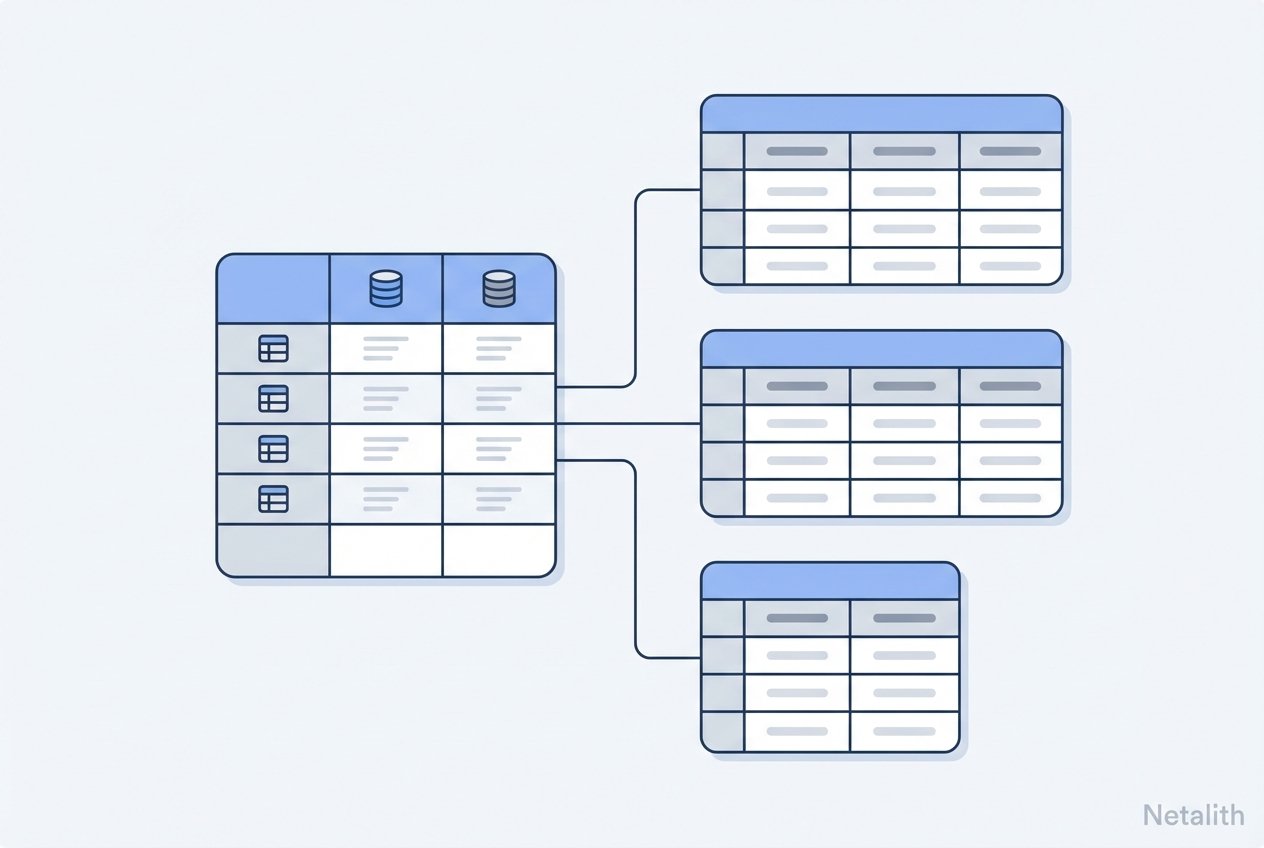
Welcome to a definitive DBMS tutorial for beginners and seasoned software engineers alike. In the rapidly evolving landscape of data architecture, mastering database normalization techniques is more crucial than ever. Whether you are migrating from legacy monolithic systems or designing cutting-edge distributed database systems, establishing a structurally sound foundation dictates your application's efficiency, scalability, and security.
In this article, we will unpack how to properly structure your data using modern database normalization principles. By understanding these concepts, you can preserve ACID properties in databases, improve query performance, and ensure smooth cloud-native database management. Let's explore everything you need to build efficient databases in this comprehensive breakdown.
Understanding Database Normalization Techniques for Modern Systems
In modern software engineering, implementing proper database design normalization is essential for optimizing storage and preventing data anomalies. At its core, database design normalization is a systematic approach to organizing relational database schemas to minimize redundancy and improve data integrity.
This normal forms guide serves to demystify the process. Effective data redundancy removal is the foundation of a reliable relational schema design. When data is duplicated across multiple tables, an update to one record might not automatically cascade to another, leading to severe data inconsistencies. Applying robust database design normalization allows teams to decouple entities, ensuring that every piece of information is stored in exactly one logical place.
Core Concepts: Keys and Dependencies
Before diving into step-by-step methodologies, you must grasp foundational data structuring techniques. The cornerstone of proper relational schema design revolves around identifying your candidate keys and maintaining strict referential integrity.
- Candidate Keys: A minimal set of attributes that can uniquely identify a tuple (row) in a database. Among your candidate keys, one is chosen as the primary key.
- Referential Integrity: The assurance that foreign key values in one table correctly point to existing primary key values in a related table, preventing orphaned records.
Functional, Partial, and Transitive Dependency
To accurately map out your architecture, you need to recognize how attributes interact. Functional dependency occurs when one attribute uniquely determines another. For instance, if you know a student's ID, you can determine their name. This means "Name" is functionally dependent on "Student ID."
A functional dependency is written as X → Y, meaning attribute X determines attribute Y.
There are two problematic dependencies we must eliminate to achieve higher normal forms:
- Partial Dependency: This occurs when a non-prime attribute is dependent on only a part of a composite primary key. Removing partial dependency is critical for early-stage normalization.
- Transitive Dependency: This happens when a non-prime attribute depends on another non-prime attribute rather than directly on the primary key. Eliminating transitive dependency ensures cleaner data structuring techniques.
Step-by-Step Database Normalization Techniques (1NF to BCNF
If you're looking for a practical database normalization techniques 1NF to BCNF guide, this section breaks down the entire pipeline. Knowing how to normalize a database table is a transformative skill that bridges the gap between a basic SQL basics guide and enterprise-level database architecture. The most common progression is moving through the standard 1NF 2NF 3NF sequence.
First Normal Form (1NF
To qualify for the First Normal Form, a table must follow the fundamental rule of atomicity. Every column must hold indivisible (atomic) values, and there can be no repeating groups or arrays within a single field. When learning how to normalize a database table, achieving 1NF is the simplest yet most crucial step toward data redundancy removal.
Second Normal Form (2NF
Once your table is in 1NF, you can move to 2NF. This stage of the normal forms guide focuses entirely on eliminating partial dependency. A table is in 2NF if it is in 1NF and all non-key attributes are fully functionally dependent on the entire primary key. If your table uses a composite primary key, no non-key attribute should depend on just a fraction of that key.
Third Normal Form (3NF
Moving through 1NF 2NF 3NF requires us to tackle transitive dependency. A table is in 3NF if it is in 2NF and no non-key attribute depends on another non-key attribute. Excellent database design normalization involves moving related attributes into separate tables to solidify a pristine relational schema design.
Boyce-Codd Normal Form (BCNF
Often referred to as "3.5NF," Boyce-Codd Normal Form is a stricter version of 3NF. A table is in BCNF if, for every functional dependency X → Y, X is a superkey. Understanding the difference between 3NF and BCNF with examples is pivotal when candidate keys overlap and cause subtle anomalies.
Difference Between 3NF and BCNF with Examples
It is common to confuse 3NF and BCNF. Let's clarify the difference between 3NF and BCNF with examples, a staple in any comprehensive database normalization techniques manual.
Imagine a table that books seminar sessions with columns: [Student_ID, Course, Instructor]. Assume a student can enroll in multiple courses, and each instructor teaches exactly one course. The composite candidate keys are (Student_ID, Course) and (Student_ID, Instructor).
The table may satisfy 3NF because there are no non-prime attributes depending on others. However, the functional dependency Instructor → Course violates BCNF because "Instructor" is not a superkey. To resolve this, you must decompose the table into two: one mapping instructors to courses and another mapping students to instructors. This high-level data structuring technique eliminates update anomalies.
Database Design Best Practices for Junior Developers
When discussing database design best practices for junior developers, theory must meet practical application. As you transition between relational vs NoSQL databases, remember that while NoSQL allows for denormalization, relational databases demand rigorous database design normalization.
- Prioritize Data Structuring Techniques Early: Don't wait until production to normalize. Design your relational schema design with scalability in mind from day one.
- Maintain Referential Integrity: Use foreign keys to ensure data consistency across your normalized tables.
- Document Dependencies: Keep a record of functional dependencies to make future refactoring easier for the whole team.
Conclusion: Elevating Your Relational Schema Design
Mastering database normalization techniques is an essential milestone for any developer. By methodically applying the rules of 1NF, 2NF, 3NF, and BCNF, you ensure your database remains efficient, consistent, and free of redundant data. Whether you are following a simple normal forms guide or building a complex distributed system, utilizing these database normalization techniques ensures a robust foundation for any application. Start refining your data structures today to prevent the technical debt of tomorrow.