Zero Trust vs VPN: Why the Traditional Network Perimeter is Obsolete
A comprehensive comparison of Zero Trust vs VPN, exploring architecture, performance, and why traditional network perimeters are failing in the modern enterprise.

Long Nguyen
Fullstack Developer · AI Engineer · Researcher
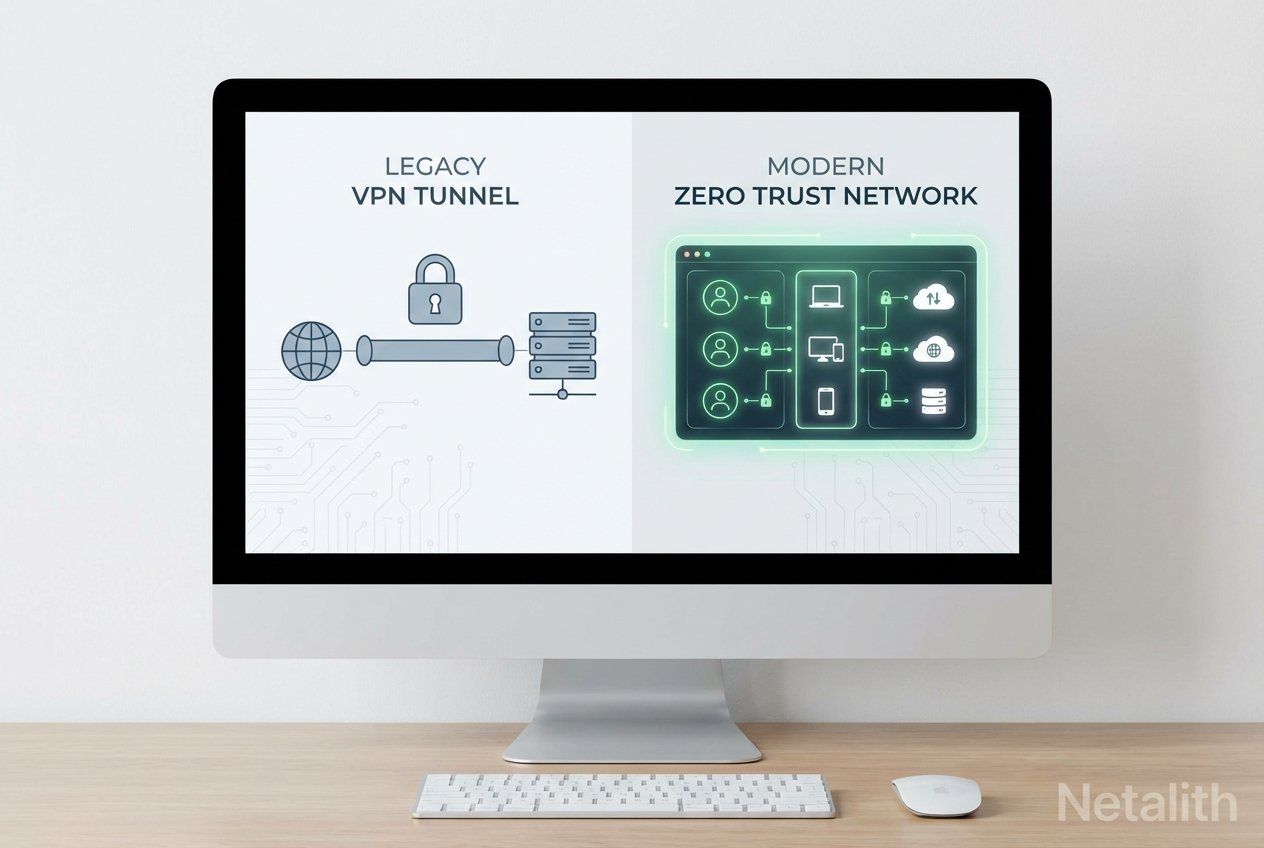
In the current landscape of enterprise networking, infrastructure looks vastly different than it did a decade ago. With workloads distributed across hybrid clouds and a globally decentralized workforce, the traditional perimeter is officially dead. For IT security professionals, Cloud Architects, and CISOs, the debate of Zero Trust vs VPN has reached a definitive climax. Traditional Virtual Private Networks (VPNs) were once the enterprise gold standard, but today's sophisticated threat landscape renders them inadequate. Understanding the critical differences between modern identity-based access and legacy perimeter security is no longer optional—it is a mandate for organizational resilience. In this comprehensive guide, we analyze why traditional perimeters are failing and how moving to a zero trust architecture can future-proof your organization.
The Evolution of Remote Access Security
The story of enterprise network security is an ongoing race against sophisticated adversaries. Tracing the remote access security evolution reveals a clear, necessary shift from hardware-centric firewalls to agile, software-defined environments. In the past, securing an enterprise meant defending a single physical location. However, as organizations scaled globally and adopted multi-cloud infrastructures, the limitations of a legacy network architecture became glaringly apparent. A comprehensive network perimeter defense evolution became a fundamental necessity as IT leaders realized that an IP address alone no longer equates to trust.
The Fall of the Castle and Moat Security Model
For decades, enterprise security heavily relied on the "castle and moat" concept. Once a user crossed the digital moat—typically via a successful VPN connection—they were trusted implicitly and given broad lateral access inside the network. Today, evaluating the castle and moat security model vs zero trust exposes the critical flaw of legacy systems: inherent trust. If an attacker breaches the perimeter through compromised credentials, they hold the keys to the entire corporate kingdom. The rapid shift between traditional vs modern network security models reflects an industry-wide realization that threats are just as likely to originate from inside the network as they are from the outside internet.
Zero Trust vs VPN: Core Architecture Differences
The core discussion surrounding ZTNA vs VPN comparison fundamentally boils down to how each framework handles user verification, risk assessment, and resource access. When conducting a deep ZTNA vs VPN comparison, the stark contrast between modern security vs legacy security becomes immediately clear.
Traditional VPNs: Network-Centric Access
A traditional VPN operates by granting broad, network-centric access. Once a user's device authenticates at the gateway, it is virtually placed on the local area network (LAN). This legacy approach assumes the user and their endpoint remain safe for the entire duration of the session. It lacks granular controls and rarely inspects the ongoing health of the device, making traditional networks prime targets for malware propagation and lateral movement attacks.
ZTNA (Zero Trust Network Access): Identity-Centric Security
In direct contrast, ZTNA utilizes a strict identity-centric security model. Instead of connecting users to a sprawling network, ZTNA connects authenticated users exclusively to the specific applications they are authorized to use. It operates entirely on the principle of "never trust, always verify." Crucially, ZTNA relies on continuous authentication and authorization, dynamically evaluating the user's context, device posture, location, and behavior throughout the entirety of their session.
Why the Traditional VPN is Obsolete in a Zero Trust World
Enterprise IT managers frequently ask why the traditional VPN is obsolete in a zero trust world. The answer lies in both risk mitigation and operational agility. Legacy VPNs create notorious network bottlenecks, as all remote traffic must be backhauled through a central, physical data center before reaching the cloud. As organizations actively seek a viable VPN replacement, comparing a firewall vs ZTNA highlights the severe limitations of hardware dependencies. Modern secure remote access solutions enforce a strict least privilege access policy, ensuring that employees, contractors, and third-party vendors can only interact with the exact micro-segmented resources they need to perform their jobs.
Performance and Cost: Perimeter Security vs Zero Trust Architecture
When IT leaders evaluate perimeter security vs zero trust architecture performance and cost, the operational differences are staggering. Traditional VPNs require massive capital expenditures in on-premises appliances, redundant bandwidth for traffic backhauling, and constant patch management. In the ongoing debate of Zero Trust vs Perimeter frameworks, Zero Trust consistently wins by drastically reducing latency. It routes traffic directly to cloud applications rather than funneling it through centralized choke points.
Furthermore, a comprehensive comparison between zero trust architecture and traditional perimeter based security shows that transitioning away from physical appliances yields exceptional long-term ROI. A detailed security model comparison proves that operational overhead drops significantly when adopting a perimeterless model, allowing IT teams to focus on strategic threat hunting rather than managing VPN capacity limits.
How to Migrate to Software-Defined Perimeter (SDP
Modernizing your infrastructure means fully replacing hardware firewalls with software-defined zero trust solutions. By moving to a software-defined perimeter (SDP), network administrators can completely cloak their infrastructure from the public internet, making applications invisible to unauthorized entities.
Initiating a successful legacy network migration requires a phased approach. It starts with implementing an effective micro-segmentation strategy to map out data flows and application dependencies accurately. From there, organizations should adopt the strict guidelines outlined in NIST SP 800-207, which provides a rigorous, standardized framework for deploying zero trust architecture principles. Implementing an SDP ensures that access is granted dynamically, completely redefining the boundaries of corporate security.
Conclusion: Embracing Perimeterless Security
The conclusion to the Zero Trust vs VPN dilemma is definitive: the traditional network perimeter is obsolete. Organizations clinging to legacy security models expose themselves to unacceptable levels of cyber risk and critical performance bottlenecks. When comparing perimeterless vs perimeter-based security, adopting a modern Zero Trust framework guarantees that every single access request is vetted, authenticated, and strictly scoped. The future of enterprise security relies entirely on dynamic, identity-first strategies.
Frequently Asked Questions
-
What is the main difference between Zero Trust vs VPN?
A traditional VPN connects a remote user to a broad network, providing wide lateral access once authenticated. Zero Trust connects an authenticated user strictly to specific applications, never granting broad network access and continuously verifying trust based on identity and device posture.
-
Can Zero Trust completely replace traditional VPNs?
Yes. Zero Trust Network Access (ZTNA) is designed as a direct VPN replacement, offering better security through micro-segmentation and eliminating the need for hardware-heavy traffic backhauling.
-
Is Zero Trust more expensive than a VPN?
While the initial transition requires a shift in strategy, Zero Trust often reduces long-term costs by eliminating expensive hardware maintenance, reducing the risk of costly data breaches, and lowering bandwidth expenses associated with traditional VPN backhauling. In summary, a strong Zero Trust vs VPN strategy should stay useful long after publication.