Micro-segmentation Strategy: Preventing Lateral Movement in Enterprise Networks
Comprehensive guide to building an enterprise micro-segmentation strategy to prevent lateral movement, secure workloads, and implement Zero Trust networking.

Long Nguyen
Fullstack Developer · AI Engineer · Researcher
Introduction
In the evolving landscape of enterprise IT, relying solely on traditional perimeter defenses is no longer sufficient to protect critical data. Once an attacker breaches the outer firewall, flat network architectures offer little resistance, allowing threats to propagate undetected across the data center. To combat this reality, enterprise security leaders must implement a comprehensive micro-segmentation strategy. By creating secure zones at the individual workload level, organizations can fundamentally restrict unauthorized access and contain potential breaches before they cause systemic damage.
This guide provides a strategic roadmap for CISOs, Cloud Architects, and IT Security Managers aiming to architect and deploy a robust Granular network segmentation in today's multi-cloud environments. We will explore advanced methodologies to secure environments, differentiate between deployment models, and demonstrate how this strategy anchors a broader zero trust initiative.
The Imperative for a Modern Micro-segmentation Strategy
Historically, enterprise security relied heavily on traditional Network Segmentation—dividing the network into broad subnets using VLANs and internal firewalls. While this approach provides basic structure, it leaves large, implicit trust zones where malware and threat actors can freely navigate once inside. The modern threat landscape demands a paradigm shift toward ensuring Secure Workloads regardless of their physical or logical location.
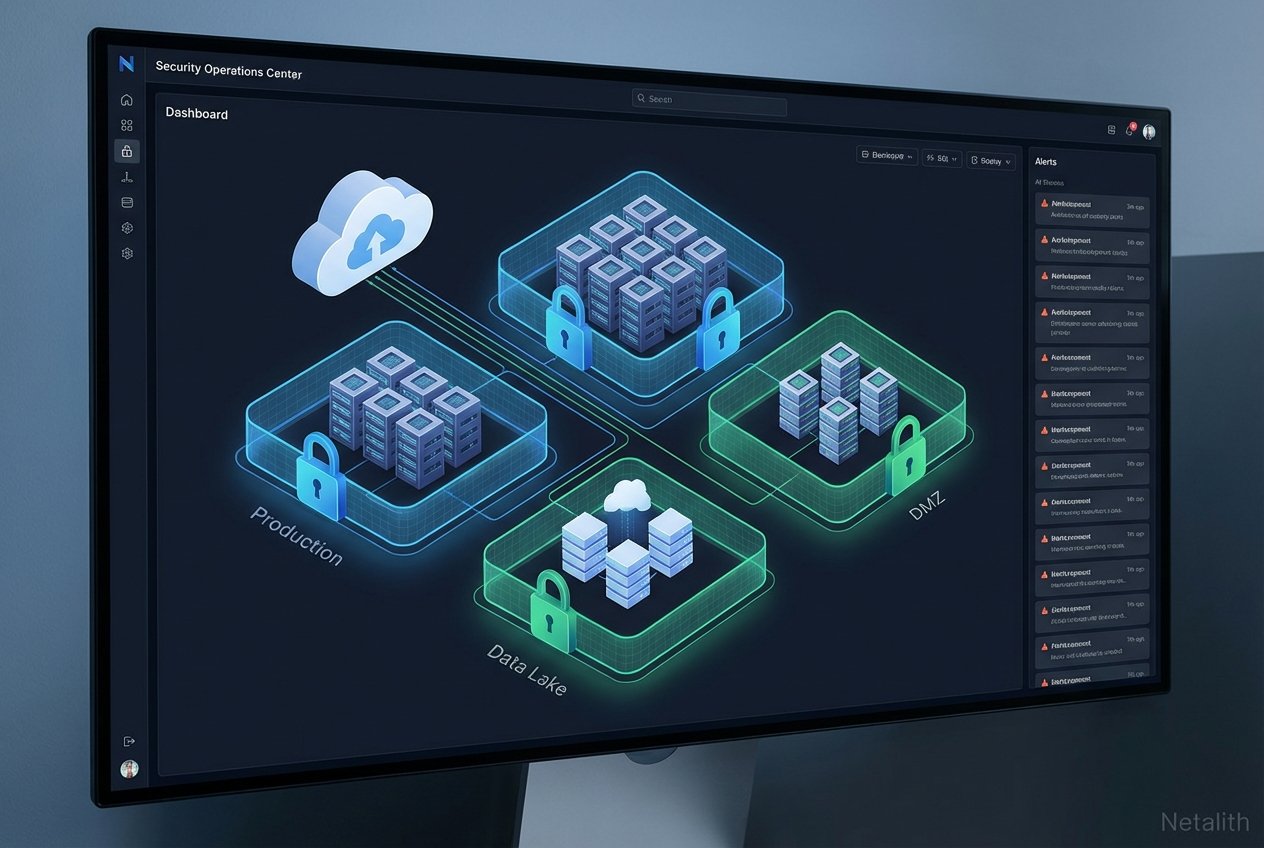
A formalized Granular network segmentation introduces advanced network isolation techniques that decouple security from the underlying network infrastructure. Instead of relying on static choke points, security controls are pushed directly to the host or virtual machine. This approach provides immediate blast radius reduction. If a single web server is compromised, the attacker cannot pivot to the database tier because the communication pathways are explicitly denied by default.
What Constitutes an Effective Micro-segmentation Strategy?
An effective Granular network segmentation is built on the principle of least privilege applied to network communications. At its core, it leverages Granular network segmentation to define security controls based on application logic, identity, and context, rather than rigid IP addresses.
This granularity enables the creation of Network micro-perimeters around individual applications, virtual machines, or containerized services. To achieve this scale, modern architectures rely on distributed firewalling, a mechanism that embeds firewall capabilities directly into the hypervisor or operating system kernel. By enforcing policies at the source and destination of the traffic, a Granular network segmentation drastically improves East-West traffic security—the server-to-server communication that typically makes up the vast majority of data center traffic.
Preventing Lateral Movement with Micro-segmentation Techniques
When cybercriminals breach an organization, their initial point of entry is rarely their final target. They use techniques like credential dumping and vulnerability exploitation to traverse the network. Preventing lateral movement with micro-segmentation techniques is the most reliable way to disrupt this attack chain.
By enforcing a strict least privilege access policy, security teams ensure that workloads only communicate with the specific services required for their function. For instance, a front-end application is only permitted to talk to its designated middleware, completely isolating it from HR databases or financial systems.
"Effective micro-segmentation ensures that a compromise in one sector of your data center does not lead to an enterprise-wide catastrophic failure."
Prioritizing East-West traffic security creates frictionless barriers that contain ransomware and advanced persistent threats (APTs). The immediate technical benefit is a profound blast radius reduction, transforming what could be a massive data breach into a localized, easily remediated incident.
Host-Based Micro-segmentation vs Network-Based Micro-segmentation
As enterprise IT leaders formalize their Micro-segmentation initiatives, they often face a critical architectural decision: evaluating host-based micro-segmentation vs network-based micro-segmentation.
- Network-Based Micro-segmentation: This approach typically utilizes software-defined networking (SDN) technologies to enforce rules at the network or hypervisor layer. It is highly effective in homogenous, virtualization-heavy data centers but can struggle to extend granular visibility into bare-metal servers or public cloud PaaS offerings.
- Host-Based Micro-segmentation: This methodology relies on lightweight software agents installed directly on the workload's operating system. It decouples security completely from the network topology. Host-based agents often integrate seamlessly with modern workload protection platforms (CWPP), providing deep process-level visibility and uniform policy enforcement across multi-cloud, hybrid, and legacy environments.
An optimized Granular network segmentation often utilizes a hybrid approach or leans heavily on host-based solutions to guarantee universal coverage as workloads migrate across varying cloud infrastructures.
Micro-segmentation Deployment Steps for Enterprise IT
Transitioning from a flat network to a sophisticated Workload isolation strategy requires careful planning. Rushing into enforcement without adequate visibility often leads to critical application outages. Security architects should follow these micro-segmentation deployment steps for enterprise IT to ensure a seamless rollout.
Phase 1: Visibility and Discovery
You cannot secure what you cannot see. The foundational step of any Granular network segmentation is mapping the entire application ecosystem. Collect granular telemetry on all existing East-West traffic flows. Understanding historical baseline communications allows teams to accurately map application dependencies without breaking legitimate business processes.
Phase 2: Building the Application Segmentation Policy
Once traffic flows are mapped, security teams must design the application segmentation policy. This involves labeling and grouping workloads based on their environment (e.g., Development, Production), application tier (e.g., Web, App, Database), and regulatory requirements. Policies should be built in simulation mode, allowing administrators to observe how the rules would affect live traffic without actually dropping packets.
Phase 3: Enforcement and Policy Automation
After validating the ruleset, teams can gradually transition from monitoring to active enforcement. Because cloud environments are ephemeral—with IP addresses changing continuously—organizations must leverage segmentation policy automation. Automated policies dynamically adapt to workload scaling, ensuring new instances instantly inherit the correct security posture based on their cryptographic identity and tags.
Best Practices for Micro-segmentation Strategy in Hybrid Cloud Networks
Operating across on-premises data centers and multiple public clouds introduces massive complexity. Adopting best practices for Granular network segmentation in hybrid cloud networks ensures that security is both consistent and manageable.
- Standardize Across Environments: Avoid vendor lock-in by using a platform that provides a unified control plane across AWS, Azure, GCP, and on-premise hardware.
- Prioritize High-Value Assets: Start your micro-segmentation strategy by isolating high-risk Secure Workloads, such as those handling PCI, HIPAA, or PII data.
- Integrate with Vulnerability Management: Use vulnerability management integration to adjust segmentation policies dynamically based on the risk profile of a workload. A server with a known high-severity vulnerability should automatically have its network access tightened.
Aligning Micro-segmentation with Zero Trust Architecture
A micro-segmentation strategy is the practical implementation of zero trust architecture principles within the network layer. By aligning with frameworks like NIST SP 800-207, organizations shift from a perimeter-centric view to an identity-centric security model.
This alignment ensures that every access request—whether from a user or another service—is verified before being granted. Network Segmentation is no longer just about subnets; it is about creating micro-perimeters that enforce security at the most granular level possible.
Conclusion: Securing Your Enterprise with Netalith
Implementing a comprehensive micro-segmentation strategy is the single most effective step an organization can take to mitigate the risk of lateral movement and reduce the blast radius reduction of potential cyberattacks. By focusing on Secure Workloads and leveraging continuous authentication and authorization, Netalith helps enterprises navigate the complexities of modern network security.
As you refine your approach to Micro-segmentation, remember that the goal is not just to build walls, but to create a dynamic, responsive security environment that protects your most critical assets wherever they reside. Embrace a forward-thinking micro-segmentation strategy today to ensure your enterprise remains resilient against the threats of tomorrow.