Custom AI Customer Service Agent for Ecommerce: Tools Over RAG
A custom AI customer service agent for ecommerce works best on live tools, not a document index. Architecture, guardrails, handoff and what to build first.

Long Nguyen
Fullstack Developer · AI Engineer · Researcher
What a custom AI customer service agent does that a chatbot doesn't
A custom AI customer service agent for ecommerce is a language model wired into your store's own systems through tools: order lookup, product search, return policy, escalation. It answers from live data and takes defined actions, instead of reciting a generic FAQ.
The practical difference is where the answer comes from:
- Chatbot: matches the question to canned text or a pasted knowledge base.
- Agent: decides which tool to call, reads the result, and answers from it. If the order is delayed, it says so, because it just looked.
Custom agent vs off-the-shelf chatbot for ecommerce
| Dimension | Off-the-shelf widget | Custom agent |
|---|---|---|
| Data access | Whatever the vendor's connector exposes | Any API or database you own, including internal ones |
| Actions | Usually answers only | Defined actions: start a return, route to a person, return a checkout link |
| Business logic | Generic | Your rules: fitment, B2B pricing, multichannel orders |
| Policy answers | Pasted text, paraphrased freely | Fetched from one source of truth with a date |
| Handoff | Fixed to the vendor's inbox | Into your helpdesk, CRM or email, with a structured brief |
| Control and liability | Limited visibility into why it said something | Full transcripts and tool logs you can audit |
My rule of thumb: if most of your tickets are "where is my order" and your helpdesk already has a native order integration, buy the widget. Build custom when your logic is unusual or the answer lives across several systems.
Tools first, RAG second: how the agent is wired
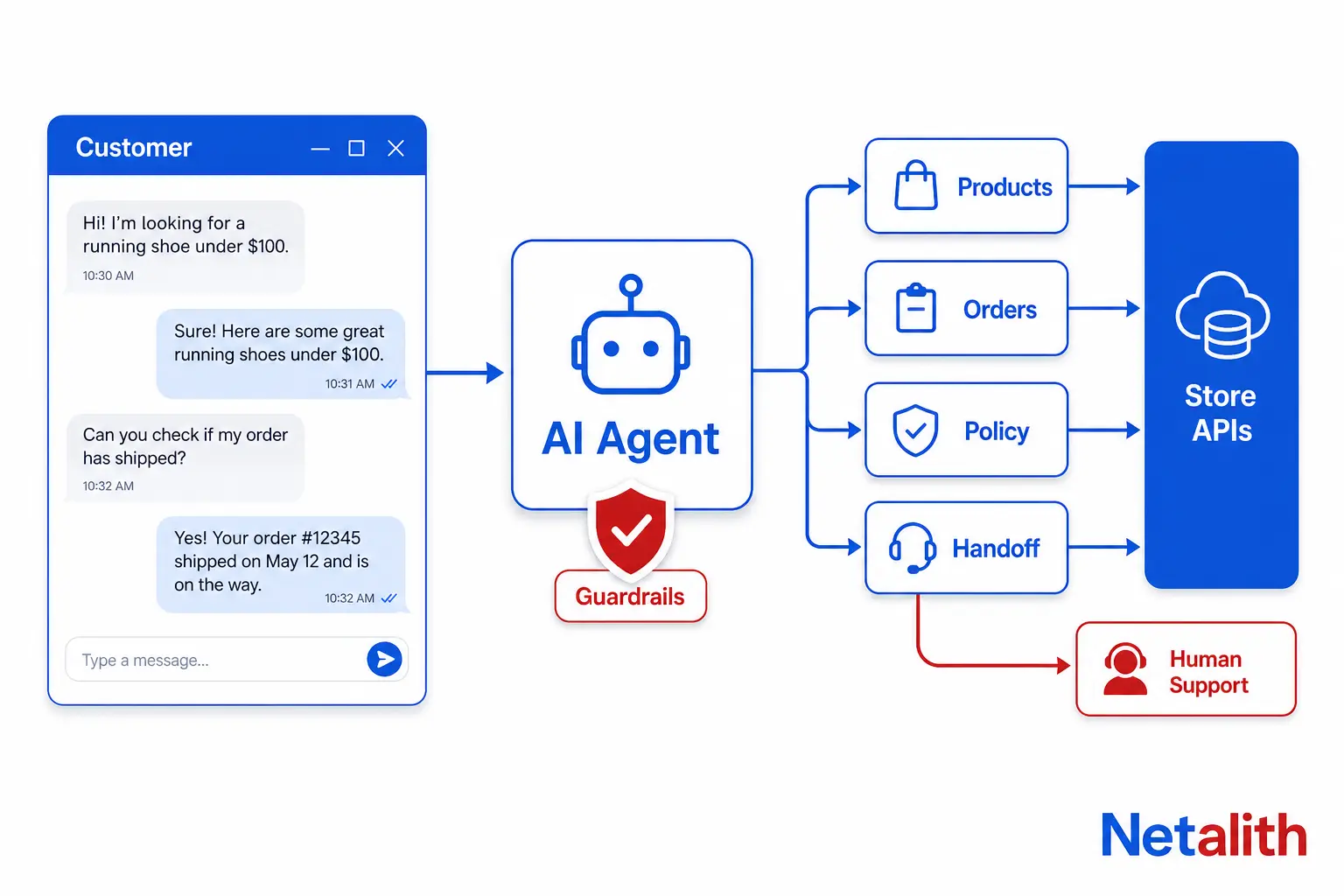
The agent on netalith.com is built directly on the OpenAI API with function tools. It queries blog, service, product and project data in real time. It does not use RAG.
The reason is freshness. Catalog, stock and price change constantly. A vector index built from last night's export will confidently quote yesterday's price. A tool call reads the current record.
RAG still earns its place for long, unstructured material such as manuals or lengthy policy documents. Even then, I would expose it as one tool among several, not as the whole architecture.
Tools are defined as JSON schemas, and OpenAI's function calling guide recommends always enabling strict mode so arguments match your schema.
One honest scope note: our own site's agent handles pre-sale work. It advises, recommends products, returns checkout links, qualifies visitors and collects contact details for human support. Post-purchase support uses the same pattern with order and returns tools added. If you want this built for your store, our AI development service covers customer service agents.
The tool list for an ecommerce support agent
| Tool | Type | Guardrail that matters |
|---|---|---|
| search_products | Read | Return live price and stock, plus the product link. Never answer availability from memory. |
| lookup_order | Read | Require order number plus the email on the order, checked in your backend. Return status and tracking only. |
| get_policy | Read | Return the policy text with its last-updated date. The agent quotes it; it does not improvise. |
| start_return | Write | Creates a return request, not a refund. The customer confirms before it runs. |
| escalate_to_human | Write | Sends a brief: summary, order id, reason, language. |
Here is how one of those tools looks in the Responses API's flat tool format:
{
  "type": "function",
  "name": "lookup_order",
  "description": "Look up one order's status and tracking. Call only after the customer has given both the order number and the email on the order.",
  "parameters": {
    "type": "object",
    "properties": {
      "order_number": { "type": "string" },
      "email": { "type": "string" }
    },
    "required": ["order_number", "email"],
    "additionalProperties": false
  },
  "strict": true
}
The trap: a strict schema guarantees the shape of the arguments, not that the caller is allowed to see that order. Authorization belongs in your backend. If the email does not match the order, the tool returns "not found" and the agent says it cannot find a match. Never rely on the prompt to enforce who can see what.
Ship read-only tools first. Add write tools one at a time, and only after you have read real transcripts.
How to stop the agent inventing policies
This is the risk that should shape your design. In , a British Columbia tribunal found Air Canada liable after its website chatbot gave a customer wrong bereavement-fare information. It rejected the argument that the chatbot was responsible for itself. The American Bar Association's summary is a good short read. The takeaway for a store: what your agent says about refunds, shipping times and warranties is something you own.
Rules I build in:
- Policy answers come only from a policy tool result. No result, no answer: the agent says it cannot confirm and offers a human.
- No discounts, refunds or exceptions promised in free text. Those are tool actions with limits, or a human decision.
- Every conversation and tool call is logged, so you can show exactly what was said and why.
- A weekly sample of transcripts is read by a person. Not optional.
Human handoff: when the agent must stop talking
Hand off on: refund or chargeback requests, legal or safety language, an angry customer, the same question failing twice, or a high-value order.
The handoff should be a brief, not a transcript dump: who the customer is, what they want, what the agent already checked, and what is left. Our own agent works this way. It qualifies the visitor, collects contact details and sends the brief to human support. It does not do live chat takeover, because we do not need it on our site.
For a store with a busy support queue, live takeover may matter more. It can be built; decide it up front, because it changes the architecture.
What to measure after launch
| Metric | What it tells you |
|---|---|
| Resolved without a human | Whether the agent removes tickets or just adds a step |
| Wrong-answer rate (sampled transcripts) | The number that protects you legally and reputationally |
| Handoff quality | Whether staff had to re-ask the customer everything |
| Tool failure rate | Broken integrations that quietly degrade answers |
| Cost per conversation | Model usage against the tickets it replaced |
What it takes to build one
- Export your last few months of tickets and rank the ticket types by volume.
- Map each of the top types to a tool and a data source.
- Ship read-only: product search, order status, policy.
- Add write actions with customer confirmation.
- Review transcripts weekly and tighten tool descriptions and guardrails.
Because tools are thin wrappers over your platform's API, the agent logic carries across Shopify, WooCommerce, BigCommerce, Odoo and marketplace back ends. Only the tool layer changes.
If you want a custom AI customer service agent for your store, scope and price depend on your platforms and ticket types. Send us the details through the free quote form and we will tell you what is realistic.
FAQ
Frequently asked questions
What is a custom AI customer service agent for ecommerce?
It is a language model connected to your store's systems through tools such as product search, order lookup, policy retrieval and human escalation. It answers from live data and performs defined actions, rather than matching questions to canned FAQ text.
Do I need RAG to build an ecommerce support agent?
Not necessarily. For fast-changing data like price, stock and order status, direct tool calls to your platform are more accurate than a document index. RAG is useful for long unstructured material such as manuals, ideally exposed as one tool among several.
Should the agent be allowed to issue refunds?
Not at first. Start with read-only tools, then add actions such as creating a return request that the customer confirms. Refunds, discounts and exceptions should stay with a human or a tightly limited tool, because the store is responsible for what its agent promises.
How do I stop an AI agent from giving wrong policy answers?
Make policy answers come only from a policy tool that returns the current text with a date. If there is no result, the agent should say it cannot confirm and offer a human. Log every conversation and review a sample of transcripts every week.
Can the agent work with Shopify, WooCommerce or Odoo?
Yes. The tools are wrappers over your platform's API, so the agent logic stays the same and only the tool layer changes per platform. Cost depends on your platforms and ticket types, so it is quoted to scope.