Odoo Implementation Cost for Small Business: What I Budget and Why
Odoo implementation cost for a small business, line by line: 2026 license tiers, Success Pack hours, and the customisation cliff that doubles the bill.

Long Nguyen
Fullstack Developer · AI Engineer · Researcher
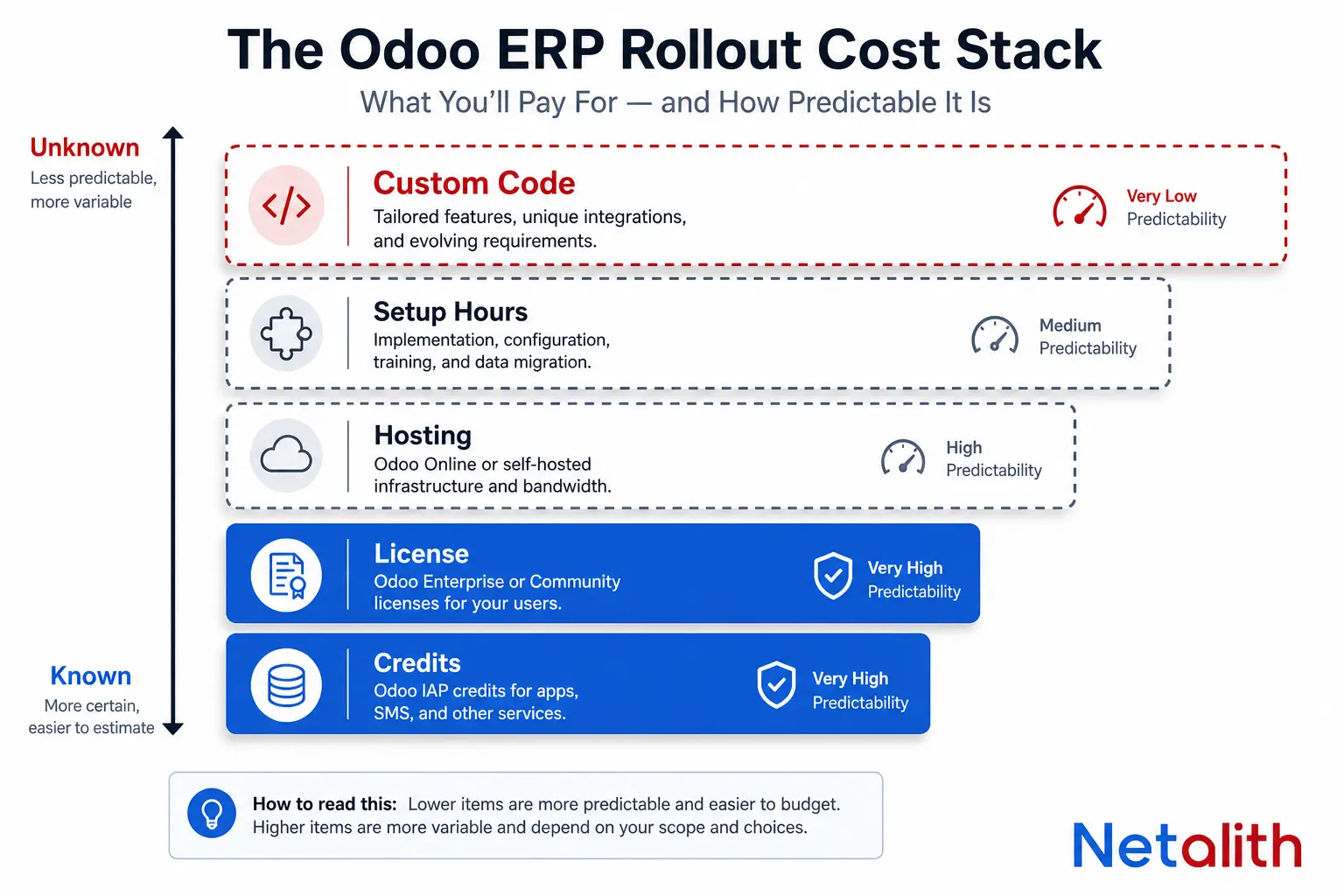
What you are actually paying for
I moved my own digital-products shop off hand-written Django onto Odoo Community this year, and I have scoped Odoo for client sites since. The budget conversation goes the same way every time: the owner has read the per-user price, multiplied it by headcount, and believes that is the number.
It is not, and the error does not run in the direction they expect. For a small business the license is usually the smallest line. Five things cost money, and only two of them have a public price tag.
| Line item | Can you know it before you start? | Recurring? |
|---|---|---|
| License (per backend user) | Yes — published list price | Monthly, forever |
| Hosting | Yes, if you use Odoo Online or your own VPS; metered on Odoo.sh | Monthly |
| Implementation hours | Partly — Odoo sells fixed-hour packs; partners quote per scope | One-off, mostly |
| Custom code | No — depends entirely on how far you stray from standard | One-off to build, recurring to maintain |
| In-app purchase credits (SMS, bill scanning, lead enrichment) | No — metered on usage | As used |
Everything below prices those five, with the published 2026 numbers checked on . The important part is not the arithmetic. It is knowing which decision pushes you over the cliff, and it is not hiring your sixth employee.
How much does Odoo cost per user?
Odoo sells three tiers, and the headline price you see on the site is a promotional rate, not the steady-state one. The official Odoo pricing page lists US rates as follows.
| Plan | Yearly billing | Monthly billing | What you get |
|---|---|---|---|
| One App Free | $0 | $0 | One app, unlimited users, Odoo Online |
| Standard | $24.90 → renews $31.10 | $31.10 → renews $38.90 | All apps, Odoo Online only |
| Custom | $37.40 → renews $46.70 | $46.80 → renews $58.40 | All apps, plus Studio, multi-company, external API, and the right to self-host or use Odoo.sh |
Three things in that table decide your budget, and two of them are easy to miss.
- The discount lasts twelve months and covers only the users you order up front. Budget the renewal rate. Standard goes up about 25% in year two; so does Custom. A five-user Standard database is $1,494 in year one and $1,866 in year two for identical software.
- Annual billing is roughly 20% cheaper than monthly at every tier. On a five-user team that is around $370 a year for a decision you make once at checkout.
- Every paid tier includes every app. A user who touches Sales, Inventory, Accounting and HR costs the same as a user who only opens CRM. This is the opposite of how most SaaS prices, and it means the question is never which apps you can afford — it is which ones you can actually run.
How many users do you actually pay for?
This is where most small-business estimates are wrong by a factor of ten, and always in the owner's favour once they understand it.
A paying user is an internal person with backend access who creates, views or edits documents — an employee filing a timesheet, your outside accountant working on your books. Customers and suppliers using the portal are free. Someone placing an order on your Odoo eCommerce site and tracking the delivery is free. There is no cap on them.
So a shop with 3,000 registered customers, 40 dropshipping suppliers and four staff pays for four users. On Standard that is about $1,195 in year one. Owners routinely quote me a number built from their customer list, and the real figure comes in under a fifth of it.
The related trap sits next to it. Many small businesses talk themselves onto the Custom plan because they think they need API access. Odoo's definition is narrower than people assume: external API means outside software calling into Odoo. When Odoo itself initiates the call — Stripe, PayPal, a shipping carrier, bank synchronisation — that is standard behaviour on the cheaper plan. Check which direction your integration runs before you pay 50% more per seat for it.
Is Odoo Community really free?
The license genuinely is $0. Community is open source, you self-host it, and nobody invoices you per user. That is the plan I run my own shop on, on a small VPS, and for the right business it is the correct answer rather than the cheap one.
What you take on instead is real work: provisioning and patching a server, backups you have actually tested, PostgreSQL tuning once the database grows, and every version upgrade from here to forever. Community also omits the accounting features most countries need for compliance, plus Studio, so anything you want changed is a Python module someone has to write.
| Community | Standard | Custom | |
|---|---|---|---|
| License | $0 | $24.90/user/mo | $37.40/user/mo |
| Hosting | Yours (VPS, roughly $15–40/mo for a small instance) | Odoo Online, included | Odoo Online included, or Odoo.sh / on-premise |
| Custom Python modules | Yes | No — Odoo Online will not host them | Yes, on Odoo.sh or on-premise |
| Studio (no-code changes) | No | No | Yes |
| Upgrades and backups | You | Odoo | Odoo, except your custom code |
Read the third row twice, because it is the cliff. Odoo Online does not host databases with custom modules. The moment one requirement cannot be met by configuration, you are not just paying a developer — you are also moving to the Custom plan and adding a hosting bill. One custom field can restructure your entire cost model, which is why I push every client to exhaust standard configuration first.
My rule of thumb: pick Community when you have a developer on hand (or you are one) and you expect meaningful customisation. Pick a paid plan when nobody in the building wants to own a server at 2am.
What does Odoo's implementation service cost?
Odoo steers companies under 50 employees to buy implementation directly from Odoo as a Success Pack: a block of hours with a dedicated consultant covering requirement analysis, configuration, data import assistance and training. Odoo publishes the pack prices; the effective hourly column below is mine, and it changes how you should buy.
| Pack | Hours | Standard price | New customer (15% off) | Effective rate, new customer |
|---|---|---|---|---|
| Starter | 4 | $580 | $493 | ~$123/hr |
| Basic | 25 | $3,600 | $3,060 | ~$122/hr |
| Standard | 50 | $7,000 | $5,950 | ~$119/hr |
| Custom | 100 | $12,500 | $10,625 | ~$106/hr |
| Pro | 200 | $25,000 | $21,250 | ~$106/hr |
Two conclusions a small business should act on:
- There is no volume discount worth chasing below 100 hours. The rate is flat from 4 hours to 50 hours. Buying a bigger pack 'to be safe' buys you hours at the same price you would have paid later. Buy the smallest pack that covers the work.
- The 15% new-customer discount applies to your first pack only. Spending it on a $580 Starter saves you $87. Spending it on the 25-hour pack you were always going to need saves $540. If you are reasonably sure the project needs more than a few hours of help, do not burn the discount on a trial purchase.
Odoo also notes that extra monthly charges apply for maintaining extra modules and custom code. That is not a one-off line, and it belongs in your year-two budget, not your launch budget.
Can a small business implement Odoo itself?
Often, yes — and the One App Free plan makes the trial genuinely free, including dependencies. Install eCommerce and you get Website and Invoicing at no cost, unlimited users, indefinitely. For a business that needs one workflow running properly, that can be the whole implementation.
From the rollouts I have been close to, the split is fairly predictable.
| Do it yourself | Buy hours |
|---|---|
| Single app, standard workflow (CRM, Website, Inventory basics) | Accounting with local tax and statutory reporting |
| Under ~500 clean records to import | Migrating a messy legacy database or an old store |
| You are comfortable in spreadsheets and settings screens | Multi-warehouse, manufacturing, or anything with routing rules |
| You can absorb two or three weeks of slow adoption | A hard cutover date you cannot move |
The honest failure mode of DIY is not technical. It is that the owner configures Odoo around how the business works today, including the broken parts, and then nobody uses it. The main thing a paid consultant sells is the argument to change the process instead of the software.
A realistic first-year budget for a 3–10 person business
Three scenarios, priced for five backend users at list rates, so you can see the shape rather than one invented total.
| Lean: Community, self-hosted | Supported: Standard + Starter pack | Customised: Custom + 25-hour pack | |
|---|---|---|---|
| License, year 1 | $0 | $1,494 | $2,244 |
| Hosting, year 1 | ~$180–480 | $0 | $0, or Odoo.sh if custom modules |
| Implementation | Your own time, realistically 40–120 hours | $493 | $3,060 |
| Year 1 cash | ~$180–480 | ~$1,987 | ~$5,304+ |
| Year 2 cash | ~$180–480 | ~$1,866 | ~$2,802 + code maintenance |
Notice what moves the total. Going from five users to eight adds about $900 a year on Standard. Going from zero customisation to a single custom module adds a plan upgrade, a hosting bill, a build cost and a permanent maintenance line. Headcount is linear and predictable; customisation is a step change.
What I would do with a small budget
Start on One App Free with the one process that hurts most, and run it for a month with real data. You will learn more about your actual requirements in those four weeks than in any scoping document, and it costs nothing.
Then make the customisation decision deliberately, before you buy anything. If the business can run on standard Odoo, take Standard on annual billing and a 4-hour Starter pack for the parts you get stuck on. If it genuinely cannot, accept that you are in the Custom-plus-hosting-plus-maintenance world and budget year two as carefully as year one.
The rollouts I have seen fail did not fail on price. They failed because someone customised early, for a process that should have changed instead. If you want a second opinion on where your own requirements sit on that line before you commit, send us the scope and get a free quote — no account, no cost, and we will tell you if you do not need us.
FAQ
Frequently asked questions
How much does Odoo cost per month for a small business?
On the published 2026 US rates, Odoo Standard is $24.90 per user per month on annual billing, renewing at $31.10 after the first twelve months, and Custom is $37.40 renewing at $46.70. A five-person team on Standard pays about $1,494 in year one and $1,866 in year two. One App Free costs $0 for a single app with unlimited users, and Odoo Community has no license fee at all if you self-host it.
Do I pay for customers and suppliers who log into Odoo?
No. Odoo charges only for internal users with backend access who create, view or edit documents. Customers viewing invoices on the portal, suppliers, and shoppers placing eCommerce orders are free and uncapped. This is why most small-business estimates come in far too high: count your staff, not your contact list.
What is the cheapest way to implement Odoo?
Start on One App Free with the single process that causes the most pain, and run it on real data for a month. Dependencies come free too, so installing eCommerce also gives you Website and Invoicing at no charge. That month tells you what you actually need before you spend anything on licenses or consulting hours.
How much does an Odoo Success Pack cost?
Odoo's published packs run from a 4-hour Starter at $580 to a 200-hour Pro at $25,000, with a 15% discount on a new customer's first pack only. The effective hourly rate is roughly flat at $140 to $145 from 4 hours through 50 hours, and only drops to about $125 at 100 hours, so there is no volume saving worth chasing at small-business scale. Buy the smallest pack that covers the work, and spend the one-time discount on the pack you genuinely need.
Why does one custom field make Odoo so much more expensive?
Odoo Online will not host a database containing custom modules. So a requirement that configuration cannot meet pushes you from Standard to the Custom plan, adds a hosting decision (Odoo.sh or your own server), adds the build cost, and adds permanent maintenance, since Odoo excludes custom code from its upgrade and support coverage. Headcount scales your bill linearly; customisation is a step change.
Is Odoo Community free for commercial use?
Yes, Odoo Community is open source with no per-user license fee, and you can run a business on it. The costs move rather than disappear: you provide the server, backups, database tuning and every future version upgrade, there is no Studio, and the accounting features many countries require for compliance are not included. It works well when you have development capability in-house, and poorly when nobody wants to own the infrastructure.