Microservices vs Monolith: Choosing the Right Software Architecture
A comprehensive guide comparing microservices vs monolith architectures, including migration strategies, scalability pros/cons, and decision frameworks for modern software engineering.

Long Nguyen
Fullstack Developer · AI Engineer · Researcher
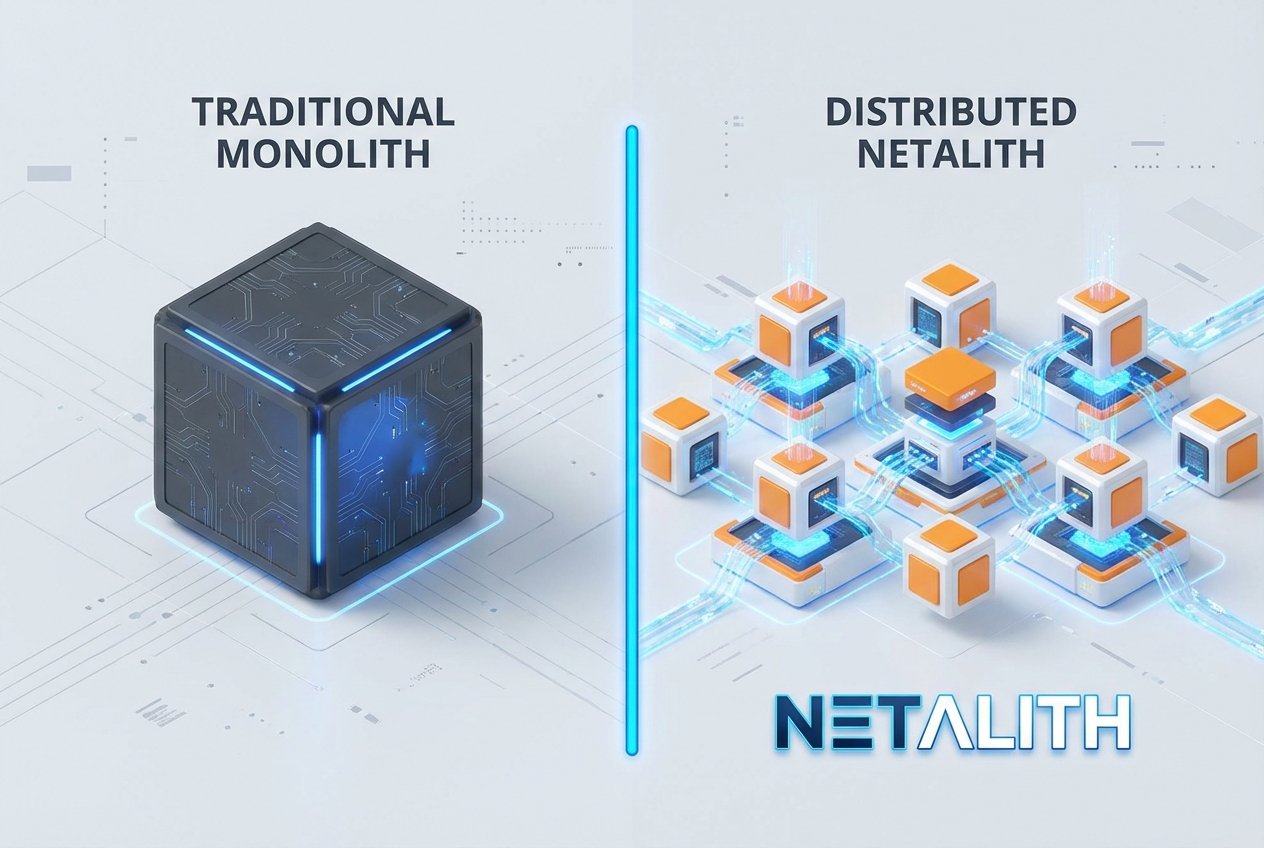
Software Architecture Evolution: Microservices vs Monolith
As digital ecosystems grow increasingly demanding, understanding the trajectory of software architecture evolution is paramount for engineering leaders. In the modern landscape, the debate surrounding infrastructure design is no longer just theoretical; it directly impacts operational efficiency, release velocity, and cloud costs. When evaluating application modernization strategies, the central discussion consistently returns to one fundamental comparison: microservices vs monolith.
Choosing the correct architectural pattern dictates how your applications scale, how your teams collaborate, and how resilient your software remains during traffic spikes. The microservices vs monolithic architecture decision requires a deep technical understanding of distributed systems, domain boundaries, and organizational readiness.
Understanding Monolithic Systems
At its core, a monolithic system is a unified software application where the user interface, business logic, and data access layers are combined into a single deployable artifact. For decades, monolithic systems have served as the standard starting point for new projects due to their simplicity in deployment, end-to-end testing, and straightforward debugging processes.
However, as codebases expand, the tightly coupled nature of a monolith can become a liability. The process of decoupling monolithic applications often becomes necessary when multiple development teams step on each other\'s toes, leading to merge conflicts and bottlenecked release pipelines.
Scalability of Monolithic Systems
The scalability of monolithic systems is inherently limited to a vertical approach (scaling up) or running complete duplicate instances behind a load balancer (scaling out). While scaling out works for stateless web layers, it becomes highly inefficient when only one specific module—such as a memory-intensive reporting engine—requires additional resources. You are forced to scale the entire application, wasting costly compute and memory resources. This inefficiency is a primary catalyst driving the microservices vs monolithic architecture architectural debate.
The Rise of Microservices Architecture
To overcome the limitations of the monolith, the industry shifted toward distributed computing. Microservices architecture structures an application as a collection of loosely coupled, independently deployable services organized around business capabilities. But before adopting this model, engineers must ask: what is a distributed system in practice? It involves independent nodes communicating over a network to achieve a common goal, utilizing distributed system design patterns like API Gateways, Circuit Breakers, and Event Sourcing.
Benefits and Challenges of Modern Microservices
When analyzing the benefits and challenges of microservices, the advantages are clear: independent scaling, technology heterogeneity, and improved fault isolation. If a payment service crashes, the catalog service can theoretically remain operational.
Conversely, managing microservices ecosystem complexity is the primary challenge. Engineering teams must address complex operational hurdles, including automated provisioning, distributed logging, and maintaining data consistency across various distributed database types.
Microservices vs Monolith: Core Architecture Comparison
When comparing microservices vs monolithic architecture, the technical trade-offs become stark. A microservices vs monolithic architecture comparison reveals that while a monolith offers low latency due to in-memory function calls, a microservices environment introduces network-level latency. The inter-service communication overhead—often requiring JSON over HTTP/REST or gRPC—can significantly degrade performance if not properly optimized.
It is also crucial to differentiate between service-oriented architecture vs microservices. While SOA focuses on enterprise-wide integration using heavy Enterprise Service Buses (ESBs), microservices favor "smart endpoints and dumb pipes," focusing on bounded contexts and lightweight message brokers.
"The shift from a monolith vs distributed services is not merely a technical upgrade; it is a fundamental transformation in how engineering teams align with business domains."
Modular Monolith vs Microservices Architecture Comparison
Before leaping to fully distributed microservices, architects are increasingly leveraging the modular monolith. A modular monolith vs microservices architecture comparison highlights that a modular monolith enforces strict logical boundaries and dependency rules within a single codebase. It offers the organizational benefits of microservices—clear code ownership and separation of concerns—without the crippling network latency and infrastructure overhead.
When to Switch from Monolith to Microservices Architecture
Knowing exactly when to switch from monolith to microservices architecture is the most critical decision an engineering leader will make. Transitioning too early leads to over-engineering; transitioning too late results in technical debt and stagnated growth.
You should consider a system migration when:
- Independent teams are blocked by a unified release cycle.
- Specific application features demand drastically different scaling requirements.
- The codebase has grown so large that local development environments cannot efficiently run it.
Avoiding the Distributed Monolith Anti-Pattern
The most dangerous outcome of a poorly executed system migration is creating a distributed monolith. Distributed monolith anti-pattern avoidance is critical. This anti-pattern occurs when services are physically separated but logically coupled, meaning a change in Service A requires simultaneous changes and deployments in Service B and Service C.
To ensure fault tolerance and reliability, architects must embrace asynchronous event-driven communication and careful boundary definitions, adhering to principles like the CAP theorem and utilizing consensus algorithms like Paxos or Raft for state management.
Microservices vs Monolith Migration Strategies and Decision Framework
To successfully navigate modernization, organizations must adopt a robust microservices vs monolithic architecture migration strategies and decision framework. The most effective strategy is the Strangler Fig pattern, where edge functionality is gradually extracted into separate services while the core monolith continues to serve legacy requests.
Applying domain-driven design for microservices (DDD) is non-negotiable during this phase. DDD helps identify bounded contexts, ensuring that each microservice encapsulates a cohesive business capability. As you map out these domains, architects must also account for distributed data complexities, keeping the CAP theorem explained (Consistency, Availability, Partition tolerance) in mind.
Conclusion: Selecting the Optimal Path
Ultimately, the microservices vs monolith debate does not have a one-size-fits-all answer. For startups and small teams, the simplicity of monolithic systems often outweighs the benefits of distribution. However, for enterprise-scale applications requiring high availability and rapid feature iteration, a microservices architecture or a well-structured modular monolith is the superior choice. By focusing on software architecture evolution and clear domain boundaries, organizations can build resilient systems that support long-term growth.
Frequently Asked Questions
What is the primary difference in a microservices vs monolith comparison?
The primary difference lies in deployment and coupling. A monolithic architecture bundles all components into a single unit, whereas microservices treat components as independent, loosely coupled services that communicate over a network.
Should I always choose microservices for new projects?
No. Many successful projects start as a monolith to minimize initial microservices ecosystem complexity. You should only move to microservices when the organizational or technical scaling requirements of the monolith become unmanageable.
How does inter-service communication overhead affect performance?
In a microservices vs monolith scenario, microservices incur network latency and serialization costs that monoliths avoid through in-memory calls. Proper use of gRPC, service meshes, and caching is required to mitigate this overhead.