Backtracking Algorithm Python Tutorial: Mastering Complex Recursive Puzzles
Learn how to master backtracking in Python. This tutorial covers recursion, pruning, N-Queens, and Sudoku solver examples for coding interviews.

Long Nguyen
Fullstack Developer · AI Engineer · Researcher
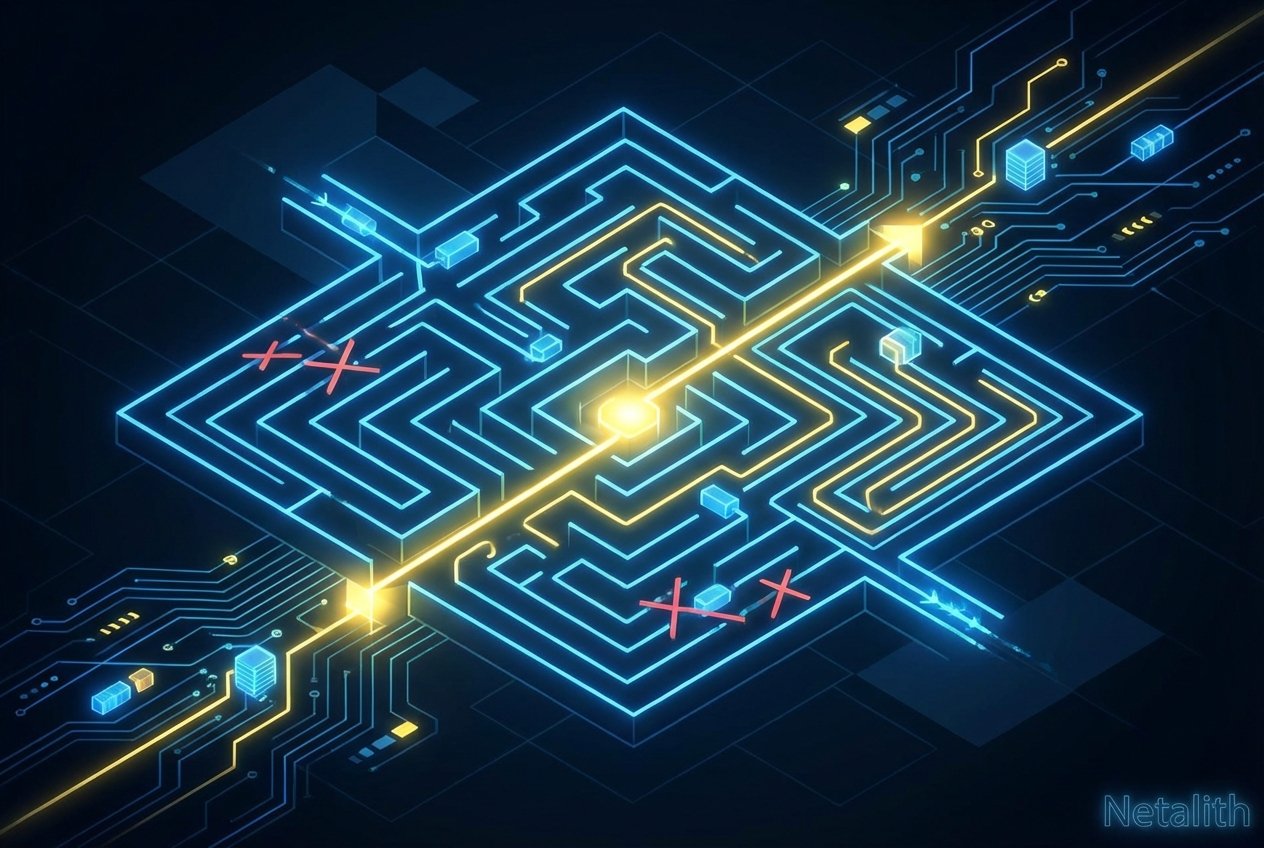
Are you preparing for top-tier software engineering interviews or tackling complex constraint-based coding problems? Welcome to the ultimate backtracking algorithm Python tutorial. Backtracking is one of the most powerful and versatile algorithmic techniques in computer science. It provides a systematic way to iterate through all possible configurations of a search space, identifying valid solutions and abandoning invalid paths as early as possible.
In this comprehensive guide, we will break down the mechanics of backtracking, explore core templates, and walk through real-world examples. By the end of this backtracking algorithm Python tutorial, you will have the confidence to dissect and solve even the most intimidating recursive problems.
What is Backtracking? A Recursive Backtracking Approach Python Tutorial
To truly understand how to leverage these methods, we must start with a solid foundation. In this recursive backtracking approach python tutorial, we define backtracking as an algorithmic paradigm designed to find solutions by incrementally building candidates. If a candidate cannot possibly lead to a valid solution, the algorithm abandons it—or "backtracks"—to the previous step.
When studying combinatorial search algorithms, backtracking stands out because it systematically explores choices. It is the go-to technique for constraint satisfaction problems python developers face, such as scheduling, routing, and solving logic puzzles. Unlike a naive brute-force method that generates all complete configurations before checking validity, Python Backtracking evaluates the validity of partial configurations, saving significant computational time.
The Core Template: Implementing Backtracking in Python Code Guide
Every effective implementing backtracking in python code guide relies on a standardized structural template. Establishing a clear mental model of how Recursive Backtracking Python logic operates is the secret to mastering it quickly.
State Space Search and Recursive State Exploration
At its core, backtracking is an exercise in recursive state exploration. You can visualize the problem as a tree, where each branch represents a decision. Traversing this tree is known as a state space search. The algorithm travels down a path, maintaining a state of choices made so far. If it hits a dead end (a constraint violation), it returns to the parent node, undoes the last choice, and explores the next branch.
def backtrack(state, choices):
    if is_solution(state):
        add_to_results(state)
        return

    for choice in choices:
        if is_valid(choice, state):
            # Make the choice
            state.append(choice)

            # Explore further
            backtrack(state, available_choices)

            # Undo the choice (Backtrack)
            state.pop()
This skeleton is your universal key to solving recursive puzzles across various coding environments.
Pruning in Backtracking Algorithms Python Explained
If there is one concept you take away regarding pruning in backtracking algorithms python explained, it is this: pruning is the process of cutting off branches in your state space search tree that are guaranteed to fail. While backtracking is essentially a brute force with pruning technique, aggressive pruning transforms it from hopelessly slow to highly efficient. Compared to basic exhaustive search techniques, pruning ensures that you never waste cycles exploring mathematically impossible outcomes.
Step-by-Step Example 1: Solving the N-Queens Python Challenge
A classic staple in this backtracking algorithm Python tutorial is the N-Queens puzzle. The goal is to place N chess queens on an N x N chessboard so that no two queens threaten each other. This is an excellent exercise for finding all solutions python developers often encounter when studying backtracking patterns in coding interviews.
Here is how the N-Queens Python implementation looks:
def solve_n_queens(n):
    def backtrack(row, diagonals, anti_diagonals, cols, state):
        if row == n:
            result.append(list(state))
            return

        for col in range(n):
            curr_diagonal = row - col
            curr_anti_diagonal = row + col

            # Pruning invalid column/diagonal paths
            if (col in cols or
                curr_diagonal in diagonals or
                curr_anti_diagonal in anti_diagonals):
                continue

            # Make a choice
            cols.add(col)
            diagonals.add(curr_diagonal)
            anti_diagonals.add(curr_anti_diagonal)
            state.append("." * col + "Q" + "." * (n - col - 1))

            # Explore
            backtrack(row + 1, diagonals, anti_diagonals, cols, state)

            # Undo choice (Backtrack)
            cols.remove(col)
            diagonals.remove(curr_diagonal)
            anti_diagonals.remove(curr_anti_diagonal)
            state.pop()

    result = []
    backtrack(0, set(), set(), set(), [])
    return result
Notice how we maintain a running set of columns and diagonals. If a square falls into these sets, we prune the path immediately to optimize performance.
Step-by-Step Example 2: Backtracking Algorithms in Python Tutorial with N-Queens and Sudoku Solver Examples
Reviewing backtracking algorithms in python tutorial with n-queens and sudoku solver examples gives you a well-rounded toolkit. Sudoku represents a massive state space, but constraints (1-9 per row, column, and 3x3 grid) make it highly susceptible to pruning.
When searching for a robust solving backtracking problems python guide, the Sudoku solver highlights how we isolate empty cells, attempt a valid integer, and backtrack if the board hits an unresolvable state. This method continues until the board is completely filled, beautifully illustrating the art of finding all solutions python functions can execute seamlessly.
Backtracking Patterns for Coding Interviews
Recognizing when to use backtracking is a critical skill for modern coding interviews. While preparing, you might review a Big O notation python tutorial, study searching algorithms python offers, or practice your dynamic programming python skills. But backtracking has specific indicators: the problem asks for "all possible ways", "all combinations", or "all permutations" of a dataset.
It is fundamentally different from a stack and queue python traversal (like BFS) because it dives deep (DFS) and actively manages a mutable state path. Integrating these patterns into your overall Python data structures guide will significantly boost your problem-solving speed.
Frequently Asked Questions (FAQ
What is the difference between backtracking and dynamic programming in Python?
Backtracking explores all potential paths to find all possible solutions (or the first valid one), actively discarding paths that violate constraints. Dynamic programming (DP), on the other hand, breaks down a problem into overlapping subproblems, solving each subproblem once and storing the result to optimize future computations. DP is usually used for optimization, while backtracking is used for combinatorial searches.
How do you identify a backtracking problem in coding interviews?
Keywords to look for include: "generate all", "find all combinations", "return all possible permutations", or "solve the puzzle". If the problem requires satisfying a strict set of constraints by making a sequence of choices, it is highly likely a backtracking candidate.
What is pruning in backtracking algorithms?
Pruning is the process of stopping the exploration of a particular path in the search tree as soon as it is determined that it cannot lead to a valid solution. This drastically reduces the number of recursive calls, making the algorithm significantly faster than a pure brute-force approach.
Conclusion: Master the Backtracking Algorithm Python Tutorial
Mastering the backtracking algorithm Python tutorial concepts allows you to approach complex combinatorial problems with a structured mindset. By utilizing a consistent backtracking implementation tutorial python developers can trust, you move away from messy trial-and-error code toward elegant, recursive solutions. Whether you are solving the N-Queens problem or optimizing a delivery route, these python coding interview questions and patterns will serve as your foundation for success.