How to Make a Family Household Budget: 7 Simple Steps
Learn how to make a family household budget using real spending, needs-based buckets, savings goals, and regular reviews. Start today.

Long Nguyen
Fullstack Developer · AI Engineer · Researcher

How to Make a Family Household Budget: Start With Take-Home Income
Learning how to make a family household budget starts with one reliable number: your monthly take-home income. Add recent post-tax paychecks from all household earners to determine the amount available for bills, spending, savings, and debt goals.
Include consistent income you can reasonably expect each month, but leave out uncertain bonuses, gifts, freelance payments, or other irregular money until it is actually received. This total is the starting point for your household budget and the amount your plan should be built around.
Step 1: Track Household Expenses Honestly
Before setting spending limits, find out where your money is currently going. Keep a spending log for one or two months and record every purchase, bill, transfer, and cash expense. This gives you a realistic picture of monthly expenses instead of relying on estimates.
Review bank and credit card transactions to catch small recurring expenses, forgotten subscriptions, and annual charges. An account-linked budgeting tool or a spreadsheet can gather income and spending in one place, making it easier to see patterns and decide how to track household expenses consistently.
- Record fixed bills such as rent, mortgage payments, insurance, and childcare.
- Track variable purchases including groceries, fuel, dining, clothing, and activities.
- Include irregular costs by setting aside their monthly equivalent.
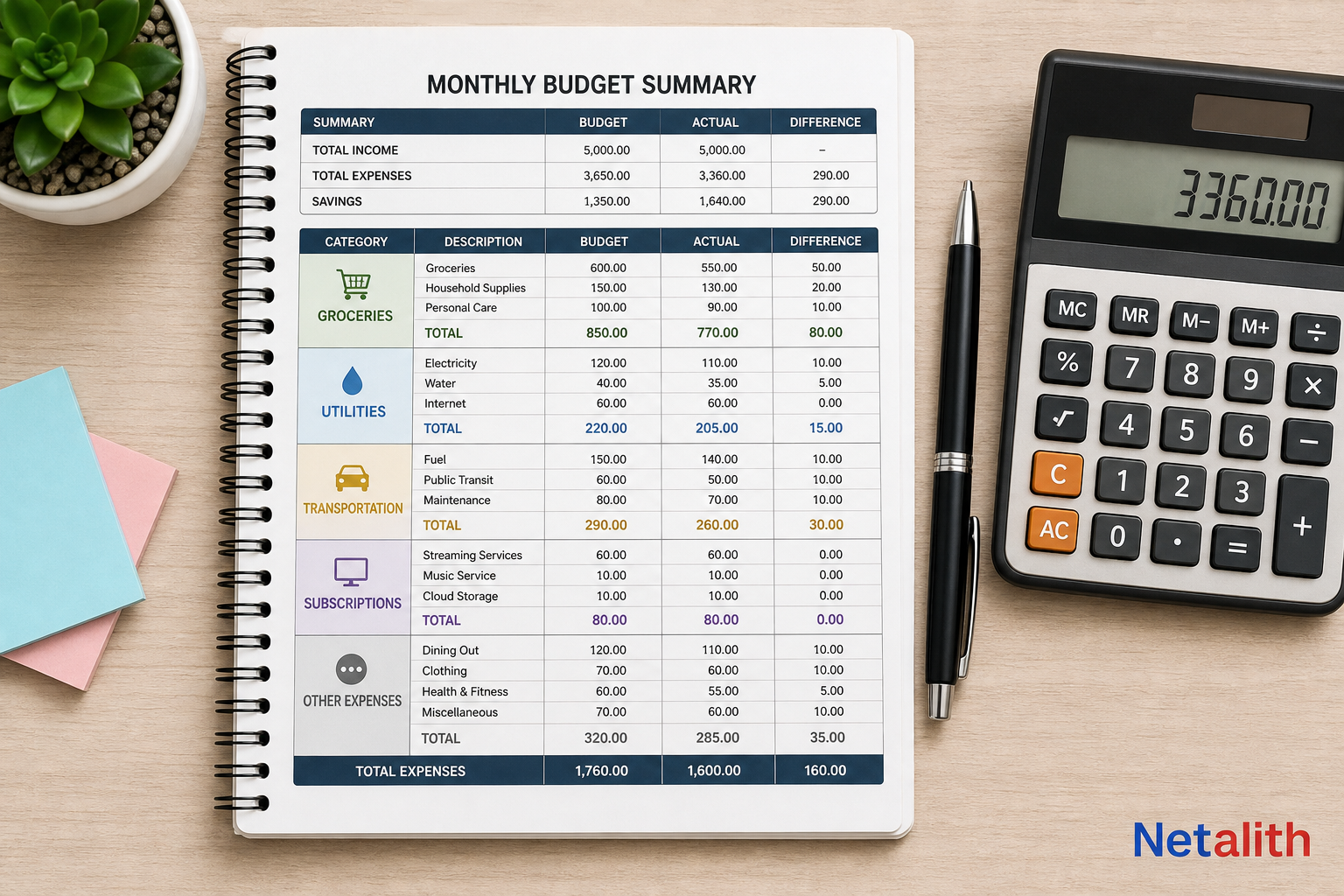
Step 2: List Essential Monthly Expenses
Next, list the costs that must be funded before optional spending. Include housing, utilities, groceries, clothing, insurance, transportation, childcare, and other unavoidable bills. Compare the total cost of these bare necessities with your take-home income.
Use the 50% guideline as a diagnostic rather than a rule. If necessities use half of your income or less, you may have more room for flexible spending and savings. If they take more than half, that signals a need to reduce expenses or reconsider major fixed costs before adding new goals.
- Housing and household utilities
- Groceries and basic clothing
- Health, life, auto, or other necessary insurance
- Transportation and required vehicle costs
- Childcare, school-related essentials, and unavoidable bills
Step 3: Sort Spending Into Needs, Wants, and Savings
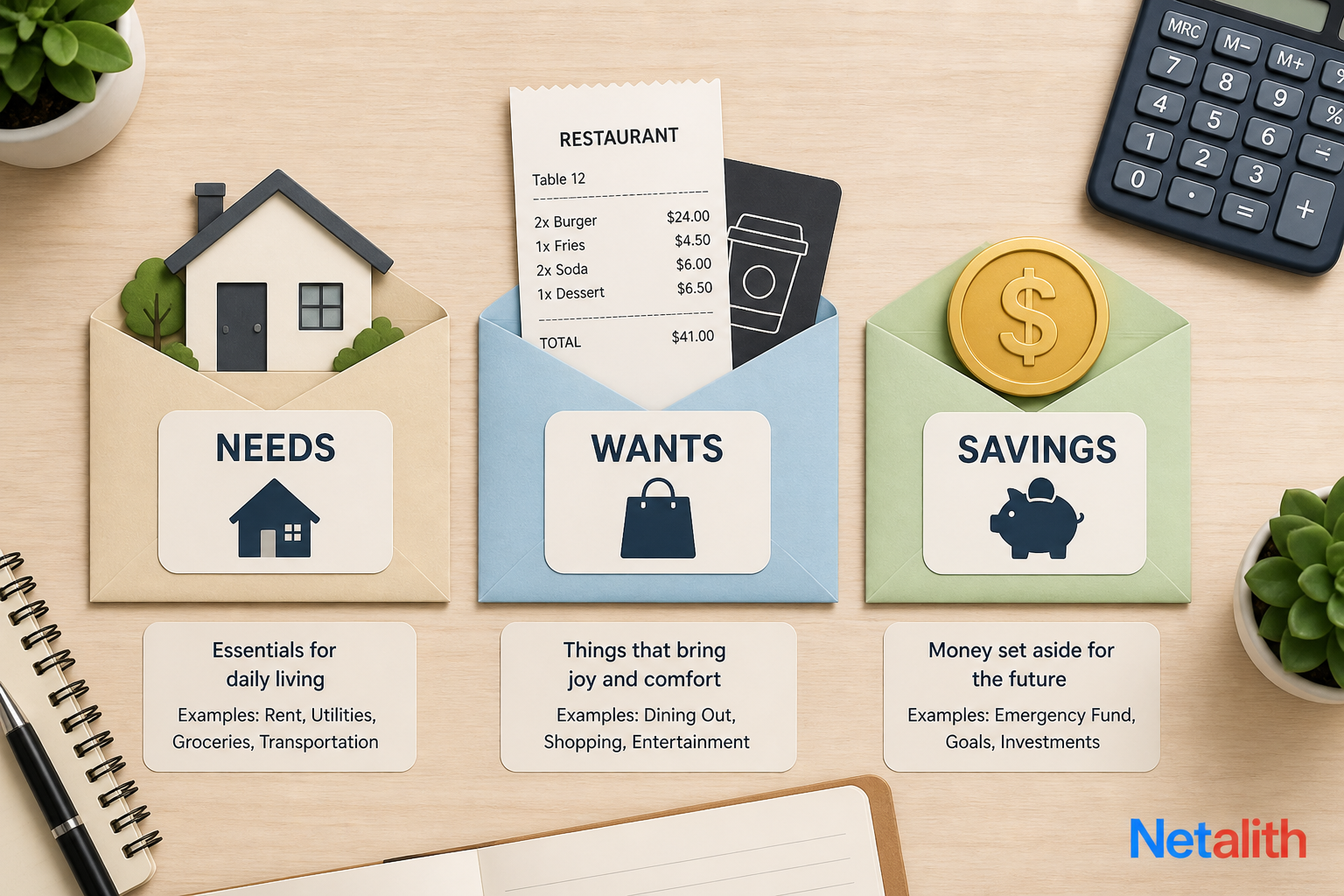
Assign every expense to one of three simple categories: needs, wants, or savings. Needs cover essential living costs, wants include optional purchases, and savings covers financial goals such as an emergency fund or debt repayment.
Some expenses may be ambiguous. Do not get stuck trying to find the perfect category; make a reasonable choice and adjust it during a later review. These needs, wants, and savings buckets make trade-offs clearer when income is limited.
| Bucket | Examples | Purpose |
|---|---|---|
| Needs | Housing, utilities, groceries, insurance | Fund essential living costs first |
| Wants | Dining out, entertainment, nonessential shopping | Provide flexible spending choices |
| Savings | Emergency fund, planned purchases, retirement | Support current and future financial goals |
Step 4: Choose a Flexible Budget Framework
The 50/30/20 budget rule is a useful starting framework: about 50% of take-home income for needs, 30% for wants, and 20% for savings or debt goals. It gives each dollar a destination without requiring a complicated living budget.
Treat these percentages as adjustable targets, not strict requirements. For example, if current needs consume 60% of income, begin with a realistic 60/30/10 plan. You can work toward a larger savings share as expenses fall, income rises, or family circumstances change.
| Starting allocation | Needs | Wants | Savings or debt goals |
|---|---|---|---|
| Typical 50/30/20 framework | 50% | 30% | 20% |
| Higher-needs starting plan | 60% | 30% | 10% |
Step 5: Set Family Financial Goals and Build Savings
Divide savings into goals with different time horizons. Short-term savings can cover planned costs, a car purchase or down payment, and expected medical expenses. Long-term savings can support retirement and other needs far in the future.
Build an emergency fund before emphasizing lower-priority goals. A common target is three to six months of essential expenses. The appropriate amount depends on income stability, household size, insurance coverage, and how quickly the family could replace lost income.
Assign a specific monthly amount to each family financial goal instead of saving whatever remains. Automatic transfers after payday can help turn those amounts into a consistent habit.
- Short-term savings: planned bills, repairs, medical costs, and purchases.
- Emergency fund: a reserve for unexpected essential expenses or income loss.
- Long-term savings: retirement and other future financial priorities.
Step 6: Reduce Monthly Expenses Where Needed
If the budget does not balance, start with recurring costs and flexible wants rather than cutting essential needs blindly. Even modest reductions can create room for savings or debt repayment when they are repeated every month.
- Cancel unused subscriptions and review recurring memberships.
- Reduce dining out, impulse shopping, and other flexible purchases.
- Compare insurance and transportation costs when practical.
- Plan groceries, use what is already at home, and reduce food waste.
- Redirect the money saved toward the emergency fund, debt repayment, or another stated goal.
Step 7: Review and Adjust the Living Budget Regularly
Review actual spending against the plan every month and discuss the results as a household. Look for categories that consistently run over or under target rather than treating one unusual month as a failure.
Update the budget when childcare, school costs, groceries, income, or other household expenses change. A budget is a living document, not a one-time exercise. Revise targets when necessary while keeping the overall plan focused on needs, flexibility, and savings.
- Schedule a monthly household budget check-in.
- Compare planned amounts with actual transactions.
- Adjust categories after changes in income or family costs.
- Keep the goals, even when the monthly amounts need to change.
Family Household Budget Checklist
Use this checklist to begin today. Start with a simple worksheet, then improve its accuracy as you collect more information over the next few months.
- Confirm reliable monthly take-home income.
- Track every purchase and bill.
- List essential monthly expenses.
- Assign spending to needs, wants, or savings.
- Choose realistic spending and savings targets.
- Fund an emergency reserve and other savings goals.
- Schedule regular reviews and adjust the plan.
A realistic family budget is more useful than a perfect plan that nobody can follow. Begin with what your household can manage, then improve it over time.
If you'd rather run this checklist on paper than build seven separate spreadsheets, the Family Budget Planner Printable brings the monthly budget sheet, bill trackers, and savings goal pages into one place — plus meal and grocery planning, which rarely fits into a generic budget template but eats a real share of most household budgets.
FAQ
Frequently asked questions
How can a family track household expenses when spending is shared across accounts?
Combine transactions from shared checking accounts, individual accounts, credit cards, and cash records in one spreadsheet or account-linked budgeting tool. Label each transaction by household category and review the combined totals monthly so spending is measured across the entire family, not just one account.
How much should an emergency fund be for a family?
A common target is three to six months of essential expenses. Calculate the amount using necessary costs such as housing, utilities, groceries, insurance, transportation, childcare, and minimum debt payments. Families with unstable income or limited support may benefit from aiming toward the higher end.
Do you have to follow the 50/30/20 budget rule exactly?
No. The 50/30/20 budget rule is a flexible starting framework, not a requirement. If essential expenses currently use 60% of take-home income, a 60/30/10 plan may be more realistic. Review the budget over time and increase savings as circumstances allow.
What should a family do when essential monthly expenses exceed 50% of income?
Treat the result as a signal to review the largest fixed and recurring costs. Look for reductions in housing, transportation, insurance, groceries, subscriptions, and other flexible categories where possible. Use a realistic allocation first, then work gradually toward lower needs spending or higher income rather than abandoning the budget.